Delmarva poultry group warns CAFO permit lapse and solar siting threaten Eastern Shore farms
February 21, 2026 | Eastern Shore, Delegation Committees, HOUSE OF REPRESENTATIVES, Committees, Legislative, Maryland
This article was created by AI summarizing key points discussed. AI makes mistakes, so for full details and context, please refer to the video of the full meeting. Please report any errors so we can fix them. Report an error »
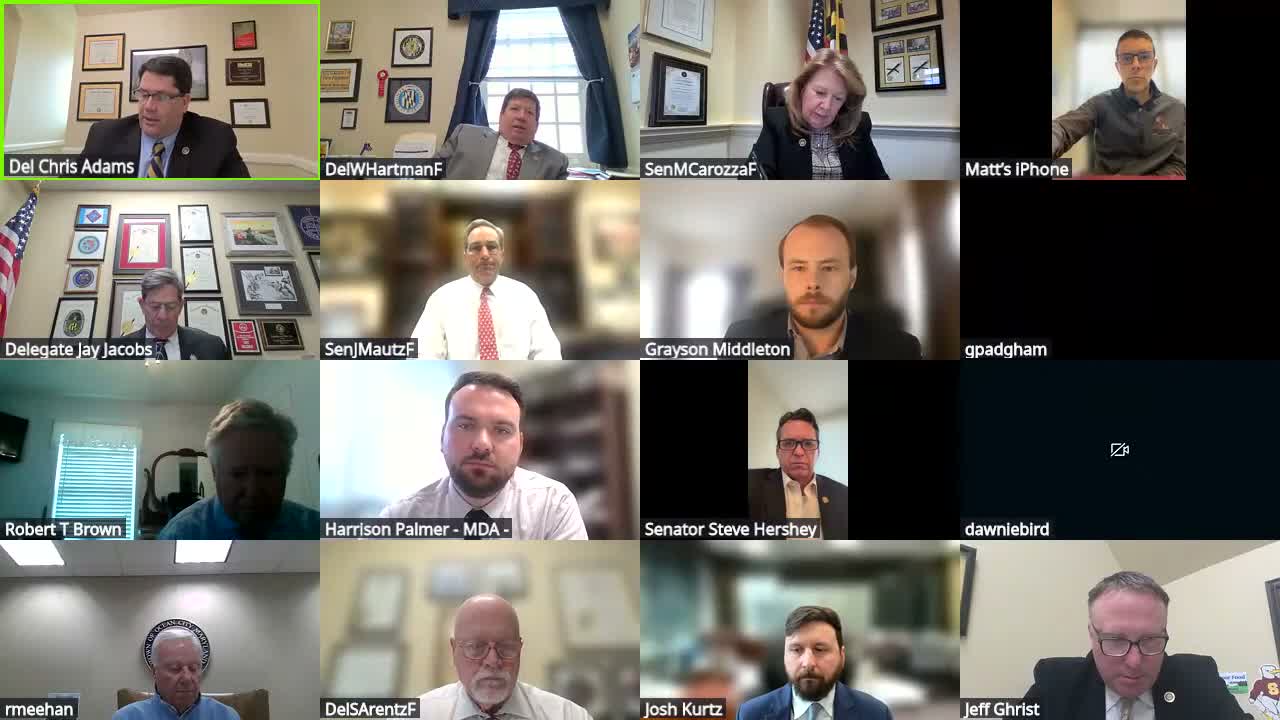
Industry representatives told the Eastern Shore delegation Feb. 20 that agriculture on Delmarva faces multiple threats: an expired CAFO general permit that has stalled tens of millions of dollars in construction, recurring highly pathogenic avian influenza cases, and pressure from utility-scale solar development that could remove prime farmland from production.
Grayson Middleton of the Delmarva Chicken Association presented industry statistics and said that the general CAFO (NPDES) permit for chicken farms expired in July 2025, leaving roughly $35 million in stalled construction projects, a figure he described as conservative. Middleton said the association is supporting emergency legislation (Senate Bill 371 / companion measures) to allow certain construction activity to proceed when a permit has lapsed while preserving MDE's review, public input and site-specific conditions.
"I just really can't stress that enough," Middleton said, emphasizing that the measure would retain permit reviews while preventing business stalls.
Tyler Hoff of Maryland Farm Bureau and other presenters warned about land-use pressures from solar and other nonfarm development, urging support for HB460 to lower the priority-preservation-area solar cap from 5% to 2% to protect productive acres important to the poultry grain supply chain. They also flagged HB91 (neonicotinoid restrictions) as a bill of concern for grain growers who rely on treated seed.
Delegation members and presenters emphasized biosecurity and continued coordination with MDA and USDA on HPAI response, and said they would continue to refine CAFO bill language in committee. Presenters requested follow-up meetings with staff and offered to provide permit-flow charts and technical detail to clarify the proposed bill's limits and safeguards.
Next steps: Delegation staff, MDE and Agriculture partners will continue consultations on CAFO permitting language, and members said they will monitor HB460 and related bills that affect farmland preservation and energy siting.
Grayson Middleton of the Delmarva Chicken Association presented industry statistics and said that the general CAFO (NPDES) permit for chicken farms expired in July 2025, leaving roughly $35 million in stalled construction projects, a figure he described as conservative. Middleton said the association is supporting emergency legislation (Senate Bill 371 / companion measures) to allow certain construction activity to proceed when a permit has lapsed while preserving MDE's review, public input and site-specific conditions.
"I just really can't stress that enough," Middleton said, emphasizing that the measure would retain permit reviews while preventing business stalls.
Tyler Hoff of Maryland Farm Bureau and other presenters warned about land-use pressures from solar and other nonfarm development, urging support for HB460 to lower the priority-preservation-area solar cap from 5% to 2% to protect productive acres important to the poultry grain supply chain. They also flagged HB91 (neonicotinoid restrictions) as a bill of concern for grain growers who rely on treated seed.
Delegation members and presenters emphasized biosecurity and continued coordination with MDA and USDA on HPAI response, and said they would continue to refine CAFO bill language in committee. Presenters requested follow-up meetings with staff and offered to provide permit-flow charts and technical detail to clarify the proposed bill's limits and safeguards.
Next steps: Delegation staff, MDE and Agriculture partners will continue consultations on CAFO permitting language, and members said they will monitor HB460 and related bills that affect farmland preservation and energy siting.
View the Full Meeting & All Its Details
This article offers just a summary. Unlock complete video, transcripts, and insights as a Founder Member.
✓
Watch full, unedited meeting videos
✓
Search every word spoken in unlimited transcripts
✓
AI summaries & real-time alerts (all government levels)
✓
Permanent access to expanding government content
30-day money-back guarantee
