Bill would criminalize knowingly driving around emergency barricades; supporters and opponents clash
February 23, 2026 | Legislative Sessions, Washington
This article was created by AI summarizing key points discussed. AI makes mistakes, so for full details and context, please refer to the video of the full meeting. Please report any errors so we can fix them. Report an error »
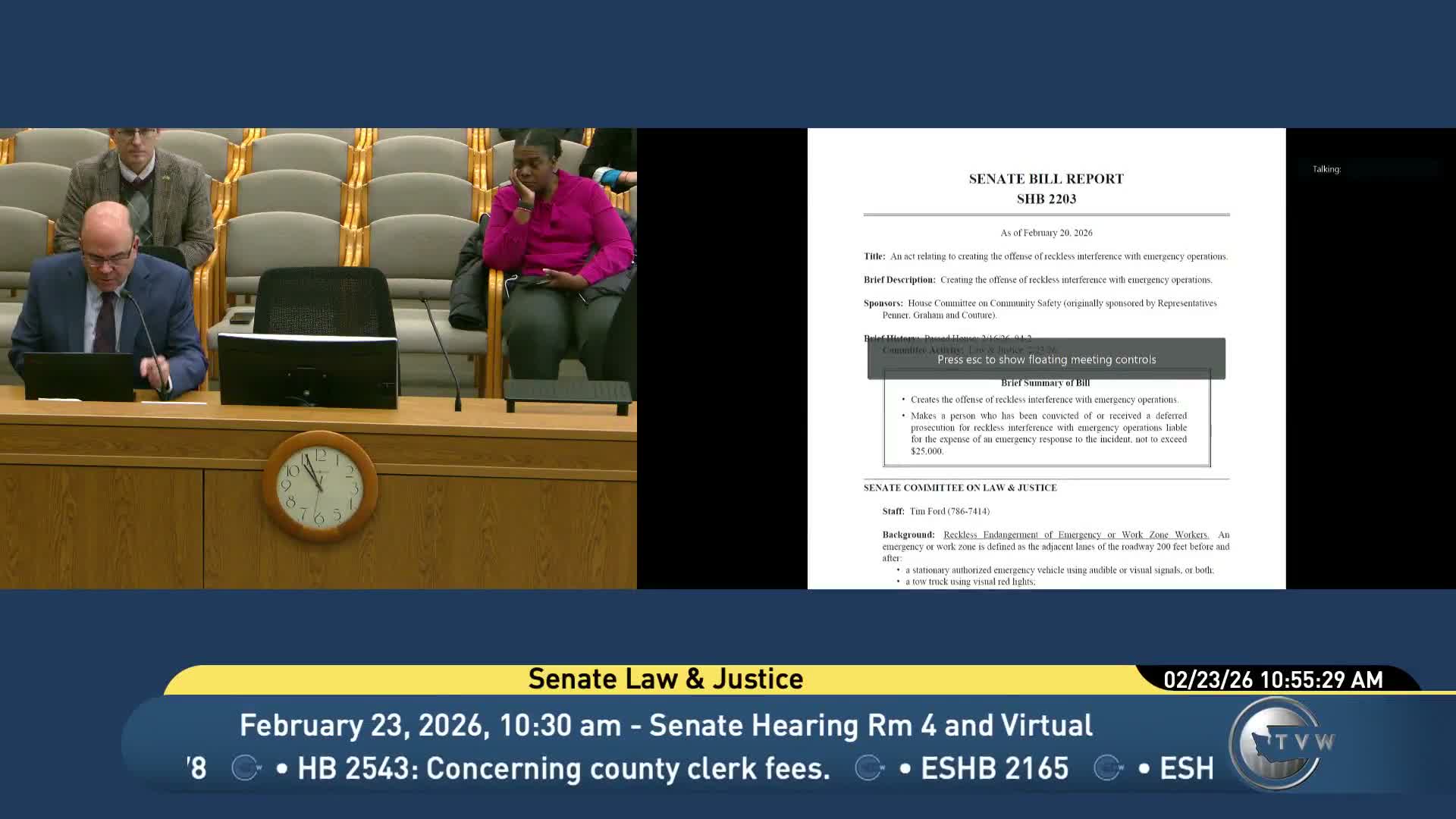
Lawmakers weighed competing public-safety and civil-justice concerns during a hearing on substitute House Bill 2203, which would establish the offense of reckless interference with emergency operations for knowingly driving into closed emergency or work zones.
Tim Ford, committee staff, summarized the measure as creating a misdemeanor offense that is elevated to a gross misdemeanor if the violation requires emergency assistance and causes bodily injury to a first responder or if a minor or vulnerable adult was present. Licensing suspensions of 30 days for misdemeanors and 60 days for gross misdemeanors are included, and the bill authorizes recovery of response costs up to $25,000 per incident.
Representative Josh Penner (31st LD), a recent mayor who described multiple swift-water rescues in his community during recent floods, said the bill aims to create a ‘‘second thought’’ for people tempted to drive around unmanned barricades. "You put the occupants of your vehicle in danger, but also you're putting first responders in danger," he said.
Support came from Jeff Faucette, speaking for Washington Fire Chiefs, who said closures are safety measures and unauthorized entry can create secondary emergencies and divert resources. Opposing testimony came from David Treeweiler of the Washington Association of Criminal Defense Lawyers and the Washington Defender Association, who called the bill "unnecessary, expensive and disproportionate," argued many cases would be essentially civil in nature, and suggested reducing the offense to an infraction.
Chair Dhingra closed the hearing after testimony; the committee recorded high sign-in support numbers and will consider the bill later.
Tim Ford, committee staff, summarized the measure as creating a misdemeanor offense that is elevated to a gross misdemeanor if the violation requires emergency assistance and causes bodily injury to a first responder or if a minor or vulnerable adult was present. Licensing suspensions of 30 days for misdemeanors and 60 days for gross misdemeanors are included, and the bill authorizes recovery of response costs up to $25,000 per incident.
Representative Josh Penner (31st LD), a recent mayor who described multiple swift-water rescues in his community during recent floods, said the bill aims to create a ‘‘second thought’’ for people tempted to drive around unmanned barricades. "You put the occupants of your vehicle in danger, but also you're putting first responders in danger," he said.
Support came from Jeff Faucette, speaking for Washington Fire Chiefs, who said closures are safety measures and unauthorized entry can create secondary emergencies and divert resources. Opposing testimony came from David Treeweiler of the Washington Association of Criminal Defense Lawyers and the Washington Defender Association, who called the bill "unnecessary, expensive and disproportionate," argued many cases would be essentially civil in nature, and suggested reducing the offense to an infraction.
Chair Dhingra closed the hearing after testimony; the committee recorded high sign-in support numbers and will consider the bill later.
View the Full Meeting & All Its Details
This article offers just a summary. Unlock complete video, transcripts, and insights as a Founder Member.
✓
Watch full, unedited meeting videos
✓
Search every word spoken in unlimited transcripts
✓
AI summaries & real-time alerts (all government levels)
✓
Permanent access to expanding government content
30-day money-back guarantee
