Senate committee advances bill to create Washington Institute for Scientific Advancement and authorize $6 billion in bonds
February 23, 2026 | Legislative Sessions, Washington
This article was created by AI summarizing key points discussed. AI makes mistakes, so for full details and context, please refer to the video of the full meeting. Please report any errors so we can fix them. Report an error »
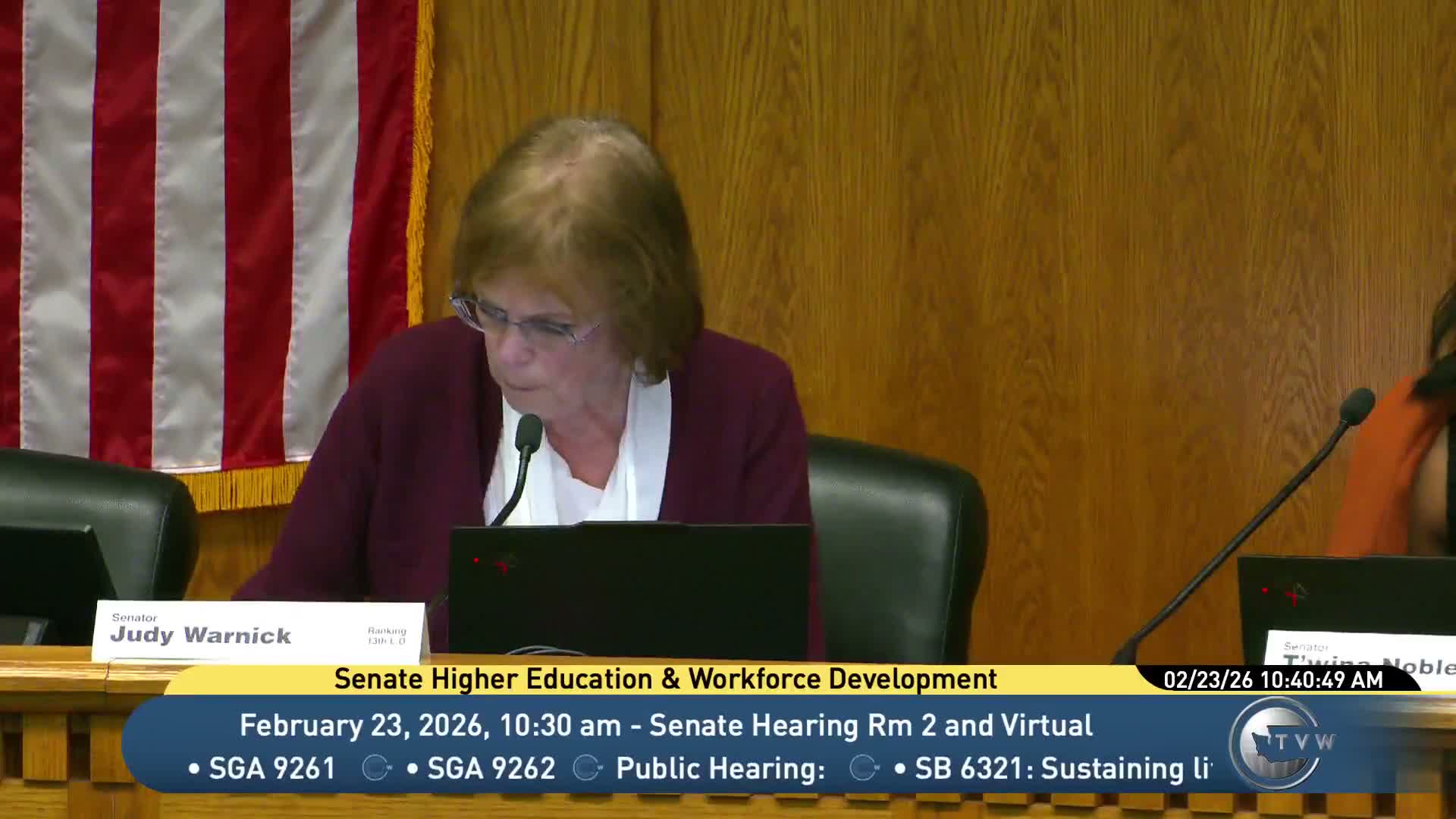
The Senate Higher Education and Workforce Development Committee on its final meeting of the 2026 legislative session advanced Senate Bill 6321, a proposal to create the Washington Institute for Scientific Advancement and allow the state to issue up to $6 billion in general‑obligation bonds to support scientific research and build research facilities.
Sponsor and structure: The prime sponsor framed the bill as a response to recent federal funding instability and described the institute as an entity housed in the Department of Commerce, run by an administrator appointed by the director of commerce and overseen by an 11‑member council "the majority of whom must be scientists," with representation from public research institutions and a public member. The bill would permit the State Finance Committee to issue up to $6,000,000,000 in GO bonds at a pace of up to $1,000,000,000 per year for six years beginning in 2027. The sponsor said the act’s sections creating the institute and authorizing debt would be subject to a voter referendum under the Washington State Constitution.
Witnesses and evidence: Multiple university officials, early‑career researchers and union leaders testified in support. Connor Haggerty of Washington State University described WSU’s research portfolio and said state investment in research attracts federal and private capital. "Research investment is economic development policy," Haggerty said.
Shelly Sakiyama Albert, vice dean for research at the University of Washington School of Medicine, provided funding figures and recent trends: UW received about $1.39 billion in federal research funding last year, the School of Medicine accounted for roughly $885 million, and two‑thirds of UW’s research funding is federal. She said new NIH awards in federal fiscal 2025 were down about 40% and described terminations and uncertainty since January 2025.
Early‑career researchers gave personal examples of harm from sudden federal cuts. "My award was terminated with no scientific concerns raised," Casey Gervin said, describing disruption to an early‑career training grant. Lucas O’Brien and others recounted furloughs, delays and lost opportunities that they said undermine workforce pipelines in suicide prevention, climate adaptation and clean‑energy research. Abigail Gambrell of UAW Local 4121 testified to broad workforce impacts and cited a reported sharp increase in research staff layoffs within her unit.
Comparative models and fiscal notes: Witnesses and members referenced similar state programs — Texas’ Cancer Prevention and Research Institute (CPRIT), California’s regenerative‑medicine bond program and a larger California proposal — as precedents that use state bonds to stabilize research funding. Committee staff noted the fiscal note is available in the legislature’s budget system (EBB) and explained that because the bill’s proposed bonds would not meet tax‑exempt bond rules, borrowing costs would be higher; the text also requires voter approval of certain sections prior to bond issuance.
Committee action and next steps: After closing the public hearing and meeting briefly in executive session, the committee moved that SB 6321 "receive a due pass recommendation and be sent to the Rules Committee." The chair called a voice vote and announced the motion passed "subject to signatures." The committee also reported a slate of gubernatorial appointments with a confirmation recommendation, again by voice vote.
What remains unresolved: The bill’s borrowing cost assumptions rely on future market conditions and the treasurer’s projections in the fiscal note; specific vote tallies were not recorded on the floor record in the hearing transcript. The bill’s referendum provision means the institute and the bond authority would require voter approval before funds could be issued under the Washington State Constitution.
The committee sent SB 6321 to the Rules Committee with a due‑pass recommendation and reported several gubernatorial appointment numbers with confirmation recommendations. No further committee votes were recorded in the hearing transcript.
Sponsor and structure: The prime sponsor framed the bill as a response to recent federal funding instability and described the institute as an entity housed in the Department of Commerce, run by an administrator appointed by the director of commerce and overseen by an 11‑member council "the majority of whom must be scientists," with representation from public research institutions and a public member. The bill would permit the State Finance Committee to issue up to $6,000,000,000 in GO bonds at a pace of up to $1,000,000,000 per year for six years beginning in 2027. The sponsor said the act’s sections creating the institute and authorizing debt would be subject to a voter referendum under the Washington State Constitution.
Witnesses and evidence: Multiple university officials, early‑career researchers and union leaders testified in support. Connor Haggerty of Washington State University described WSU’s research portfolio and said state investment in research attracts federal and private capital. "Research investment is economic development policy," Haggerty said.
Shelly Sakiyama Albert, vice dean for research at the University of Washington School of Medicine, provided funding figures and recent trends: UW received about $1.39 billion in federal research funding last year, the School of Medicine accounted for roughly $885 million, and two‑thirds of UW’s research funding is federal. She said new NIH awards in federal fiscal 2025 were down about 40% and described terminations and uncertainty since January 2025.
Early‑career researchers gave personal examples of harm from sudden federal cuts. "My award was terminated with no scientific concerns raised," Casey Gervin said, describing disruption to an early‑career training grant. Lucas O’Brien and others recounted furloughs, delays and lost opportunities that they said undermine workforce pipelines in suicide prevention, climate adaptation and clean‑energy research. Abigail Gambrell of UAW Local 4121 testified to broad workforce impacts and cited a reported sharp increase in research staff layoffs within her unit.
Comparative models and fiscal notes: Witnesses and members referenced similar state programs — Texas’ Cancer Prevention and Research Institute (CPRIT), California’s regenerative‑medicine bond program and a larger California proposal — as precedents that use state bonds to stabilize research funding. Committee staff noted the fiscal note is available in the legislature’s budget system (EBB) and explained that because the bill’s proposed bonds would not meet tax‑exempt bond rules, borrowing costs would be higher; the text also requires voter approval of certain sections prior to bond issuance.
Committee action and next steps: After closing the public hearing and meeting briefly in executive session, the committee moved that SB 6321 "receive a due pass recommendation and be sent to the Rules Committee." The chair called a voice vote and announced the motion passed "subject to signatures." The committee also reported a slate of gubernatorial appointments with a confirmation recommendation, again by voice vote.
What remains unresolved: The bill’s borrowing cost assumptions rely on future market conditions and the treasurer’s projections in the fiscal note; specific vote tallies were not recorded on the floor record in the hearing transcript. The bill’s referendum provision means the institute and the bond authority would require voter approval before funds could be issued under the Washington State Constitution.
The committee sent SB 6321 to the Rules Committee with a due‑pass recommendation and reported several gubernatorial appointment numbers with confirmation recommendations. No further committee votes were recorded in the hearing transcript.
View the Full Meeting & All Its Details
This article offers just a summary. Unlock complete video, transcripts, and insights as a Founder Member.
✓
Watch full, unedited meeting videos
✓
Search every word spoken in unlimited transcripts
✓
AI summaries & real-time alerts (all government levels)
✓
Permanent access to expanding government content
30-day money-back guarantee
