SF transportation board hears SFMTA budget plan, regional sales tax and local parcel tax proposed to avoid steep cuts
February 24, 2026 | San Francisco City, San Francisco County, California
This article was created by AI summarizing key points discussed. AI makes mistakes, so for full details and context, please refer to the video of the full meeting. Please report any errors so we can fix them. Report an error »
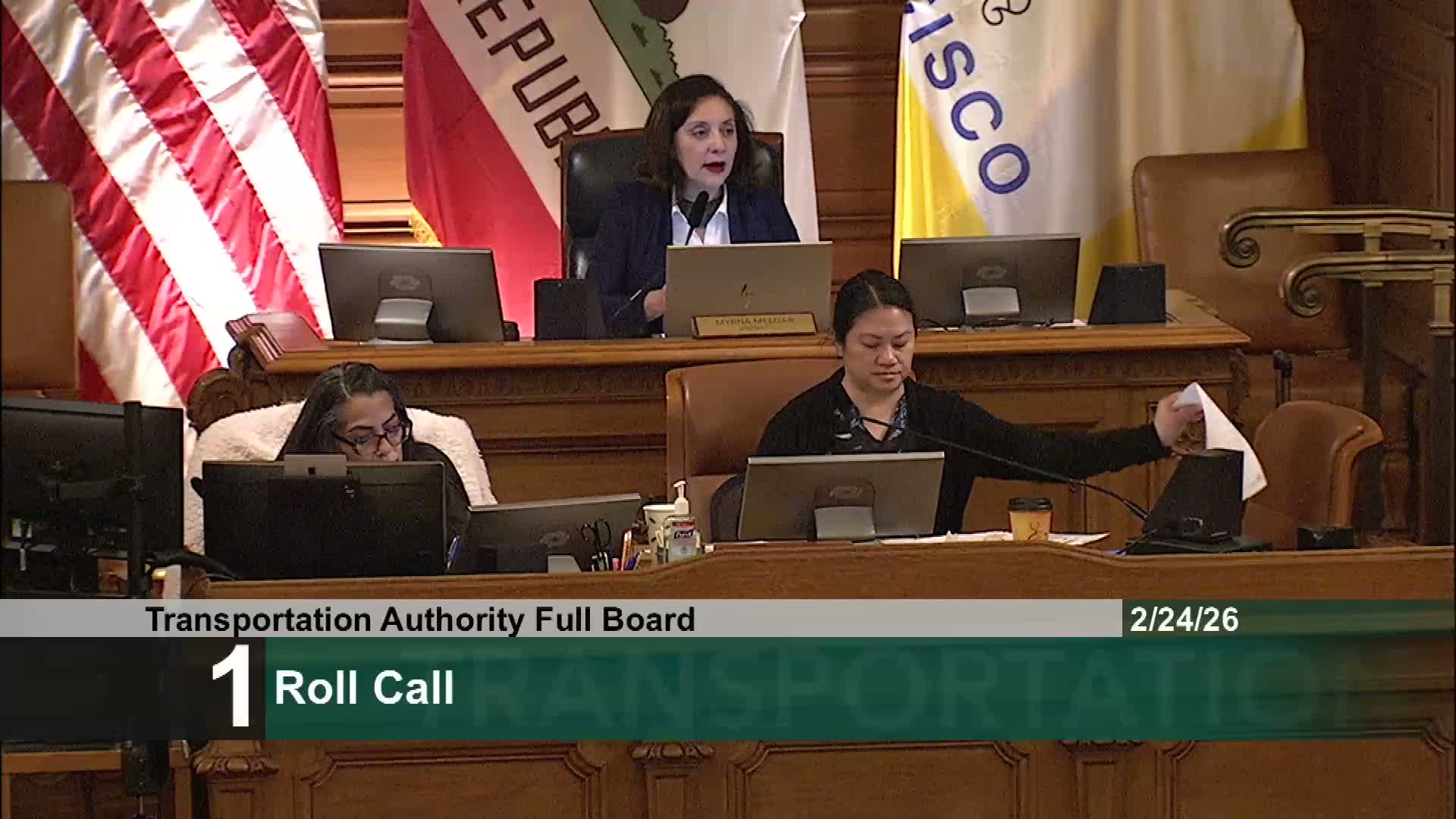
San Francisco — The San Francisco County Transportation Authority Board on Feb. 24 received a detailed budget update from SFMTA Director Julie Kirschbaum outlining a three‑part plan to close a multi‑hundred‑million‑dollar operating shortfall and avert severe service reductions.
“Governor Newsom signed the assembly and senate bills that authorized $590,000,000 in loans to Bay Area transit agencies,” Chair Mirna Melgar said, calling the state loan “critical bridge funding” while local and regional ballot measures are finalized. Kirschbaum told the board that SFMTA faces an immediate budget gap of about $300 million that could grow past $400 million within five years without new revenue and cost reductions.
Kirschbaum framed the agency’s approach as a three‑legged stool: a regional sales tax measure, a complementary local parcel tax and continued agency efficiencies. The regional proposal described by Kirschbaum would be a five‑county measure that, if approved, she said would raise roughly $1,000,000,000 annually for the region, with Muni receiving an estimated $155,000,000 per year.
The local proposal is a square‑footage parcel tax intended to raise approximately $150,000,000 for existing operations plus $10,000,000 earmarked for service‑quality improvements. Kirschbaum said the parcel tax would have three categories (single‑family residential, multifamily and nonresidential), a typical parcel payment of about $129 per year, built‑in exemptions for owner‑occupied seniors and certain institutional properties (nonprofits, hospitals, museums and government land), a 15‑year sunset and an inflation adjustment. The proposal also would allow pass‑throughs of up to 50% with a $65 cap for rent‑controlled units.
Kirschbaum emphasized that the year‑one budget relies on onetime funds — including the state loan and agency reserves — because revenue from ballot measures would not be available until fiscal year 2027–28. She said SFMTA has taken cost‑saving steps including cutting vacant positions, pursuing contractor concessions and advancing programs such as Muni Forward, which she said saves roughly $10,000,000 annually.
“If one or both measures does not pass, we are really looking at dire conditions,” Kirschbaum said, warning of potential service impacts. “We would be cutting up to 20 Muni routes. We would expect our core network like the 38 Geary and the 22 Fillmore to experience double wait times and very significant crowding.” She added that the agency’s plan should provide a runway so immediate preemptive cuts are not required.
Director Chang, in the executive director report preceding the presentation, also flagged state and federal items that affect local planning: Assemblymember Haney introduced AB 2308 to extend local tax‑increment financing for TJPA parcels near the transit center, the California DMV’s updated autonomous‑vehicle rules do not require city‑level vehicle‑miles‑traveled reporting and limit required reporting of certain incidents to roads over 35 mph — a threshold that excludes most San Francisco streets — and Waymo has begun passenger service at SFO under a permit that will require trip reporting. Chang noted a Board of Supervisors hearing about Waymo vehicle stalls is scheduled for March 2.
Board members and supervisors asked detailed questions about the parcel tax’s senior exemptions (Kirschbaum said the current exemption applies to owner‑occupied seniors, not renters), the extent of the $18,000,000 in parking‑related revenue gains, the use of forward‑facing bus cameras and an AI‑enabled RFP to improve enforcement in transit lanes (Kirschbaum said the RFP is live and a rollout could take about 18 months), and whether raising construction/temporary parking permit fees (rather than reducing permits) would be used to increase meter recovery.
Kirschbaum said staff will hold three public workshops on the budget proposals, deliver a balanced budget to the mayor on May 1 and coordinate with the Board of Supervisors in July. The agency stressed that public outreach and further technical details will continue as measures move toward potential placement on the ballot.
“Governor Newsom signed the assembly and senate bills that authorized $590,000,000 in loans to Bay Area transit agencies,” Chair Mirna Melgar said, calling the state loan “critical bridge funding” while local and regional ballot measures are finalized. Kirschbaum told the board that SFMTA faces an immediate budget gap of about $300 million that could grow past $400 million within five years without new revenue and cost reductions.
Kirschbaum framed the agency’s approach as a three‑legged stool: a regional sales tax measure, a complementary local parcel tax and continued agency efficiencies. The regional proposal described by Kirschbaum would be a five‑county measure that, if approved, she said would raise roughly $1,000,000,000 annually for the region, with Muni receiving an estimated $155,000,000 per year.
The local proposal is a square‑footage parcel tax intended to raise approximately $150,000,000 for existing operations plus $10,000,000 earmarked for service‑quality improvements. Kirschbaum said the parcel tax would have three categories (single‑family residential, multifamily and nonresidential), a typical parcel payment of about $129 per year, built‑in exemptions for owner‑occupied seniors and certain institutional properties (nonprofits, hospitals, museums and government land), a 15‑year sunset and an inflation adjustment. The proposal also would allow pass‑throughs of up to 50% with a $65 cap for rent‑controlled units.
Kirschbaum emphasized that the year‑one budget relies on onetime funds — including the state loan and agency reserves — because revenue from ballot measures would not be available until fiscal year 2027–28. She said SFMTA has taken cost‑saving steps including cutting vacant positions, pursuing contractor concessions and advancing programs such as Muni Forward, which she said saves roughly $10,000,000 annually.
“If one or both measures does not pass, we are really looking at dire conditions,” Kirschbaum said, warning of potential service impacts. “We would be cutting up to 20 Muni routes. We would expect our core network like the 38 Geary and the 22 Fillmore to experience double wait times and very significant crowding.” She added that the agency’s plan should provide a runway so immediate preemptive cuts are not required.
Director Chang, in the executive director report preceding the presentation, also flagged state and federal items that affect local planning: Assemblymember Haney introduced AB 2308 to extend local tax‑increment financing for TJPA parcels near the transit center, the California DMV’s updated autonomous‑vehicle rules do not require city‑level vehicle‑miles‑traveled reporting and limit required reporting of certain incidents to roads over 35 mph — a threshold that excludes most San Francisco streets — and Waymo has begun passenger service at SFO under a permit that will require trip reporting. Chang noted a Board of Supervisors hearing about Waymo vehicle stalls is scheduled for March 2.
Board members and supervisors asked detailed questions about the parcel tax’s senior exemptions (Kirschbaum said the current exemption applies to owner‑occupied seniors, not renters), the extent of the $18,000,000 in parking‑related revenue gains, the use of forward‑facing bus cameras and an AI‑enabled RFP to improve enforcement in transit lanes (Kirschbaum said the RFP is live and a rollout could take about 18 months), and whether raising construction/temporary parking permit fees (rather than reducing permits) would be used to increase meter recovery.
Kirschbaum said staff will hold three public workshops on the budget proposals, deliver a balanced budget to the mayor on May 1 and coordinate with the Board of Supervisors in July. The agency stressed that public outreach and further technical details will continue as measures move toward potential placement on the ballot.
Don't Miss a Word: See the Full Meeting!
Go beyond summaries. Unlock every video, transcript, and key insight with a Founder Membership.
✓
Get instant access to full meeting videos
✓
Search and clip any phrase from complete transcripts
✓
Receive AI-powered summaries & custom alerts
✓
Enjoy lifetime, unrestricted access to government data
30-day money-back guarantee
