House education panel backs shifting K–12 construction oversight to DFCM after audit finds permit lapses
February 24, 2026 | 2026 Utah Legislature, Utah Legislature, Utah Legislative Branch, Utah
This article was created by AI summarizing key points discussed. AI makes mistakes, so for full details and context, please refer to the video of the full meeting. Please report any errors so we can fix them. Report an error »
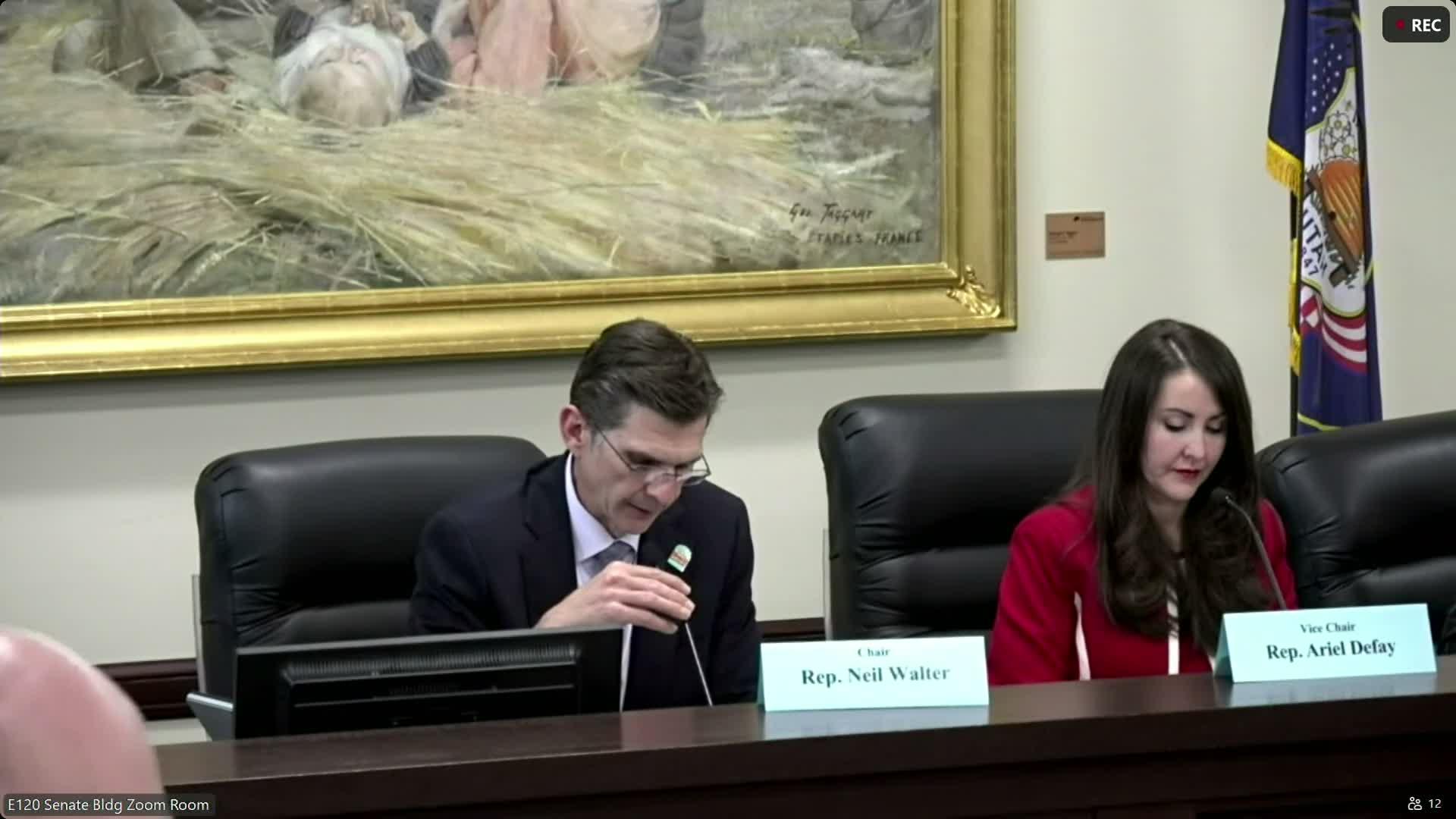
A bipartisan majority of the Utah House Education Standing Committee on Monday recommended favorably Senate Bill 164, a measure that would move high‑level oversight of K–12 public school construction from the State Board of Education to the Division of Facilities Construction & Management (DFCM).
Sen. Wilson, the bill’s sponsor, told the committee a recent performance audit of 30 school projects from 2017–2024 found serious weaknesses: only four of the audited projects obtained permits before starting construction, seven never received permits and 19 began work before permits were issued. “Authorizing unqualified individuals to make construction decisions on behalf of an LEA increases the risk of unsafe school buildings,” the audit authors wrote and the sponsor cited at the hearing.
Jim Russell, former DFCM director who participated in the audit work, said smaller and rural districts often lack qualified personnel to manage design review and construction. Russell urged the committee not to conflate the bill with an attack on local staff, but said DFCM can offer standardized plan review, building inspection lists and facility condition assessment tools that many districts lack.
State Superintendent Molly Hart told members the state board supports the bill. She said the board currently relies on attestation and has limited staff capacity for technical construction oversight. “If there is interest in more oversight, we are not the best people to do that work,” Hart said.
What the bill would do: it transfers certain oversight functions to DFCM while keeping educational program review with the State Board. DFCM would perform plan review and inspections, maintain a plan‑rack of prototype designs and a standardized cost database, and may delegate authority back to LEAs that demonstrate internal capacity. LEAs choosing to use DFCM would pay oversight fees set by rule, with a proposed minimum fee of $2,000 for small projects and a maximum line in the fiscal note of $107,000 for the largest projects; districts with qualified staff would incur no DFCM fee for those services.
Committee members pressed the sponsor and witnesses on several points. Representative Eliason and others asked whether DFCM would steer contracts or procurement to favored vendors; witnesses said DFCM’s role would be facilitator, not a voting member in local selection processes. Members also asked about the plan‑rack and whether prototype designs would force “cookie‑cutter” schools; Russell and other witnesses said prototypes would be optional tools districts could adapt to local landscape and needs.
Contractor witnesses urged caution. Joe McAllister, general counsel for Hughes General Contractors, noted the K–12 audit recommended performance audits of DFCM itself before shifting responsibility. Dan Pratt and Aaron Metcalfe, contractors with long experience in school construction, warned the committee to preserve procurement flexibility and to coordinate implementation so cost or timing impacts do not hamper outlying districts’ ability to finance projects.
After public comment and extended questioning, Representative Thompson moved that the committee recommend SB 164 favorably as substituted. The committee approved the motion on a roll call, 6–4. Representatives Wilton, Miller, Hayes and Moss voted no; the other members on the roll voted yes.
The bill would phase in data collection and DFCM oversight beginning January 1 (implementation milestones in the substitute include phased requirements and an appeals panel for DFCM decisions). The substitute also requires DFCM to report back to the interim education committee and the transportation and infrastructure appropriations subcommittee during the interim with standardized cost reporting and other metrics.
The committee record shows broad support from the State Board and some districts for increased technical oversight, but several members and public commenters urged careful implementation, further auditing of DFCM, and protections for small and charter LEAs to avoid unintended cost increases.
Next steps: SB 164 was recommended favorably by the committee and will move to the full House for further consideration.
Sen. Wilson, the bill’s sponsor, told the committee a recent performance audit of 30 school projects from 2017–2024 found serious weaknesses: only four of the audited projects obtained permits before starting construction, seven never received permits and 19 began work before permits were issued. “Authorizing unqualified individuals to make construction decisions on behalf of an LEA increases the risk of unsafe school buildings,” the audit authors wrote and the sponsor cited at the hearing.
Jim Russell, former DFCM director who participated in the audit work, said smaller and rural districts often lack qualified personnel to manage design review and construction. Russell urged the committee not to conflate the bill with an attack on local staff, but said DFCM can offer standardized plan review, building inspection lists and facility condition assessment tools that many districts lack.
State Superintendent Molly Hart told members the state board supports the bill. She said the board currently relies on attestation and has limited staff capacity for technical construction oversight. “If there is interest in more oversight, we are not the best people to do that work,” Hart said.
What the bill would do: it transfers certain oversight functions to DFCM while keeping educational program review with the State Board. DFCM would perform plan review and inspections, maintain a plan‑rack of prototype designs and a standardized cost database, and may delegate authority back to LEAs that demonstrate internal capacity. LEAs choosing to use DFCM would pay oversight fees set by rule, with a proposed minimum fee of $2,000 for small projects and a maximum line in the fiscal note of $107,000 for the largest projects; districts with qualified staff would incur no DFCM fee for those services.
Committee members pressed the sponsor and witnesses on several points. Representative Eliason and others asked whether DFCM would steer contracts or procurement to favored vendors; witnesses said DFCM’s role would be facilitator, not a voting member in local selection processes. Members also asked about the plan‑rack and whether prototype designs would force “cookie‑cutter” schools; Russell and other witnesses said prototypes would be optional tools districts could adapt to local landscape and needs.
Contractor witnesses urged caution. Joe McAllister, general counsel for Hughes General Contractors, noted the K–12 audit recommended performance audits of DFCM itself before shifting responsibility. Dan Pratt and Aaron Metcalfe, contractors with long experience in school construction, warned the committee to preserve procurement flexibility and to coordinate implementation so cost or timing impacts do not hamper outlying districts’ ability to finance projects.
After public comment and extended questioning, Representative Thompson moved that the committee recommend SB 164 favorably as substituted. The committee approved the motion on a roll call, 6–4. Representatives Wilton, Miller, Hayes and Moss voted no; the other members on the roll voted yes.
The bill would phase in data collection and DFCM oversight beginning January 1 (implementation milestones in the substitute include phased requirements and an appeals panel for DFCM decisions). The substitute also requires DFCM to report back to the interim education committee and the transportation and infrastructure appropriations subcommittee during the interim with standardized cost reporting and other metrics.
The committee record shows broad support from the State Board and some districts for increased technical oversight, but several members and public commenters urged careful implementation, further auditing of DFCM, and protections for small and charter LEAs to avoid unintended cost increases.
Next steps: SB 164 was recommended favorably by the committee and will move to the full House for further consideration.
Don't Miss a Word: See the Full Meeting!
Go beyond summaries. Unlock every video, transcript, and key insight with a Founder Membership.
✓
Get instant access to full meeting videos
✓
Search and clip any phrase from complete transcripts
✓
Receive AI-powered summaries & custom alerts
✓
Enjoy lifetime, unrestricted access to government data
30-day money-back guarantee
