Families urge lawmakers to recognize Prader‑Willi awareness day at the Capitol; resolution passes after amendment
February 24, 2026 | Health and Human Services, SENATE, Committees, Legislative, Georgia
This article was created by AI summarizing key points discussed. AI makes mistakes, so for full details and context, please refer to the video of the full meeting. Please report any errors so we can fix them. Report an error »
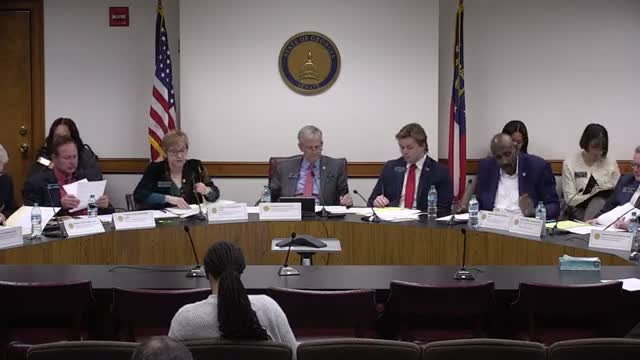
A Health and Human Services committee approved a resolution to establish a Prader‑Willi Syndrome (PWS) awareness day at the State Capitol after family members and an adult with the condition described the disorder’s medical and caregiving challenges.
Lisa Matyszak, identified herself as president of the Georgia Association for Prader Willi Syndrome and a researcher for the Foundation for Prader Willi Research, described PWS as a rare, brain‑based genetic disorder that disrupts hypothalamic function and produces an unrelenting drive to eat (hyperphagia). She told the committee that strict supervision, locked food storage and careful monitoring are frequently necessary to prevent catastrophic outcomes; she described substantial caregiving burdens and recounted a lapse in Medicaid coverage that temporarily cut off critical care.
Parent Jessica McCabe, a physiatrist and mother of a child with PWS, urged that a diagnosis be an automatic qualifier for Katie Beckett services so infants and young children could access early intervention therapies and medications. McCabe said her son required multiple specialists, five therapy services a week and had an NG tube during infancy; she said the family faced denials and had to hire a private advocate to secure benefits.
An adult with PWS (speaker 14) described living with waiver supports, significant medical challenges including insulin resistance and the need for supervised diets, and urged improved access to waiver programs for adults.
Legislators amended the resolution language so the observance would be ‘‘a day at the Capitol’’ rather than a statewide day, and approved the amendment by unanimous voice/hand vote. The committee then passed the resolution as amended unanimously.
The record contains requests for structural and programmatic changes—automatic Katie Beckett qualification for PWS, the authority to lock food in group‑home kitchens, clearer restoration procedures for benefits lost because of clerical errors, and expanded respite supports—but the resolution itself is an awareness measure, not a mandate for these policy changes.
Lisa Matyszak, identified herself as president of the Georgia Association for Prader Willi Syndrome and a researcher for the Foundation for Prader Willi Research, described PWS as a rare, brain‑based genetic disorder that disrupts hypothalamic function and produces an unrelenting drive to eat (hyperphagia). She told the committee that strict supervision, locked food storage and careful monitoring are frequently necessary to prevent catastrophic outcomes; she described substantial caregiving burdens and recounted a lapse in Medicaid coverage that temporarily cut off critical care.
Parent Jessica McCabe, a physiatrist and mother of a child with PWS, urged that a diagnosis be an automatic qualifier for Katie Beckett services so infants and young children could access early intervention therapies and medications. McCabe said her son required multiple specialists, five therapy services a week and had an NG tube during infancy; she said the family faced denials and had to hire a private advocate to secure benefits.
An adult with PWS (speaker 14) described living with waiver supports, significant medical challenges including insulin resistance and the need for supervised diets, and urged improved access to waiver programs for adults.
Legislators amended the resolution language so the observance would be ‘‘a day at the Capitol’’ rather than a statewide day, and approved the amendment by unanimous voice/hand vote. The committee then passed the resolution as amended unanimously.
The record contains requests for structural and programmatic changes—automatic Katie Beckett qualification for PWS, the authority to lock food in group‑home kitchens, clearer restoration procedures for benefits lost because of clerical errors, and expanded respite supports—but the resolution itself is an awareness measure, not a mandate for these policy changes.
View the Full Meeting & All Its Details
This article offers just a summary. Unlock complete video, transcripts, and insights as a Founder Member.
✓
Watch full, unedited meeting videos
✓
Search every word spoken in unlimited transcripts
✓
AI summaries & real-time alerts (all government levels)
✓
Permanent access to expanding government content
30-day money-back guarantee
