Committee hears extensive testimony on DUI risk-reduction bill; debate centers on assessments, fees and program integrity
February 23, 2026 | Public Safety, SENATE, Committees, Legislative, Georgia
This article was created by AI summarizing key points discussed. AI makes mistakes, so for full details and context, please refer to the video of the full meeting. Please report any errors so we can fix them. Report an error »
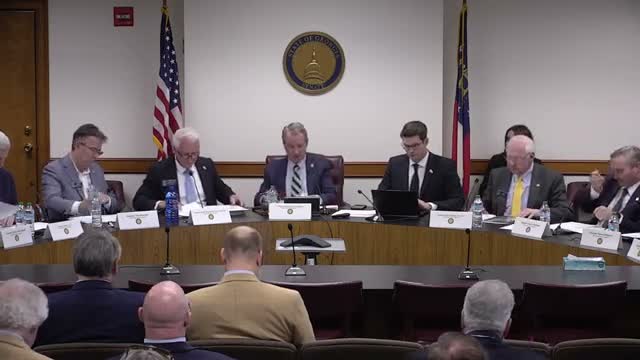
Senate Bill 473, presented by Senator Robertson, drew extended questioning and public testimony on Thursday as committee members, providers and state agencies debated how best to regulate DUI risk-reduction programs and handle associated assessments and fees.
Robertson said the bill would require proof of completion of a certified DUI risk-reduction program for those seeking limited driving permits, allow electronic transfer of certain information, revise authorized fees and remove an assessment component from DUI risk-reduction programs. "What this does is it requires submission of proof of completion of a certified DUI risk reduction program," he told the committee.
Members pressed on fiscal and administrative impacts. Department of Driver Services director of government affairs Shavonda Leslie said DDS "collect[s] those funds" and that a portion is split with DBHDD; she explained collected funds are returned to the general fund and agencies request appropriations as needed. Leslie said DDS provides oversight for driving schools and audit functions but deferred clinical assessment questions to DBHDD or providers.
Multiple witnesses representing providers and vendors told the committee they oppose the bill as drafted. Barry Schrank, president of Taggart's Driving School, and representatives from ADE (the assessment vendor) and the Prevention Research Institute (PRI) emphasized the role of the assessment and a structured, evidence-based curriculum in reducing recidivism. Schrank described the program's assessment as a roughly 130-question tool that informs instruction and DBHDD evaluations. "That assessment instrument is very, very important," he said.
Ina Mitchell of the Prevention Research Institute said the curriculum has decades of peer-reviewed evidence and that Georgia's program has produced recidivism reductions in university studies. Multiple providers warned that broadly shifting to online formats or removing assessment pillars could reduce effectiveness and increase recidivism.
Because of time limits the committee paused public testimony and scheduled continuation at the committee's next meeting on Wednesday. The chair asked stakeholders to work in "good faith" on language, particularly lines related to fees (noted as lines 140–146 in committee discussion). Senator Robertson said he is willing to work with the minority leader and stakeholders to find shared language.
Next steps: testimony will resume Wednesday; the author and stakeholders signaled willingness to negotiate fee and assessment language before further committee action.
Robertson said the bill would require proof of completion of a certified DUI risk-reduction program for those seeking limited driving permits, allow electronic transfer of certain information, revise authorized fees and remove an assessment component from DUI risk-reduction programs. "What this does is it requires submission of proof of completion of a certified DUI risk reduction program," he told the committee.
Members pressed on fiscal and administrative impacts. Department of Driver Services director of government affairs Shavonda Leslie said DDS "collect[s] those funds" and that a portion is split with DBHDD; she explained collected funds are returned to the general fund and agencies request appropriations as needed. Leslie said DDS provides oversight for driving schools and audit functions but deferred clinical assessment questions to DBHDD or providers.
Multiple witnesses representing providers and vendors told the committee they oppose the bill as drafted. Barry Schrank, president of Taggart's Driving School, and representatives from ADE (the assessment vendor) and the Prevention Research Institute (PRI) emphasized the role of the assessment and a structured, evidence-based curriculum in reducing recidivism. Schrank described the program's assessment as a roughly 130-question tool that informs instruction and DBHDD evaluations. "That assessment instrument is very, very important," he said.
Ina Mitchell of the Prevention Research Institute said the curriculum has decades of peer-reviewed evidence and that Georgia's program has produced recidivism reductions in university studies. Multiple providers warned that broadly shifting to online formats or removing assessment pillars could reduce effectiveness and increase recidivism.
Because of time limits the committee paused public testimony and scheduled continuation at the committee's next meeting on Wednesday. The chair asked stakeholders to work in "good faith" on language, particularly lines related to fees (noted as lines 140–146 in committee discussion). Senator Robertson said he is willing to work with the minority leader and stakeholders to find shared language.
Next steps: testimony will resume Wednesday; the author and stakeholders signaled willingness to negotiate fee and assessment language before further committee action.
View the Full Meeting & All Its Details
This article offers just a summary. Unlock complete video, transcripts, and insights as a Founder Member.
✓
Watch full, unedited meeting videos
✓
Search every word spoken in unlimited transcripts
✓
AI summaries & real-time alerts (all government levels)
✓
Permanent access to expanding government content
30-day money-back guarantee
