House Ag committee hears bill to create green fertilizer incentive program
February 24, 2026 | Legislative Sessions, Washington
This article was created by AI summarizing key points discussed. AI makes mistakes, so for full details and context, please refer to the video of the full meeting. Please report any errors so we can fix them. Report an error »
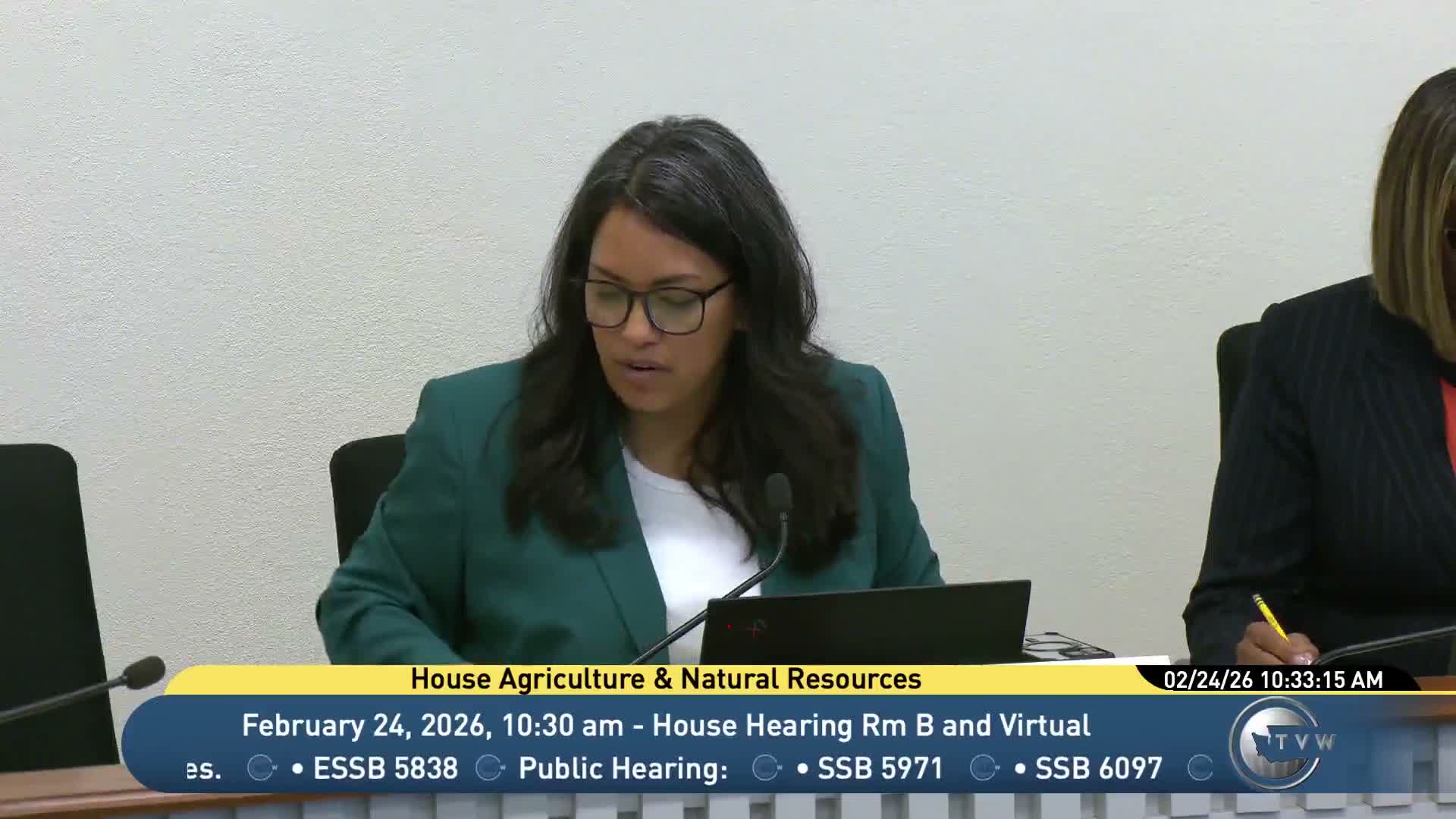
The House Agriculture and Natural Resources Committee on Feb. 24 heard testimony supporting substitute Senate Bill 5971, which would direct the Washington State Department of Agriculture to establish a green fertilizer incentive program to promote nitrogen fertilizers produced with substantially lower life-cycle greenhouse gas emissions.
Rebecca Lewis, staff to the committee, said the bill defines green fertilizer as a nitrogen-based product manufactured using processes that achieve at least an 80% reduction in life-cycle greenhouse gas emissions compared with conventional natural-gas-based production. She told the panel the department must establish program criteria by July 1, 2028, and deliver a preliminary report on program design and cost modeling by Dec. 1, 2027; the program would take effect only after that report and a legislative appropriation.
Joel Creswell of the Department of Ecology urged the committee to specify that life-cycle greenhouse gas assessments be conducted in a manner consistent with the state's clean fuel standard, to include a baseline year for emissions accounting, and to tie performance-based incentives to the proportion of emissions reduced. "These suggestions would strengthen the ability to incentivize low-carbon fertilizer manufacturing in state to better meet Washington's greenhouse gas emission limits while providing regulatory certainty for the agricultural industry," he said.
Industry and labor witnesses emphasized economic and jobs benefits. Seth Worley, government affairs director for UA Local 598 Plumbers and Steamfitters, said the measure would generate construction and long-term jobs tied to facility build-out. Dan Holmes of Atlas Agro described the Pacific Green Fertilizer Project in Richland and said decarbonizing fertilizer production is "among the fastest and most straightforward ways to reduce global emissions." Holmes said the Richland facility is projected to abate "up to 1,000,000 tons of carbon per year," and estimated the facility would employ about 200 full-time workers plus numerous contractors; he added The Fertilizer Institute projects a project of this size generates roughly 2,000 total jobs when including indirect and induced employment.
Eric Kamrath of the Natural Resources Defense Council said electrolytic hydrogen is a high-value, low-emission feedstock for fertilizer production and urged passage of the bill to help projects qualify for time-limited federal production tax credits. Carl Dye of the Tri-City Development Council said in addition to climate benefits, domestic production would reduce farmers' exposure to volatile global gas markets and help stabilize fertilizer supply and prices.
No prime sponsor appeared in person to testify; committee staff indicated a preliminary fiscal note was available in the committee's electronic bill book. The committee held no vote on the bill during the hearing; public testimony was recorded (317 pro, 87 con, 0 other) and the committee proceeded to subsequent agenda items.
Rebecca Lewis, staff to the committee, said the bill defines green fertilizer as a nitrogen-based product manufactured using processes that achieve at least an 80% reduction in life-cycle greenhouse gas emissions compared with conventional natural-gas-based production. She told the panel the department must establish program criteria by July 1, 2028, and deliver a preliminary report on program design and cost modeling by Dec. 1, 2027; the program would take effect only after that report and a legislative appropriation.
Joel Creswell of the Department of Ecology urged the committee to specify that life-cycle greenhouse gas assessments be conducted in a manner consistent with the state's clean fuel standard, to include a baseline year for emissions accounting, and to tie performance-based incentives to the proportion of emissions reduced. "These suggestions would strengthen the ability to incentivize low-carbon fertilizer manufacturing in state to better meet Washington's greenhouse gas emission limits while providing regulatory certainty for the agricultural industry," he said.
Industry and labor witnesses emphasized economic and jobs benefits. Seth Worley, government affairs director for UA Local 598 Plumbers and Steamfitters, said the measure would generate construction and long-term jobs tied to facility build-out. Dan Holmes of Atlas Agro described the Pacific Green Fertilizer Project in Richland and said decarbonizing fertilizer production is "among the fastest and most straightforward ways to reduce global emissions." Holmes said the Richland facility is projected to abate "up to 1,000,000 tons of carbon per year," and estimated the facility would employ about 200 full-time workers plus numerous contractors; he added The Fertilizer Institute projects a project of this size generates roughly 2,000 total jobs when including indirect and induced employment.
Eric Kamrath of the Natural Resources Defense Council said electrolytic hydrogen is a high-value, low-emission feedstock for fertilizer production and urged passage of the bill to help projects qualify for time-limited federal production tax credits. Carl Dye of the Tri-City Development Council said in addition to climate benefits, domestic production would reduce farmers' exposure to volatile global gas markets and help stabilize fertilizer supply and prices.
No prime sponsor appeared in person to testify; committee staff indicated a preliminary fiscal note was available in the committee's electronic bill book. The committee held no vote on the bill during the hearing; public testimony was recorded (317 pro, 87 con, 0 other) and the committee proceeded to subsequent agenda items.
Don't Miss a Word: See the Full Meeting!
Go beyond summaries. Unlock every video, transcript, and key insight with a Founder Membership.
✓
Get instant access to full meeting videos
✓
Search and clip any phrase from complete transcripts
✓
Receive AI-powered summaries & custom alerts
✓
Enjoy lifetime, unrestricted access to government data
30-day money-back guarantee
