Panel Hears Changes to Wrongly Convicted Compensation Law; Exonerees and Advocates Urge Clarification
February 24, 2026 | Legislative Sessions, Washington
This article was created by AI summarizing key points discussed. AI makes mistakes, so for full details and context, please refer to the video of the full meeting. Please report any errors so we can fix them. Report an error »
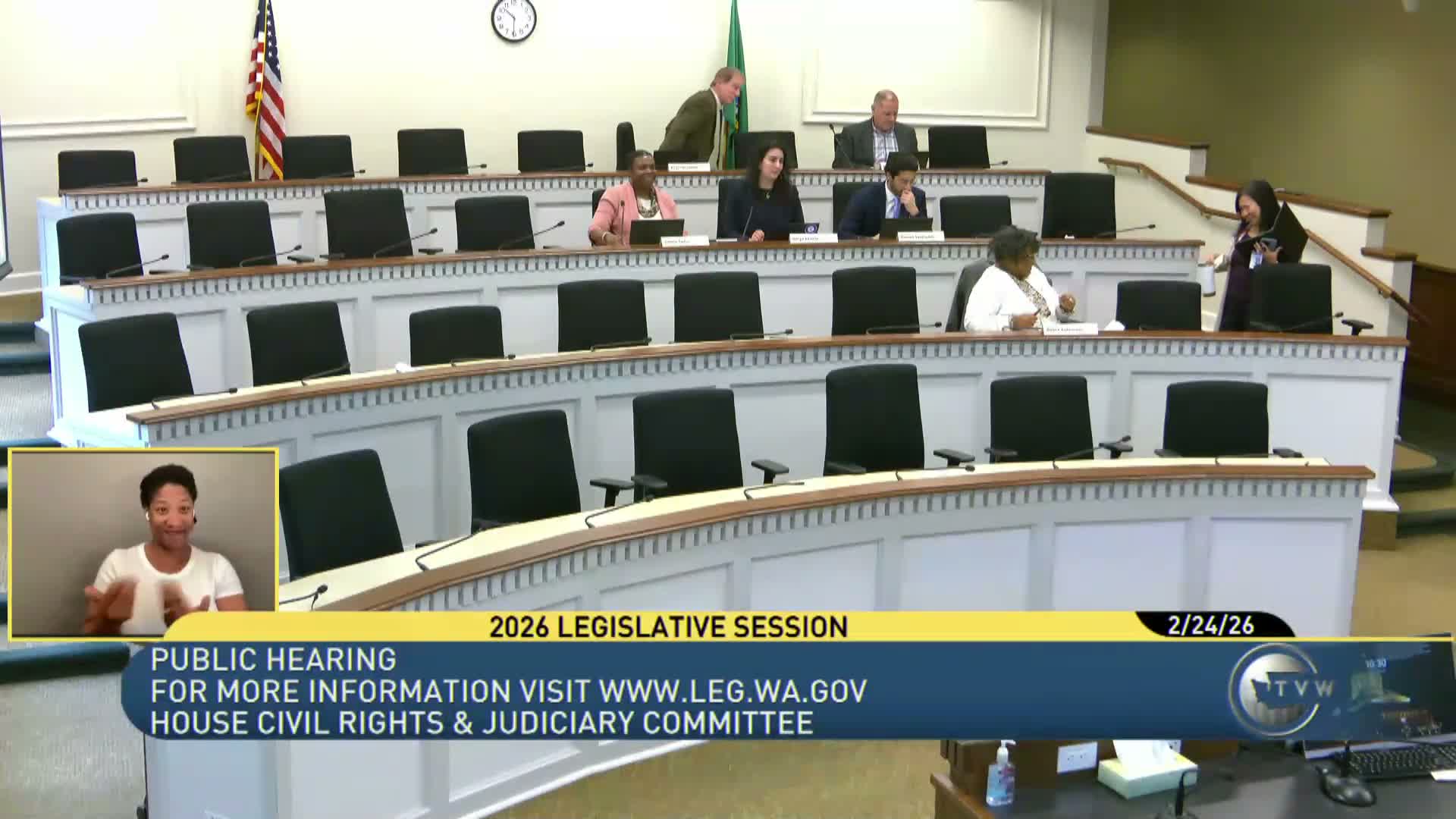
A House Civil Rights and Judiciary Committee hearing on Feb. 24 examined Substitute Senate Bill 5520, which would change how people wrongly convicted in Washington seek compensation from the state. Staff attorney Adena Baker told the panel the bill would shift some filing and proof requirements to a preponderance-of-the-evidence standard for filing claims, add an Alford-plea pathway, require the attorney general to concede covered claims in certain circumstances and expand the categories of confinement counted toward the $50,000-per-year statutory award.
The bill preserves a clear-and-convincing standard for judgments with one narrow modification: the court must find that a preponderance of the evidence no longer supports a finding that the claimant engaged in the charged conduct. It would allow an advance on monetary awards (one year of adjusted compensation or the full award, whichever is less) within 30 days of judgment and would replace the existing attorney-fee calculation with statutory fees. The statute of limitations for bringing claims would generally extend from three to six years, with a special three-year window for those who previously entered an Alford plea before the bill’s effective date.
Prime sponsor Representative Tina Orville, representing the 33rd Legislative District, said the bill builds on the 2013 framework and seeks to remove barriers that have required exonerees to relitigate innocence, recounting a constituent story of delayed relief. Laura Zaretsky of the Washington Innocence Project supported the bill as clarifying a statute she said has produced inconsistent outcomes over 12 years and stressed that the bill does not change compensation amounts or widen eligibility beyond the statute’s intent to compensate those actually innocent.
Wrongful-conviction exonerees who testified described the bill’s real-world stakes. Ted Bradford, Washington’s first DNA exoneree, said he was required to relitigate his case to obtain compensation; Jordan Coleman described severe reentry gaps—housing instability and lack of mental-health support—after decades of incarceration. Both urged passage with attention to access and reentry supports.
Opponents warned the bill as drafted could broaden eligibility and increase state costs. Citizen Jamie Taft, who testified in opposition, said some provisions would extend benefits to people who remain legally guilty after commutation or an Alford plea, lower judicial standards in parts of the statute, expand compensation to cover civil detention and remove the $75,000 cap on attorney fees—issues he said could allow double recovery of fees. Taft also said the bill language could permit interest awards under RCW 4.56.115 and urged the committee to review the fiscal and legal impacts.
The committee asked staff to follow up on where the phrase 'actual innocence' is used in state law. The hearing closed with committee members signaling requests for additional detail by email and further review before floor action.
The bill remained at the hearing stage at the close of the committee’s public testimony; no committee vote on SSB 5520 was recorded that day.
The bill preserves a clear-and-convincing standard for judgments with one narrow modification: the court must find that a preponderance of the evidence no longer supports a finding that the claimant engaged in the charged conduct. It would allow an advance on monetary awards (one year of adjusted compensation or the full award, whichever is less) within 30 days of judgment and would replace the existing attorney-fee calculation with statutory fees. The statute of limitations for bringing claims would generally extend from three to six years, with a special three-year window for those who previously entered an Alford plea before the bill’s effective date.
Prime sponsor Representative Tina Orville, representing the 33rd Legislative District, said the bill builds on the 2013 framework and seeks to remove barriers that have required exonerees to relitigate innocence, recounting a constituent story of delayed relief. Laura Zaretsky of the Washington Innocence Project supported the bill as clarifying a statute she said has produced inconsistent outcomes over 12 years and stressed that the bill does not change compensation amounts or widen eligibility beyond the statute’s intent to compensate those actually innocent.
Wrongful-conviction exonerees who testified described the bill’s real-world stakes. Ted Bradford, Washington’s first DNA exoneree, said he was required to relitigate his case to obtain compensation; Jordan Coleman described severe reentry gaps—housing instability and lack of mental-health support—after decades of incarceration. Both urged passage with attention to access and reentry supports.
Opponents warned the bill as drafted could broaden eligibility and increase state costs. Citizen Jamie Taft, who testified in opposition, said some provisions would extend benefits to people who remain legally guilty after commutation or an Alford plea, lower judicial standards in parts of the statute, expand compensation to cover civil detention and remove the $75,000 cap on attorney fees—issues he said could allow double recovery of fees. Taft also said the bill language could permit interest awards under RCW 4.56.115 and urged the committee to review the fiscal and legal impacts.
The committee asked staff to follow up on where the phrase 'actual innocence' is used in state law. The hearing closed with committee members signaling requests for additional detail by email and further review before floor action.
The bill remained at the hearing stage at the close of the committee’s public testimony; no committee vote on SSB 5520 was recorded that day.
Don't Miss a Word: See the Full Meeting!
Go beyond summaries. Unlock every video, transcript, and key insight with a Founder Membership.
✓
Get instant access to full meeting videos
✓
Search and clip any phrase from complete transcripts
✓
Receive AI-powered summaries & custom alerts
✓
Enjoy lifetime, unrestricted access to government data
30-day money-back guarantee
