Committee hears bill to let federally recognized tribes receive Conservation Futures funding
February 24, 2026 | Legislative Sessions, Washington
This article was created by AI summarizing key points discussed. AI makes mistakes, so for full details and context, please refer to the video of the full meeting. Please report any errors so we can fix them. Report an error »
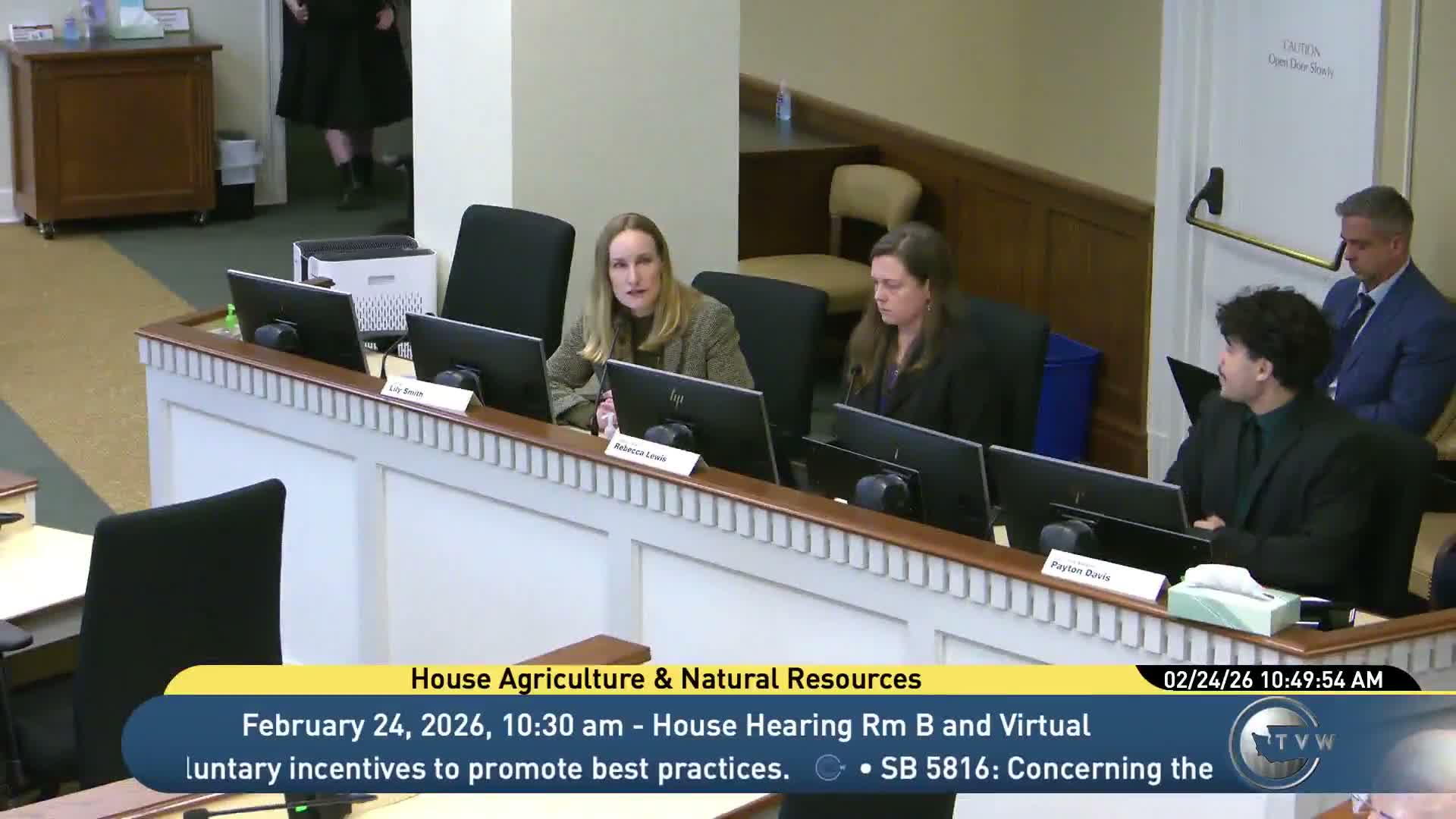
The House Agriculture and Natural Resources Committee on Feb. 24 heard public testimony supporting substitute Senate Bill 6097, which would add federally recognized Indian tribes to the list of eligible recipients of Conservation Futures Program funding used by counties to acquire land or development rights for open-space and farmland preservation.
Lily Smith, committee staff, described the current Conservation Futures Program framework and explained the bill would allow counties to provide grants to federally recognized tribes—bringing tribes into parity with nonprofit organizations, cities and towns that already may participate in the program.
Joe Sambataro, conservation advisor for the Tulalip Tribes' Natural and Cultural Resource Department, testified the change is "100% voluntary for participating county, 100% voluntary for private landowners, and 100% voluntary for federally recognized tribes," and said tribes already hold conservation easements and works with counties and land trusts to complete acquisitions. He cited RCW 84.34 and RCW 64.04 as existing authorities that enable tribes to hold conservation interests.
Mo McBroom, deputy director at King County Department of Natural Resources and Parks, said King County runs the state's largest Conservation Futures program and described three benefits of adding tribes: increasing funding available to tribes to protect culturally important places, complementing county habitat-protection work, and enabling partnerships or transfers that could allow county resources to be redirected to stewardship.
Christy England of Forterra, speaking also for the Washington Association of Land Trusts, said the bill removes structural barriers that currently require multi-step hold-and-transfer transactions, increases access to federal and state match funds, and preserves the program's application-based evaluation criteria.
Representative Engel asked whether county tax dollars could be used to purchase land that a tribe would then place into federal trust. Lily Smith replied the bill does not change federal trust processes and that whether land is placed into federal trust would be an action separate from the county grant and outside the bill's parameters. Public sign-in counts were read into the record (31 pro, 822 con, 0 other). The committee took no immediate vote on this measure during the hearing.
Lily Smith, committee staff, described the current Conservation Futures Program framework and explained the bill would allow counties to provide grants to federally recognized tribes—bringing tribes into parity with nonprofit organizations, cities and towns that already may participate in the program.
Joe Sambataro, conservation advisor for the Tulalip Tribes' Natural and Cultural Resource Department, testified the change is "100% voluntary for participating county, 100% voluntary for private landowners, and 100% voluntary for federally recognized tribes," and said tribes already hold conservation easements and works with counties and land trusts to complete acquisitions. He cited RCW 84.34 and RCW 64.04 as existing authorities that enable tribes to hold conservation interests.
Mo McBroom, deputy director at King County Department of Natural Resources and Parks, said King County runs the state's largest Conservation Futures program and described three benefits of adding tribes: increasing funding available to tribes to protect culturally important places, complementing county habitat-protection work, and enabling partnerships or transfers that could allow county resources to be redirected to stewardship.
Christy England of Forterra, speaking also for the Washington Association of Land Trusts, said the bill removes structural barriers that currently require multi-step hold-and-transfer transactions, increases access to federal and state match funds, and preserves the program's application-based evaluation criteria.
Representative Engel asked whether county tax dollars could be used to purchase land that a tribe would then place into federal trust. Lily Smith replied the bill does not change federal trust processes and that whether land is placed into federal trust would be an action separate from the county grant and outside the bill's parameters. Public sign-in counts were read into the record (31 pro, 822 con, 0 other). The committee took no immediate vote on this measure during the hearing.
Don't Miss a Word: See the Full Meeting!
Go beyond summaries. Unlock every video, transcript, and key insight with a Founder Membership.
✓
Get instant access to full meeting videos
✓
Search and clip any phrase from complete transcripts
✓
Receive AI-powered summaries & custom alerts
✓
Enjoy lifetime, unrestricted access to government data
30-day money-back guarantee
