Committee Advances Bill Letting Attorney General Issue Civil Investigative Demands, After Contentious Amendment Battle
February 24, 2026 | Legislative Sessions, Washington
This article was created by AI summarizing key points discussed. AI makes mistakes, so for full details and context, please refer to the video of the full meeting. Please report any errors so we can fix them. Report an error »
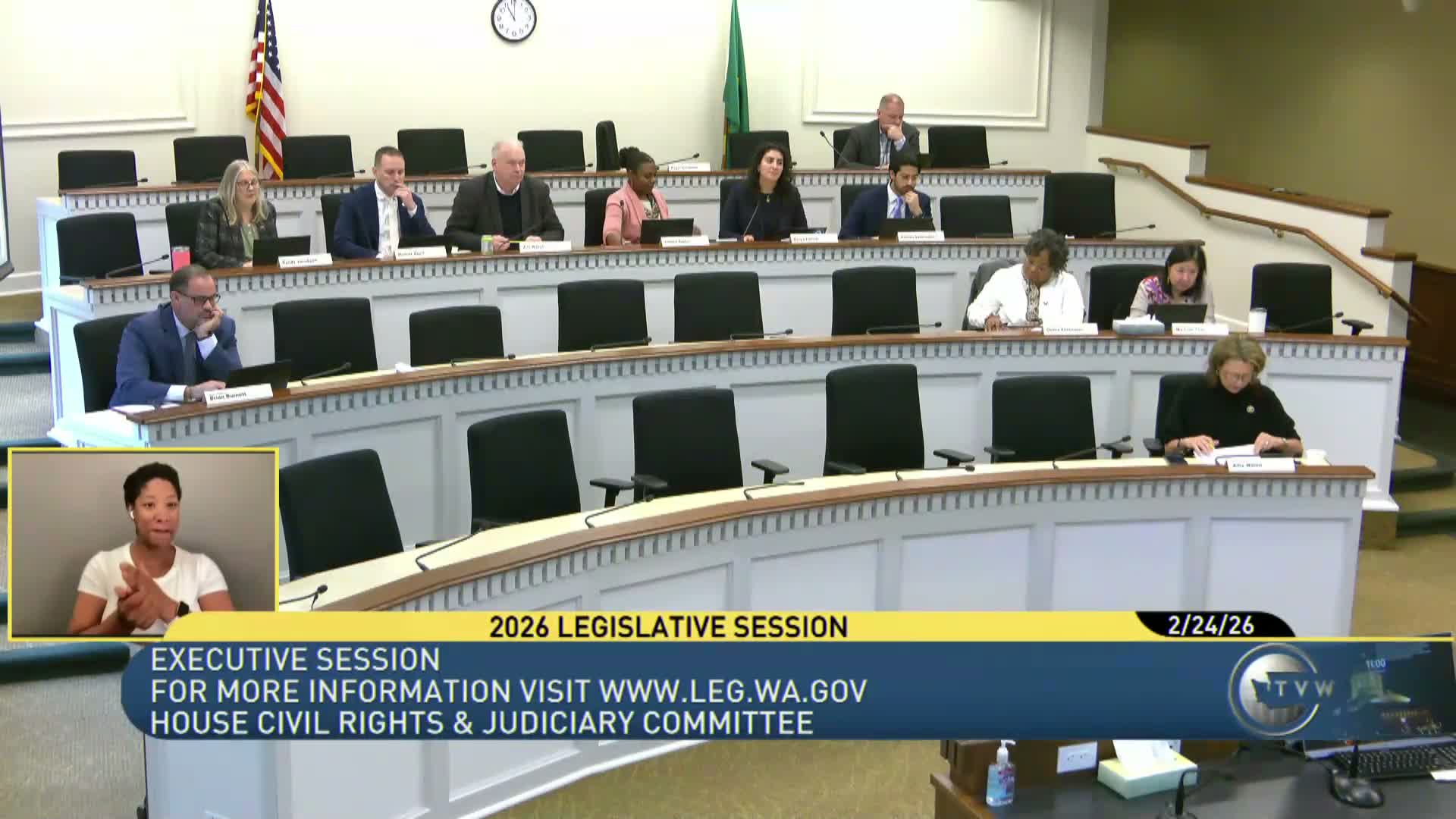
After an extended executive-session briefing and hour-plus amendment debate, the House Civil Rights and Judiciary Committee on Feb. 24 voted to report Engrossed Substitute Senate Bill 59 25 out of committee with a 'do pass as amended' recommendation by a roll call of 7 ayes, 5 nays and 1 excused.
Staff described a large amendment package that members considered one-by-one. Key amendments adopted or considered included provisions requiring the attorney general to meet and confer and give a right to cure before issuing a CID (moved but not adopted); raising the standard for issuance to clear-and-convincing evidence (moved but not adopted); requiring written, personal AG approval of each CID (moved but not adopted); prohibiting the AG's criminal-justice division from issuing CIDs (adopted); limiting CID use against federal agencies (moved but not adopted); prohibiting sharing CID materials with law-enforcement agencies for criminal investigations (moved but not adopted); fee-shifting for successful CID challenges (moved but not adopted); and an amendment authorizing county prosecutors to issue CIDs to investigate the AG (adopted).
Representative Walsh and others framed adopted amendments as necessary transparency and checks—calling for reporting, clearer standards and division safeguards. Opponents, including Representative Farber and others, argued the bill is intended as a civil investigative tool to root out violations of state constitutional and statutory rights (including labor and consumer protections), and urged keeping the issuance threshold workable so the AG can act as an effective civil-enforcement actor.
Several members warned of separation-of-powers and potential weaponization because the bill allows an executive office to issue broad investigatory demands without immediate judicial oversight; some proposed a 'striking amendment' to require judicial review by appointment of a special inquiry judge prior to issuance, but that approach failed. Representative Abel and other members repeatedly urged limiting unintended legal and fiscal consequences, while Representative Walsh led several accountability-focused amendment efforts.
After final consideration, the staff-called roll showed the bill reported out by a 7–5–1 margin. The committee’s debate and the number of narrowly decided amendment votes indicate the measure will face robust scrutiny on the House floor.
Staff described a large amendment package that members considered one-by-one. Key amendments adopted or considered included provisions requiring the attorney general to meet and confer and give a right to cure before issuing a CID (moved but not adopted); raising the standard for issuance to clear-and-convincing evidence (moved but not adopted); requiring written, personal AG approval of each CID (moved but not adopted); prohibiting the AG's criminal-justice division from issuing CIDs (adopted); limiting CID use against federal agencies (moved but not adopted); prohibiting sharing CID materials with law-enforcement agencies for criminal investigations (moved but not adopted); fee-shifting for successful CID challenges (moved but not adopted); and an amendment authorizing county prosecutors to issue CIDs to investigate the AG (adopted).
Representative Walsh and others framed adopted amendments as necessary transparency and checks—calling for reporting, clearer standards and division safeguards. Opponents, including Representative Farber and others, argued the bill is intended as a civil investigative tool to root out violations of state constitutional and statutory rights (including labor and consumer protections), and urged keeping the issuance threshold workable so the AG can act as an effective civil-enforcement actor.
Several members warned of separation-of-powers and potential weaponization because the bill allows an executive office to issue broad investigatory demands without immediate judicial oversight; some proposed a 'striking amendment' to require judicial review by appointment of a special inquiry judge prior to issuance, but that approach failed. Representative Abel and other members repeatedly urged limiting unintended legal and fiscal consequences, while Representative Walsh led several accountability-focused amendment efforts.
After final consideration, the staff-called roll showed the bill reported out by a 7–5–1 margin. The committee’s debate and the number of narrowly decided amendment votes indicate the measure will face robust scrutiny on the House floor.
View the Full Meeting & All Its Details
This article offers just a summary. Unlock complete video, transcripts, and insights as a Founder Member.
✓
Watch full, unedited meeting videos
✓
Search every word spoken in unlimited transcripts
✓
AI summaries & real-time alerts (all government levels)
✓
Permanent access to expanding government content
30-day money-back guarantee
