Committee Approves ALPR Rules After Privacy Debate, Adopts Striker Limiting Data Collection Near Schools
February 24, 2026 | Legislative Sessions, Washington
This article was created by AI summarizing key points discussed. AI makes mistakes, so for full details and context, please refer to the video of the full meeting. Please report any errors so we can fix them. Report an error »
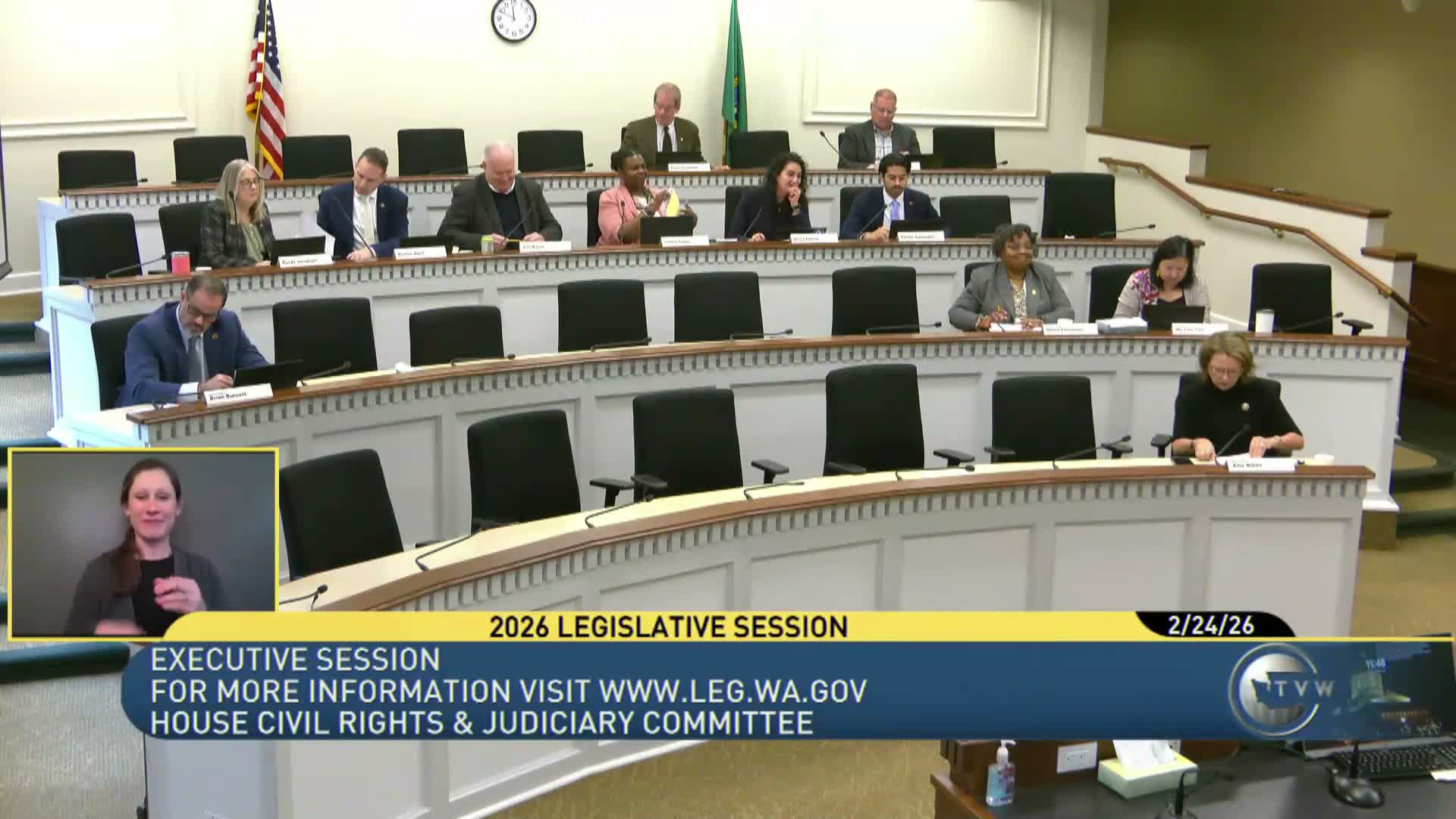
The Civil Rights and Judiciary Committee on Feb. 24 advanced Engrossed Substitute Senate Bill 6002, which sets new limits and permitted uses for automated license-plate reader (ALPR) systems in Washington. Staff summarized a striking amendment that narrows prohibited collection near elementary and secondary schools and expands definitions of facilities covered for protections (including some healthcare and immigration-related facilities). The striker also clarifies retention and deletion rules and authorizes certain uses for off-street parking enforcement, transportation safety and limited law-enforcement purposes tied to felony probable-cause warrants or subpoenas.
Representative Salahuddin, sponsor of the striker, and Representative Walsh proposed and debated line amendments to permit ALPR integration into dashboard and body-worn cameras used for law enforcement or parking enforcement and to align retention with rules of evidence where necessary. Representative Jacobson asked about the undefined term 'immediate surroundings'; staff said the bill does not define that phrase. Debaters expressed two recurring tensions: protecting privacy (preventing ALPR collection near schools/facilities and limiting retention) versus preserving ALPR utility for stolen-vehicle searches, missing-person alerts and local traffic-safety use.
The committee adopted a striking amendment (H3632.2) and considered a line amendment (H3654.1) that was not adopted; the striker was then adopted, and the committee reported the bill out by roll call, 7 ayes, 5 nays and 1 excused. Members said the bill still needs floor-level refinement on retention periods, body-worn/dash-cam integration and precise definitions of restricted areas.
Representative Salahuddin said the striker balances public-safety utility and privacy protections and that stakeholder conversations (including ACLU, local governments, vendors and law enforcement) were ongoing. Several members signaled willingness to continue bipartisan work on the language before floor action.
Representative Salahuddin, sponsor of the striker, and Representative Walsh proposed and debated line amendments to permit ALPR integration into dashboard and body-worn cameras used for law enforcement or parking enforcement and to align retention with rules of evidence where necessary. Representative Jacobson asked about the undefined term 'immediate surroundings'; staff said the bill does not define that phrase. Debaters expressed two recurring tensions: protecting privacy (preventing ALPR collection near schools/facilities and limiting retention) versus preserving ALPR utility for stolen-vehicle searches, missing-person alerts and local traffic-safety use.
The committee adopted a striking amendment (H3632.2) and considered a line amendment (H3654.1) that was not adopted; the striker was then adopted, and the committee reported the bill out by roll call, 7 ayes, 5 nays and 1 excused. Members said the bill still needs floor-level refinement on retention periods, body-worn/dash-cam integration and precise definitions of restricted areas.
Representative Salahuddin said the striker balances public-safety utility and privacy protections and that stakeholder conversations (including ACLU, local governments, vendors and law enforcement) were ongoing. Several members signaled willingness to continue bipartisan work on the language before floor action.
View the Full Meeting & All Its Details
This article offers just a summary. Unlock complete video, transcripts, and insights as a Founder Member.
✓
Watch full, unedited meeting videos
✓
Search every word spoken in unlimited transcripts
✓
AI summaries & real-time alerts (all government levels)
✓
Permanent access to expanding government content
30-day money-back guarantee
