Committee Moves Multiple Judiciary Bills Forward in One Day; Votes Recorded
February 24, 2026 | Legislative Sessions, Washington
This article was created by AI summarizing key points discussed. AI makes mistakes, so for full details and context, please refer to the video of the full meeting. Please report any errors so we can fix them. Report an error »
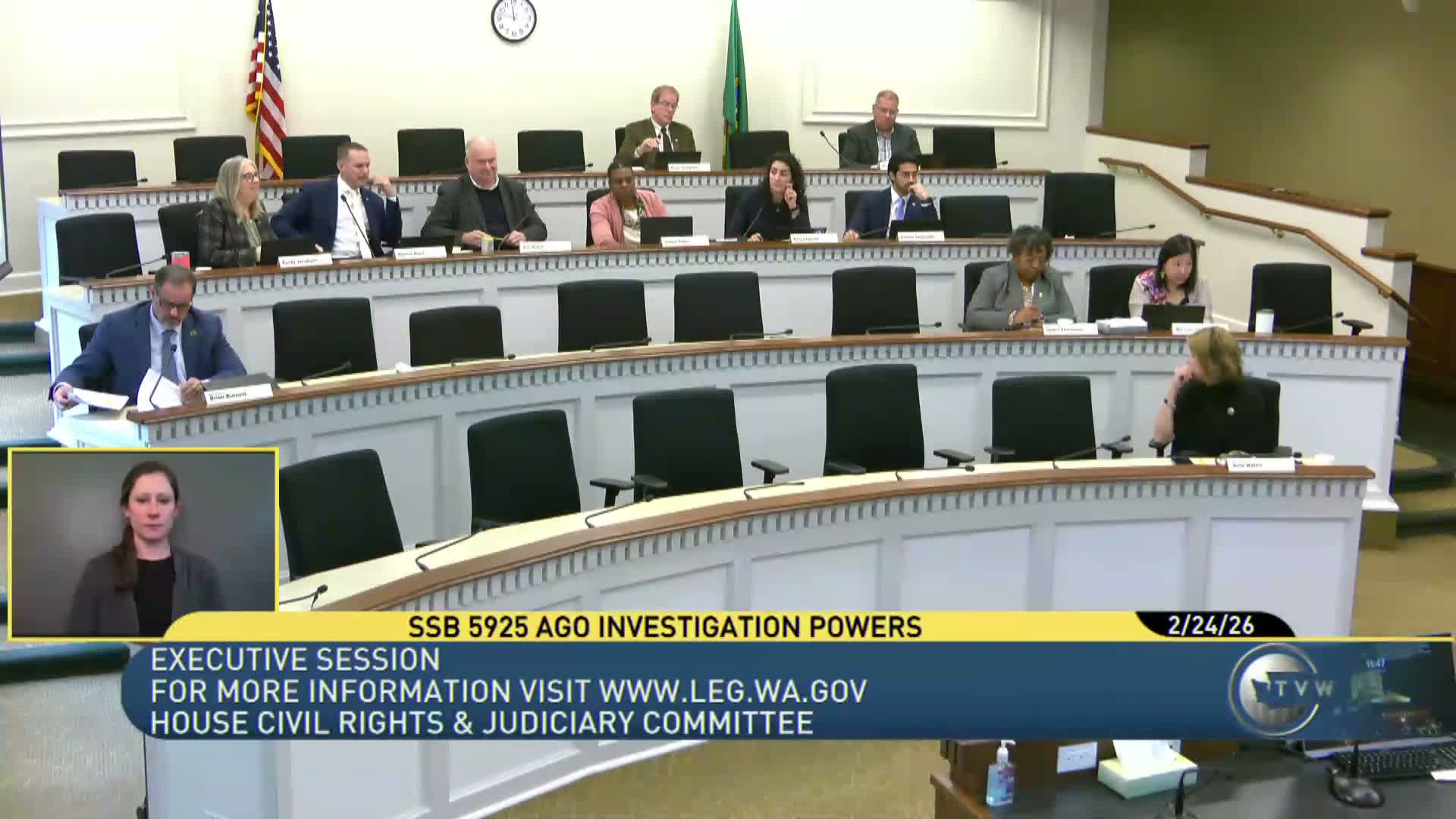
Beyond the day’s two headline items, the House Civil Rights and Judiciary Committee advanced a series of bills on Feb. 24 with committee recommendations to the floor.
Notable committee actions and outcomes recorded in the hearing included:
- Engrossed SSB 5925 (civil investigative demands): reported out as amended, roll-call 7 ayes, 5 nays, 1 excused (committee debate focused on checks, standards and sharing rules).
- Engrossed SSB 6002 (automated license-plate readers): reported out with a striking amendment, roll-call 7 ayes, 5 nays, 1 excused (privacy vs. utility debate; striker narrows collection near schools and clarifies retention).
- Engrossed SSB 5993 (medical-debt interest): committee voted to report the bill out with a due-pass recommendation (roll-call reported as 7 ayes, 5 nays, 1 excused); the bill would limit prejudgment interest on new medical debt to 1% per year in many circumstances and prohibit interest in specified situations.
- Substitute SSB 5720 (uniform consumer debt default-judgment act): reported out by voice vote (12 ayes, 0 nays, 1 excused); the bill adopts standardized procedures and notice requirements for default-judgment consumer collection cases.
- Engrossed SSB 5837 (guardianship/Uniform Guardianship Act updates): reported out (11 ayes, 1 nay, 1 excused) after limited discussion about public-counsel cost implications.
- SB 6011 (Court of Appeals bailiff threat-assessment authority): reported out by voice vote (12 ayes, 0 nays, 1 excused); bill authorizes Court of Appeals bailiffs to perform threat assessments and receive nonconviction criminal-history information for that purpose.
Committee staff and members noted these decisions were often contingent on technical cleanup and stakeholder follow-up; some members registered 'nay without recommendation' votes on bills they supported in principle but felt required more work.
Notable committee actions and outcomes recorded in the hearing included:
- Engrossed SSB 5925 (civil investigative demands): reported out as amended, roll-call 7 ayes, 5 nays, 1 excused (committee debate focused on checks, standards and sharing rules).
- Engrossed SSB 6002 (automated license-plate readers): reported out with a striking amendment, roll-call 7 ayes, 5 nays, 1 excused (privacy vs. utility debate; striker narrows collection near schools and clarifies retention).
- Engrossed SSB 5993 (medical-debt interest): committee voted to report the bill out with a due-pass recommendation (roll-call reported as 7 ayes, 5 nays, 1 excused); the bill would limit prejudgment interest on new medical debt to 1% per year in many circumstances and prohibit interest in specified situations.
- Substitute SSB 5720 (uniform consumer debt default-judgment act): reported out by voice vote (12 ayes, 0 nays, 1 excused); the bill adopts standardized procedures and notice requirements for default-judgment consumer collection cases.
- Engrossed SSB 5837 (guardianship/Uniform Guardianship Act updates): reported out (11 ayes, 1 nay, 1 excused) after limited discussion about public-counsel cost implications.
- SB 6011 (Court of Appeals bailiff threat-assessment authority): reported out by voice vote (12 ayes, 0 nays, 1 excused); bill authorizes Court of Appeals bailiffs to perform threat assessments and receive nonconviction criminal-history information for that purpose.
Committee staff and members noted these decisions were often contingent on technical cleanup and stakeholder follow-up; some members registered 'nay without recommendation' votes on bills they supported in principle but felt required more work.
View the Full Meeting & All Its Details
This article offers just a summary. Unlock complete video, transcripts, and insights as a Founder Member.
✓
Watch full, unedited meeting videos
✓
Search every word spoken in unlimited transcripts
✓
AI summaries & real-time alerts (all government levels)
✓
Permanent access to expanding government content
30-day money-back guarantee
