Republicans call proposed operating budget risky, warn cuts to schools and childcare will hit rural communities
February 24, 2026 | Legislative Sessions, Washington
This article was created by AI summarizing key points discussed. AI makes mistakes, so for full details and context, please refer to the video of the full meeting. Please report any errors so we can fix them. Report an error »
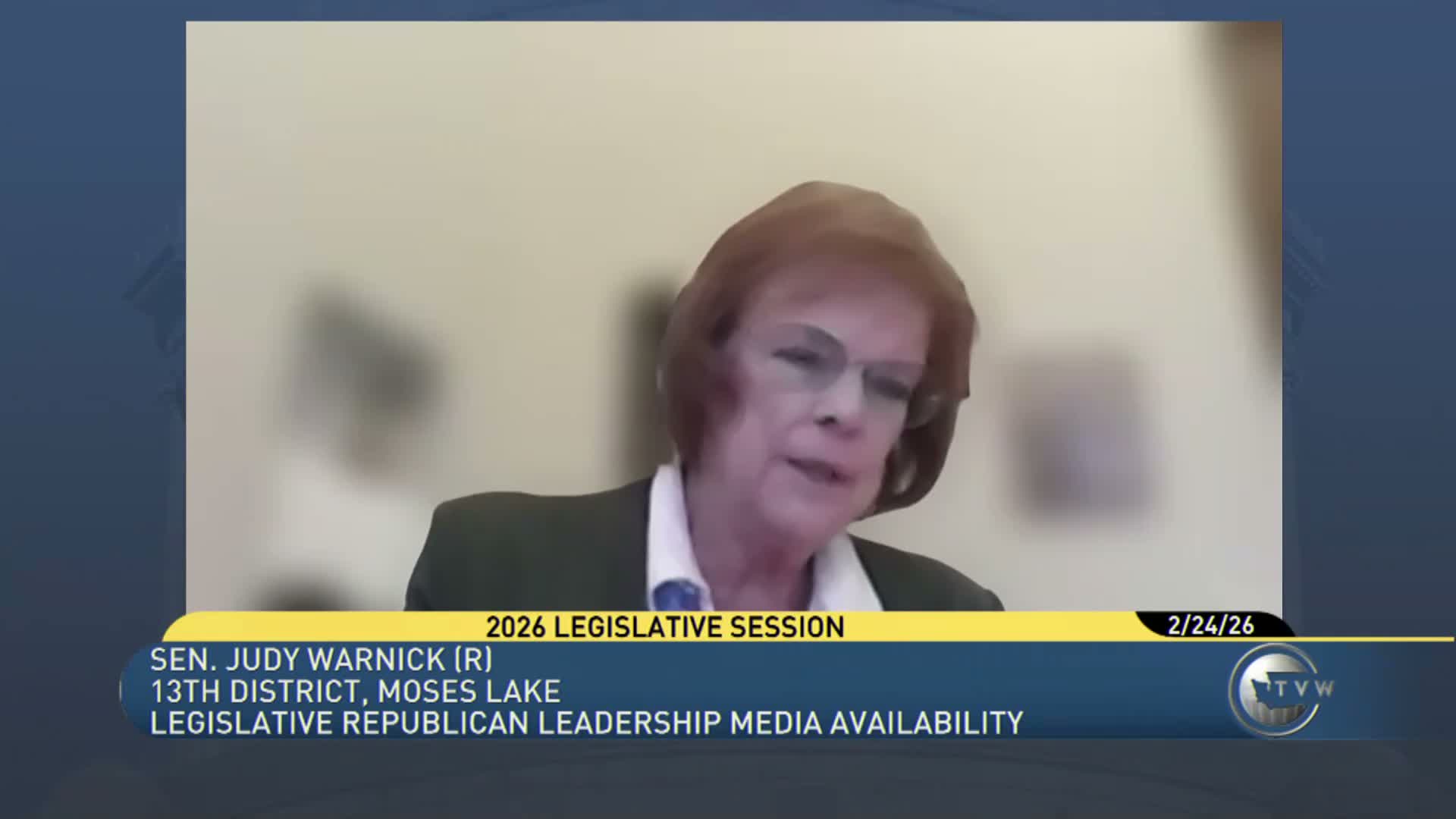
Republican leaders at a joint media availability on day 44 of the session sharply criticized the Democrats’ proposed operating budget, saying it reduces the rainy day fund and contains cuts that would harm education and childcare, especially in rural districts.
Senator Judy Warnecke said the budget has "put some extra money in, but when I hear from the people who are advocating for transitional kindergarten, TK, they're not happy," and warned that the plan draws down the rainy day fund and leaves the state with fewer reserves for future shocks.
Representative Travis Couture and other GOP leaders said the budget relies on large new revenues and short-term accounting moves. "On top of the $2,000,000,000 additional spending that both budgets essentially do," one GOP speaker said, arguing the plan assumed new income-tax revenue and used fund sweeps and other measures the caucus called "budget gimmicks." Republicans also listed a proposed $1,000,000,000 cut to Medicaid in the biennium as alarming and said cuts to transitional kindergarten, running start and other education programs would disproportionately harm property-poor districts.
On childcare, Republicans criticized changes to the Working Connections child-care program that would tie payments more closely to attendance. They acknowledged attendance-based payments could address alleged overpayments to some providers and said they had pursued amendments to let the Department of Children, Youth, and Families (DCYF) use electronic monitoring to verify attendance — but warned that embedding attendance changes in a package of other cuts would damage access in rural counties.
"If you have this regulatory regime that is nearly impossible to run, and then you strip away all the subsidies, what you get is less child care, for families that need the dollars the most," a GOP speaker said, arguing that without broader regulatory reform the cuts would deepen childcare deserts in counties such as Benton, Walla Walla and Clark.
Republicans also warned that the budget’s pattern of cuts and taxes, taken together, would make the state less affordable and saddle future legislatures with unsustainable obligations. They said they will continue to press amendments and to contest provisions in the coming weeks.
Senator Judy Warnecke said the budget has "put some extra money in, but when I hear from the people who are advocating for transitional kindergarten, TK, they're not happy," and warned that the plan draws down the rainy day fund and leaves the state with fewer reserves for future shocks.
Representative Travis Couture and other GOP leaders said the budget relies on large new revenues and short-term accounting moves. "On top of the $2,000,000,000 additional spending that both budgets essentially do," one GOP speaker said, arguing the plan assumed new income-tax revenue and used fund sweeps and other measures the caucus called "budget gimmicks." Republicans also listed a proposed $1,000,000,000 cut to Medicaid in the biennium as alarming and said cuts to transitional kindergarten, running start and other education programs would disproportionately harm property-poor districts.
On childcare, Republicans criticized changes to the Working Connections child-care program that would tie payments more closely to attendance. They acknowledged attendance-based payments could address alleged overpayments to some providers and said they had pursued amendments to let the Department of Children, Youth, and Families (DCYF) use electronic monitoring to verify attendance — but warned that embedding attendance changes in a package of other cuts would damage access in rural counties.
"If you have this regulatory regime that is nearly impossible to run, and then you strip away all the subsidies, what you get is less child care, for families that need the dollars the most," a GOP speaker said, arguing that without broader regulatory reform the cuts would deepen childcare deserts in counties such as Benton, Walla Walla and Clark.
Republicans also warned that the budget’s pattern of cuts and taxes, taken together, would make the state less affordable and saddle future legislatures with unsustainable obligations. They said they will continue to press amendments and to contest provisions in the coming weeks.
Don't Miss a Word: See the Full Meeting!
Go beyond summaries. Unlock every video, transcript, and key insight with a Founder Membership.
✓
Get instant access to full meeting videos
✓
Search and clip any phrase from complete transcripts
✓
Receive AI-powered summaries & custom alerts
✓
Enjoy lifetime, unrestricted access to government data
30-day money-back guarantee
