Commission tables front-porch restoration at 414 Clay Street, approves rear-porch, windows, door and foundation repairs
February 23, 2026 | Lynchburg, Campbell County, Virginia
This article was created by AI summarizing key points discussed. AI makes mistakes, so for full details and context, please refer to the video of the full meeting. Please report any errors so we can fix them. Report an error »
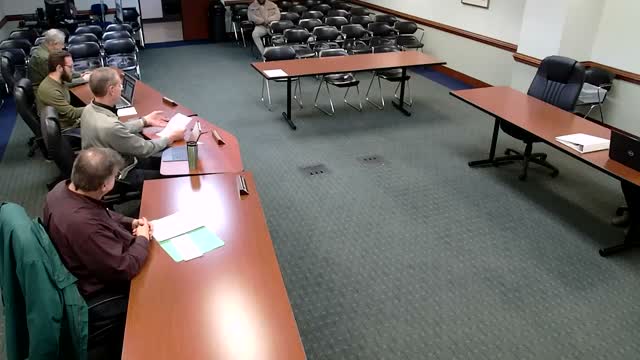
The Historic Preservation Commission split the application from the owners of 414 Clay Street, approving several rear- and rear-facing repairs while tabling the more complex front-porch restoration until architects can advise.
Applicant Jacqueline Junior Linus presented multiple requests for the property, saying the original front porch had been "literally falling apart" and that some original elements were removed before staff review. Commissioners reviewed historic and recent photos and discussed restoring the defining porch entablature and pilasters. Several commissioners recommended recreating lost features rather than retaining the plain temporary elements now on the house; because the work requires detailed dimensional and design input, the commission voted to table the front-porch restoration (item 1) until its architects can attend a future meeting.
For the rear porch (item 2) — which includes replacement of stairs, railing, ceiling and a new double door — commissioners approved the proposal but emphasized safety: the replacement railing must meet current code and prioritize 4-inch maximum picket spacing rather than replicate a non-original railing. On the basement windows (item 3), the commission approved restoring and reinstalling two original windows that had become water-damaged rather than replacing them. The commission also approved resizing a larger non-original rear window (item 4) to a smaller, more proportional opening, and approved replacing the front door slab with one of the two presented options (item 5), with a preference expressed for clear glass.
Finally, commissioners approved narrowly scoped repairs to deteriorated stucco on the front-porch foundation (item 6), specifying that exposed brick and stone should be left unpainted where intact and that stucco be repaired only where it already exists. Staff (Eve) will prepare the written approvals and outline which elements may proceed and which remain pending further review.
Commissioners reminded the applicant that demolition of historic fabric prior to explicit approval complicates restoration and that reconstructing lost features generally requires careful documentation and design input from architects.
Applicant Jacqueline Junior Linus presented multiple requests for the property, saying the original front porch had been "literally falling apart" and that some original elements were removed before staff review. Commissioners reviewed historic and recent photos and discussed restoring the defining porch entablature and pilasters. Several commissioners recommended recreating lost features rather than retaining the plain temporary elements now on the house; because the work requires detailed dimensional and design input, the commission voted to table the front-porch restoration (item 1) until its architects can attend a future meeting.
For the rear porch (item 2) — which includes replacement of stairs, railing, ceiling and a new double door — commissioners approved the proposal but emphasized safety: the replacement railing must meet current code and prioritize 4-inch maximum picket spacing rather than replicate a non-original railing. On the basement windows (item 3), the commission approved restoring and reinstalling two original windows that had become water-damaged rather than replacing them. The commission also approved resizing a larger non-original rear window (item 4) to a smaller, more proportional opening, and approved replacing the front door slab with one of the two presented options (item 5), with a preference expressed for clear glass.
Finally, commissioners approved narrowly scoped repairs to deteriorated stucco on the front-porch foundation (item 6), specifying that exposed brick and stone should be left unpainted where intact and that stucco be repaired only where it already exists. Staff (Eve) will prepare the written approvals and outline which elements may proceed and which remain pending further review.
Commissioners reminded the applicant that demolition of historic fabric prior to explicit approval complicates restoration and that reconstructing lost features generally requires careful documentation and design input from architects.
Don't Miss a Word: See the Full Meeting!
Go beyond summaries. Unlock every video, transcript, and key insight with a Founder Membership.
✓
Get instant access to full meeting videos
✓
Search and clip any phrase from complete transcripts
✓
Receive AI-powered summaries & custom alerts
✓
Enjoy lifetime, unrestricted access to government data
30-day money-back guarantee
