Council approves MR‑5 rezoning at 2211 Rose Hill Road amid resident objections over traffic and flooding
February 24, 2026 | Fayetteville City, Cumberland County, North Carolina
This article was created by AI summarizing key points discussed. AI makes mistakes, so for full details and context, please refer to the video of the full meeting. Please report any errors so we can fix them. Report an error »
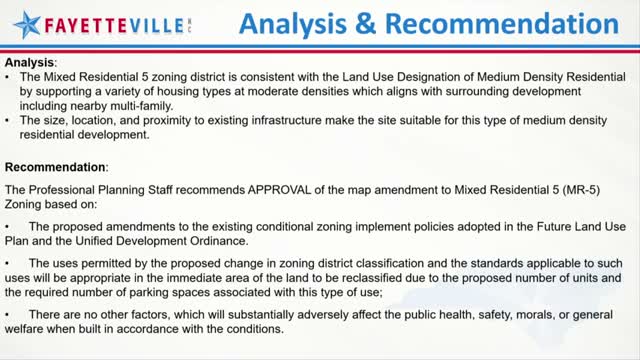
The Fayetteville City Council voted Feb. 23 to rezone 2211 Rose Hill Road from single‑family SF‑6 to mixed residential MR‑5, overturning the Planning Commission’s earlier denial and following a lengthy public hearing with substantial resident opposition.
Attorney Jonathan Charleston, representing the applicant, told council the proposal would use roughly 5 acres of Rose Hill frontage for five apartment buildings while leaving about 17 acres in the rear undisturbed because of challenging topography and floodplain constraints. "We believe that by leaving that property in this natural state, 17 acres of it, will not impact and dump water on the folks that live behind it," Charleston said.
Residents from the surrounding neighborhoods urged denial, citing a history of speeding and traffic fatalities on Rose Hill Road, recurring backyard flooding and concerns the developer could later expand into the rear acreage. Longtime resident Elmer Floyd said the rezoning would "change the character of the neighborhood" and raised safety concerns for families and students.
Planning staff noted the land‑use plan designates medium density residential for the corridor; staff recommended approval, while the Planning Commission had denied the request citing safety concerns after hearing opposition. Councilmembers debated traffic, setbacks and whether conditional rezoning or technical review should limit future development. The council ultimately approved the straight rezoning by majority vote after finding the amendment consistent with the city's future land‑use plan, and council recorded a formal consistency statement with the action.
Technical site plan review, stormwater and traffic engineering remain required before any construction permits could be issued. Because the rezoning was a straight map amendment, approval does not legally bind the developer to limit development to the five front buildings; any site work must comply with the city’s Unified Development Ordinance and technical review committee processes.
Attorney Jonathan Charleston, representing the applicant, told council the proposal would use roughly 5 acres of Rose Hill frontage for five apartment buildings while leaving about 17 acres in the rear undisturbed because of challenging topography and floodplain constraints. "We believe that by leaving that property in this natural state, 17 acres of it, will not impact and dump water on the folks that live behind it," Charleston said.
Residents from the surrounding neighborhoods urged denial, citing a history of speeding and traffic fatalities on Rose Hill Road, recurring backyard flooding and concerns the developer could later expand into the rear acreage. Longtime resident Elmer Floyd said the rezoning would "change the character of the neighborhood" and raised safety concerns for families and students.
Planning staff noted the land‑use plan designates medium density residential for the corridor; staff recommended approval, while the Planning Commission had denied the request citing safety concerns after hearing opposition. Councilmembers debated traffic, setbacks and whether conditional rezoning or technical review should limit future development. The council ultimately approved the straight rezoning by majority vote after finding the amendment consistent with the city's future land‑use plan, and council recorded a formal consistency statement with the action.
Technical site plan review, stormwater and traffic engineering remain required before any construction permits could be issued. Because the rezoning was a straight map amendment, approval does not legally bind the developer to limit development to the five front buildings; any site work must comply with the city’s Unified Development Ordinance and technical review committee processes.
View the Full Meeting & All Its Details
This article offers just a summary. Unlock complete video, transcripts, and insights as a Founder Member.
✓
Watch full, unedited meeting videos
✓
Search every word spoken in unlimited transcripts
✓
AI summaries & real-time alerts (all government levels)
✓
Permanent access to expanding government content
30-day money-back guarantee
