Johnson County commissioners urge residents to oppose Indiana bill HB 1001, say it removes local zoning control
February 23, 2026 | Johnson County, Indiana
This article was created by AI summarizing key points discussed. AI makes mistakes, so for full details and context, please refer to the video of the full meeting. Please report any errors so we can fix them. Report an error »
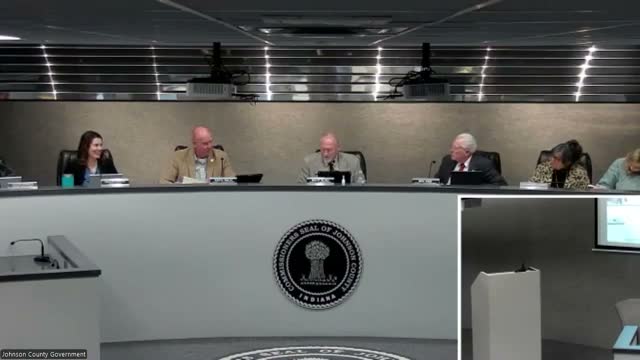
Speaker 1 delivered an extended public statement at the Feb. 23 meeting of the Board of Johnson County Commissioners urging residents to oppose Indiana House Bill 1001, which he said would substantially limit local governments' authority over planning and zoning. "HB 1001 removes the ability to maintain oversight and regulate design elements, including the number of rooms, setbacks, parking spaces, personal density, and square footage of residential structures," Speaker 1 said, adding that the change would affect septic systems, stormwater, traffic and county services.
Speaker 1 said the measure had passed out of the Indiana Senate Judiciary Committee on Feb. 18, 2026, and described it as an attempt to impose a "one-size-fits-all" zoning mandate. "Nothing in HB 1001 seeks to reduce interest rates for buyers," he said, "and it does not mandate any savings from removing local fees to be passed on to home buyers." He argued that counties and municipalities had spent significant time and money creating master plans tailored to local communities, and that the bill would render those efforts "no avail."
Speaker 2, who spoke after Speaker 1, said he concurred "100% with Commissioner Baird" and called on residents to consider local representation when voting: "If they're not gonna go to the state house and represent us fairly and equitably, then we need to give that serious consideration." Speaker 4 also urged residents to contact their local representatives and stressed that local investment could be put at risk by the legislation.
The meeting noted Representative Craig Haggard had voted against the bill in the House, and that Senators Bray and Walker had not recorded a vote at the time of the meeting. No formal county resolution on the bill was recorded during the session; speakers framed their remarks as a call to public engagement and advocacy rather than a formal action taken by the board.
How this matters: county speakers argued HB 1001 would curtail local control over development standards and local permitting, with potential impacts on public health issues such as septic-system oversight. Board members encouraged constituents to contact state lawmakers ahead of further legislative action.
Next step: Speakers asked residents and local officials to reach out to their state representatives and senators; no vote or formal county-level ordinance on the matter was taken at the meeting.
Speaker 1 said the measure had passed out of the Indiana Senate Judiciary Committee on Feb. 18, 2026, and described it as an attempt to impose a "one-size-fits-all" zoning mandate. "Nothing in HB 1001 seeks to reduce interest rates for buyers," he said, "and it does not mandate any savings from removing local fees to be passed on to home buyers." He argued that counties and municipalities had spent significant time and money creating master plans tailored to local communities, and that the bill would render those efforts "no avail."
Speaker 2, who spoke after Speaker 1, said he concurred "100% with Commissioner Baird" and called on residents to consider local representation when voting: "If they're not gonna go to the state house and represent us fairly and equitably, then we need to give that serious consideration." Speaker 4 also urged residents to contact their local representatives and stressed that local investment could be put at risk by the legislation.
The meeting noted Representative Craig Haggard had voted against the bill in the House, and that Senators Bray and Walker had not recorded a vote at the time of the meeting. No formal county resolution on the bill was recorded during the session; speakers framed their remarks as a call to public engagement and advocacy rather than a formal action taken by the board.
How this matters: county speakers argued HB 1001 would curtail local control over development standards and local permitting, with potential impacts on public health issues such as septic-system oversight. Board members encouraged constituents to contact state lawmakers ahead of further legislative action.
Next step: Speakers asked residents and local officials to reach out to their state representatives and senators; no vote or formal county-level ordinance on the matter was taken at the meeting.
Don't Miss a Word: See the Full Meeting!
Go beyond summaries. Unlock every video, transcript, and key insight with a Founder Membership.
✓
Get instant access to full meeting videos
✓
Search and clip any phrase from complete transcripts
✓
Receive AI-powered summaries & custom alerts
✓
Enjoy lifetime, unrestricted access to government data
30-day money-back guarantee
