Committee restores legislative oversight of state liabilities, limits meeting frequency
February 25, 2026 | Budget and Fiscal Affairs Oversight, HOUSE OF REPRESENTATIVES, Committees, Legislative, Georgia
This article was created by AI summarizing key points discussed. AI makes mistakes, so for full details and context, please refer to the video of the full meeting. Please report any errors so we can fix them. Report an error »
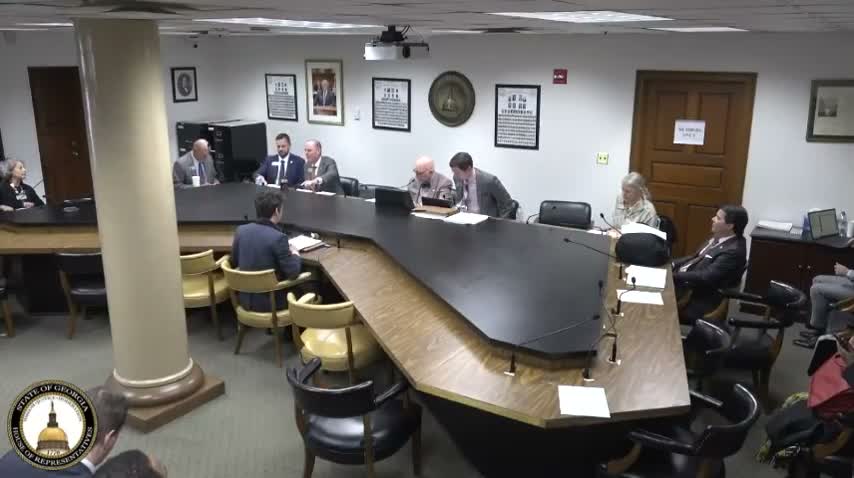
House panel votes to restore oversight of state-funded entities and limit meeting burden.
The House Committee on Budget and Fiscal Affairs Oversight on Wednesday voted to give the panel renewed authority to review state liabilities and to tighten how and when the committee may carry out audits. Representative Horner introduced House Bill 1178 (LC590374S), saying the measure ``puts, as previously under code section, it puts it right back into code section'' and restores language the sponsor said had been removed from law.
Horner told the committee the bill includes three amendments adopted in response to members' concerns: it replaces a mandatory meeting requirement with discretion so the committee ``may meet up to 9 times per year,'' it makes audits and necessary funds ``subject to the approval of the Speaker of the House of Representatives,'' and it clarifies committee-chair discretion for hearings. Horner said the changes were intended to retain legislative oversight while avoiding unfunded or excessive activity by the committee.
Members pressed the sponsor on scope; Representative Gamble asked whether ``liabilities'' meant financial liabilities tied to the state budget, and Horner replied: ``Correct. Just liabilities are tied to our budget and our our fiscal responsibilities.'' Several members sought and received assurance the bill applies to entities that receive state funding rather than to purely local spending decisions.
After discussion the chair called for a motion. A "do pass" motion was made and seconded; the committee voted in favor and the chair said the vote was unanimous. The committee record does not include a roll-call tally in the transcript.
What happens next: With committee approval the bill is positioned to move to the next step in the House process; committee members said they would continue to monitor implementation and any audit costs tied to the measure.
The House Committee on Budget and Fiscal Affairs Oversight on Wednesday voted to give the panel renewed authority to review state liabilities and to tighten how and when the committee may carry out audits. Representative Horner introduced House Bill 1178 (LC590374S), saying the measure ``puts, as previously under code section, it puts it right back into code section'' and restores language the sponsor said had been removed from law.
Horner told the committee the bill includes three amendments adopted in response to members' concerns: it replaces a mandatory meeting requirement with discretion so the committee ``may meet up to 9 times per year,'' it makes audits and necessary funds ``subject to the approval of the Speaker of the House of Representatives,'' and it clarifies committee-chair discretion for hearings. Horner said the changes were intended to retain legislative oversight while avoiding unfunded or excessive activity by the committee.
Members pressed the sponsor on scope; Representative Gamble asked whether ``liabilities'' meant financial liabilities tied to the state budget, and Horner replied: ``Correct. Just liabilities are tied to our budget and our our fiscal responsibilities.'' Several members sought and received assurance the bill applies to entities that receive state funding rather than to purely local spending decisions.
After discussion the chair called for a motion. A "do pass" motion was made and seconded; the committee voted in favor and the chair said the vote was unanimous. The committee record does not include a roll-call tally in the transcript.
What happens next: With committee approval the bill is positioned to move to the next step in the House process; committee members said they would continue to monitor implementation and any audit costs tied to the measure.
Don't Miss a Word: See the Full Meeting!
Go beyond summaries. Unlock every video, transcript, and key insight with a Founder Membership.
✓
Get instant access to full meeting videos
✓
Search and clip any phrase from complete transcripts
✓
Receive AI-powered summaries & custom alerts
✓
Enjoy lifetime, unrestricted access to government data
30-day money-back guarantee
