Committee hears split testimony on bill allowing limited EV direct sales and raising documentary fee
February 24, 2026 | Legislative Sessions, Washington
This article was created by AI summarizing key points discussed. AI makes mistakes, so for full details and context, please refer to the video of the full meeting. Please report any errors so we can fix them. Report an error »
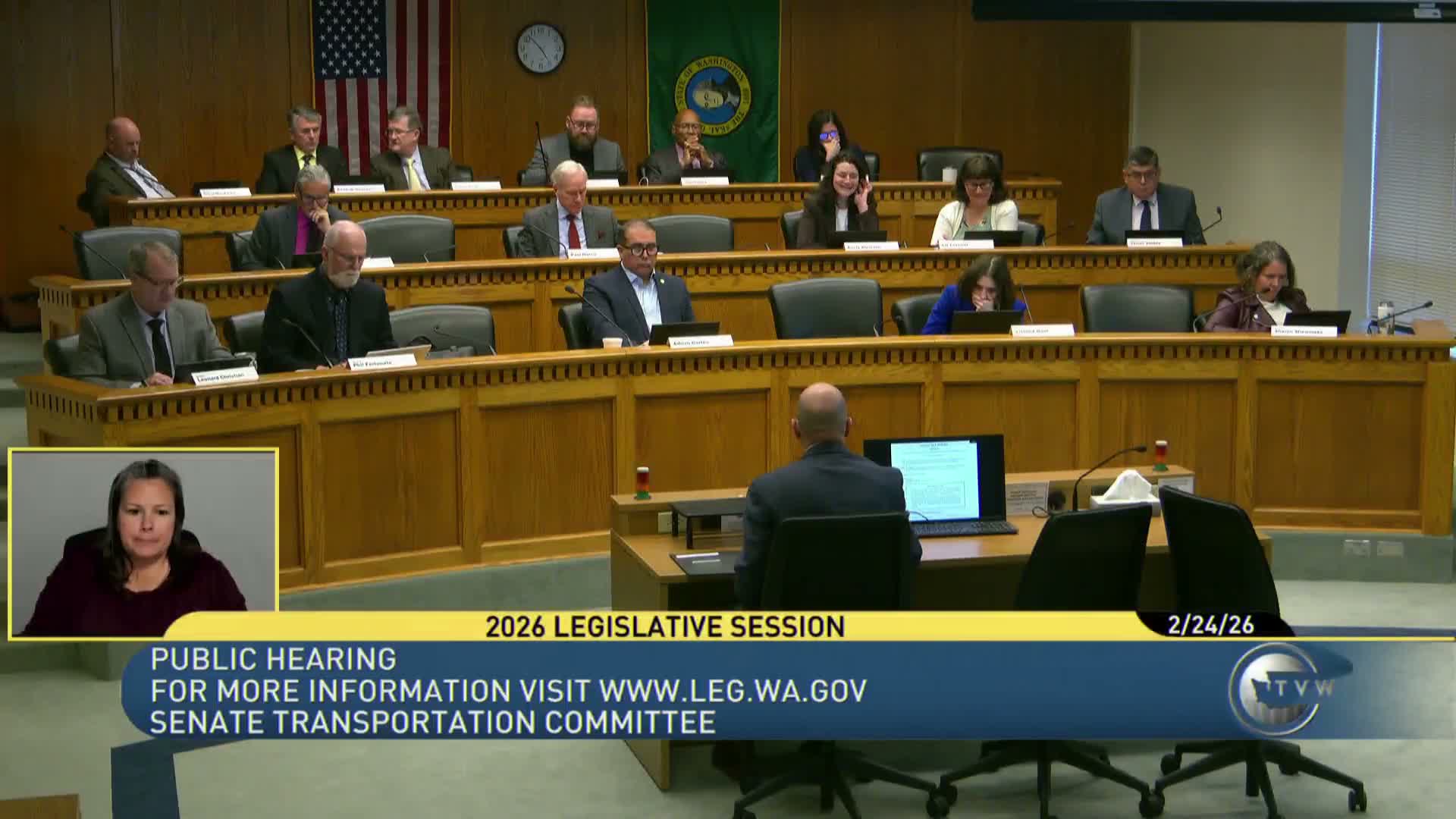
The Senate Transportation Committee received hours of public testimony on SB 6,354, a bill that would amend Washington’s vehicle franchise law to allow qualifying, U.S.-incorporated, battery-electric-vehicle-only manufacturers that meet registration and service thresholds to obtain vehicle dealer licenses and sell directly in the state.
Brandon Popovac, committee staff, summarized the bill’s eligibility criteria: a qualifying manufacturer must be incorporated in the United States, have never entered into a franchise agreement with a motor vehicle dealer, have operated at least one in‑state service facility as of Jan. 1, 2026, and have at least 300 battery-electric vehicles registered in Washington by that date. Popovac said the bill would require qualifying manufacturers to apply for and maintain a dealer license and permits the Department of Licensing to revoke the license if eligibility criteria are no longer met. He also described an increase in the documentary service fee from $200 to $250 until Dec. 31, 2036, with 50% of the $50 increase apportioned between two accounts (25% to the electric vehicle account for instant rebates to households at or below 300% of the federal poverty level, and 75% to the multimodal transportation account); the fee would fall to $225 on Jan. 1, 2037. His preliminary apportioned revenue estimate for the fee increase was approximately $22,500,000 per year.
Climate advocates and EV manufacturers backed the bill as an electrification measure. Leah Missick (Climate Solutions) said independent research estimates direct sales by EV manufacturers could raise zero‑emission vehicle adoption by as much as 13% by 2030 and urged directing at least half of the fee increase to instant rebates for low‑income buyers. Abigail Ramsden (Rivian) and Daniel Witt (Lucid) testified that the bill provides a clear regulatory path for EV‑only manufacturers and would allow them to operate within a licensing framework.
Dealers and traditional automakers expressed mixed views. The Washington State Auto Dealers Association and many franchised‑dealer owners described the bill as a negotiated compromise that preserves consumer protections and requires dealer licensure for qualifying manufacturers; several dealer witnesses said the approach balances new market entrants and community dealer interests. By contrast, the Alliance for Automotive Innovation and American Honda registered opposition, arguing the bill would create two rules for competitors, erode the franchise system, and that major automakers were not part of the negotiations.
No final action was taken on SB 6,354 during the hearing; the committee closed the public testimony and staff said the bill’s executive timing will be set later. Several witnesses were asked to submit written testimony.
Brandon Popovac, committee staff, summarized the bill’s eligibility criteria: a qualifying manufacturer must be incorporated in the United States, have never entered into a franchise agreement with a motor vehicle dealer, have operated at least one in‑state service facility as of Jan. 1, 2026, and have at least 300 battery-electric vehicles registered in Washington by that date. Popovac said the bill would require qualifying manufacturers to apply for and maintain a dealer license and permits the Department of Licensing to revoke the license if eligibility criteria are no longer met. He also described an increase in the documentary service fee from $200 to $250 until Dec. 31, 2036, with 50% of the $50 increase apportioned between two accounts (25% to the electric vehicle account for instant rebates to households at or below 300% of the federal poverty level, and 75% to the multimodal transportation account); the fee would fall to $225 on Jan. 1, 2037. His preliminary apportioned revenue estimate for the fee increase was approximately $22,500,000 per year.
Climate advocates and EV manufacturers backed the bill as an electrification measure. Leah Missick (Climate Solutions) said independent research estimates direct sales by EV manufacturers could raise zero‑emission vehicle adoption by as much as 13% by 2030 and urged directing at least half of the fee increase to instant rebates for low‑income buyers. Abigail Ramsden (Rivian) and Daniel Witt (Lucid) testified that the bill provides a clear regulatory path for EV‑only manufacturers and would allow them to operate within a licensing framework.
Dealers and traditional automakers expressed mixed views. The Washington State Auto Dealers Association and many franchised‑dealer owners described the bill as a negotiated compromise that preserves consumer protections and requires dealer licensure for qualifying manufacturers; several dealer witnesses said the approach balances new market entrants and community dealer interests. By contrast, the Alliance for Automotive Innovation and American Honda registered opposition, arguing the bill would create two rules for competitors, erode the franchise system, and that major automakers were not part of the negotiations.
No final action was taken on SB 6,354 during the hearing; the committee closed the public testimony and staff said the bill’s executive timing will be set later. Several witnesses were asked to submit written testimony.
View the Full Meeting & All Its Details
This article offers just a summary. Unlock complete video, transcripts, and insights as a Founder Member.
✓
Watch full, unedited meeting videos
✓
Search every word spoken in unlimited transcripts
✓
AI summaries & real-time alerts (all government levels)
✓
Permanent access to expanding government content
30-day money-back guarantee
