Committee hears support for bill allowing voluntary relinquishment of medical licenses
February 24, 2026 | Legislative Sessions, Washington
This article was created by AI summarizing key points discussed. AI makes mistakes, so for full details and context, please refer to the video of the full meeting. Please report any errors so we can fix them. Report an error »
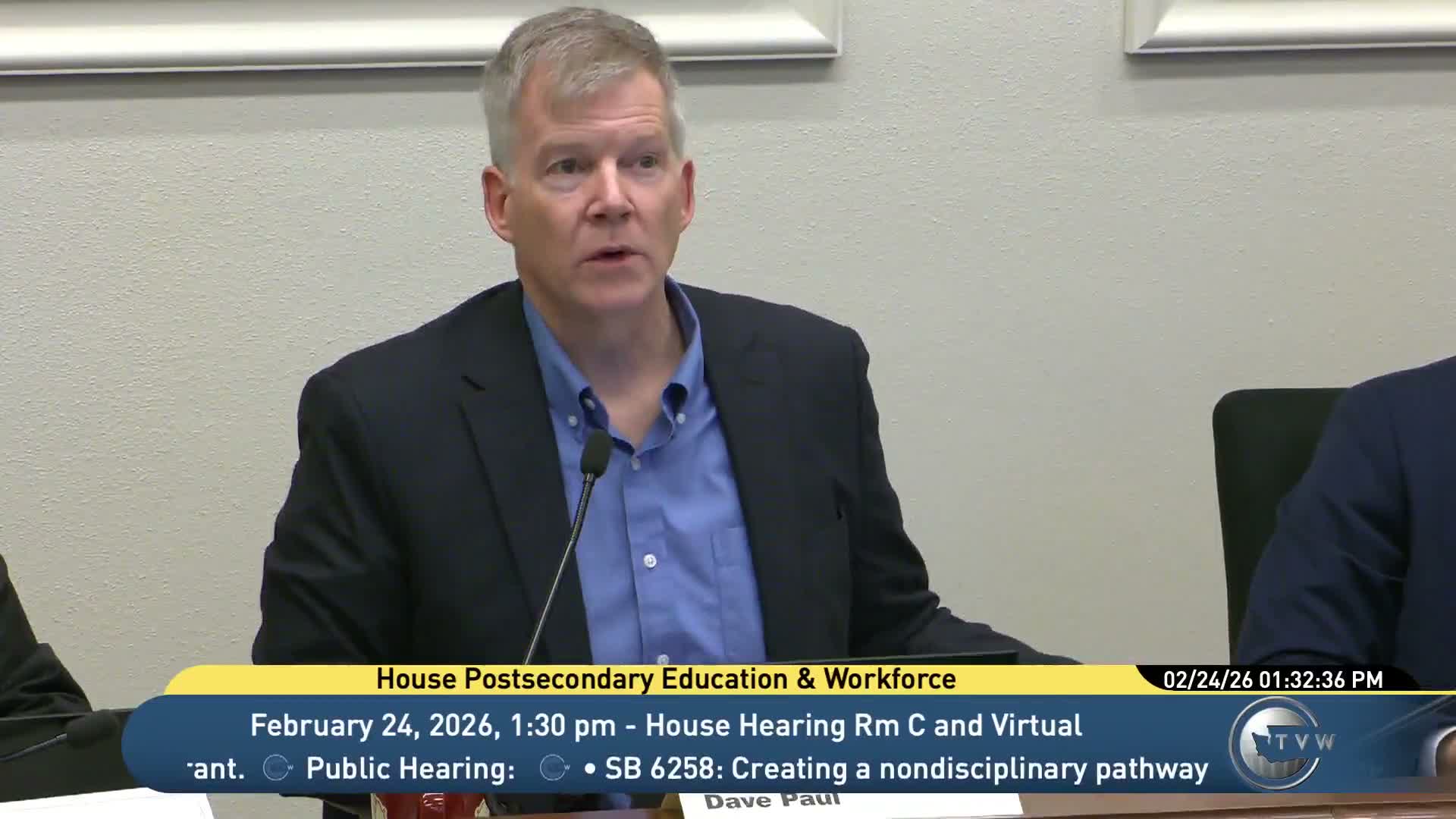
The House Postsecondary Education & Workforce Committee on Feb. 24 heard a staff briefing and two expert testimonies in support of Senate Bill 6,258, which would let the Washington Medical Commission conduct rulemaking to permit voluntary relinquishment of licenses for physicians and other licensees.
Saranda Ross, staff to the committee, told lawmakers that the Washington Medical Commission issues licenses for physicians and related professions and that SB 6,258 "authorizes the commission to conduct rulemaking to allow for the voluntary relinquishment of licenses issued by the commission." Ross said relinquishment "is not considered an adverse action and as such is not reportable to any disciplinary database" and that the process would be permanent.
Senator Ron Mazzall, sponsor of the bill in the Senate, said the measure fills a gap in current law by creating a non‑disciplinary path for professionals who wish to give up a license without entering a disciplinary agreement. "This piece of legislation just allows them to create that path so that a professional can relinquish their licence," Mazzall said.
Fatima Merza, identified herself as staff with the Washington Medical Commission, testified the current practice often requires a quasi‑disciplinary agreement to effect a voluntary exit and that mandatory reporting to national data banks can stigmatize providers even when no misconduct occurred. "By placing this process outside of the disciplinary framework, the legislation takes a more human centered approach to license relinquishment while maintaining patient safety," Merza said, describing the bill as creating a "graceful exit." She emphasized that practitioners under investigation, discipline or compliance oversight would not be eligible for the non‑disciplinary pathway.
Chris Bundy, executive medical director of the Washington Physicians Health Program, described the program’s role as a confidential, non‑disciplinary alternative for clinicians with health conditions that can impair practice. Bundy argued relinquishment gives clinicians who can no longer practice (for example because of cognitive decline) a respectful option to leave the profession without being funneled into discipline. "This allows us to provide a dignified, respectful, exit from the profession that honors a medical professional's contribution," he said.
Committee members asked how relinquishment differs from letting a license expire and what oversight remains if a clinician later seeks to reactivate a license; Ross and Merza said that the commission remains responsible for expired licenses and that the relinquishment pathway would enable a more thorough review if someone reapplies.
The committee concluded the public hearing on SB 6,258 and announced plans to executive the bill the following day. Lawmakers were asked to submit amendment requests to staff by 6:00 p.m. the same day so any amendments could be drafted and posted prior to executive action.
The staff briefing, testimonies and committee discussion were recorded in the committee transcript and broadcast on TVW. The committee did not take a final vote on SB 6,258 during the Feb. 24 public hearing; the next procedural step is the executive session scheduled by the committee.
Saranda Ross, staff to the committee, told lawmakers that the Washington Medical Commission issues licenses for physicians and related professions and that SB 6,258 "authorizes the commission to conduct rulemaking to allow for the voluntary relinquishment of licenses issued by the commission." Ross said relinquishment "is not considered an adverse action and as such is not reportable to any disciplinary database" and that the process would be permanent.
Senator Ron Mazzall, sponsor of the bill in the Senate, said the measure fills a gap in current law by creating a non‑disciplinary path for professionals who wish to give up a license without entering a disciplinary agreement. "This piece of legislation just allows them to create that path so that a professional can relinquish their licence," Mazzall said.
Fatima Merza, identified herself as staff with the Washington Medical Commission, testified the current practice often requires a quasi‑disciplinary agreement to effect a voluntary exit and that mandatory reporting to national data banks can stigmatize providers even when no misconduct occurred. "By placing this process outside of the disciplinary framework, the legislation takes a more human centered approach to license relinquishment while maintaining patient safety," Merza said, describing the bill as creating a "graceful exit." She emphasized that practitioners under investigation, discipline or compliance oversight would not be eligible for the non‑disciplinary pathway.
Chris Bundy, executive medical director of the Washington Physicians Health Program, described the program’s role as a confidential, non‑disciplinary alternative for clinicians with health conditions that can impair practice. Bundy argued relinquishment gives clinicians who can no longer practice (for example because of cognitive decline) a respectful option to leave the profession without being funneled into discipline. "This allows us to provide a dignified, respectful, exit from the profession that honors a medical professional's contribution," he said.
Committee members asked how relinquishment differs from letting a license expire and what oversight remains if a clinician later seeks to reactivate a license; Ross and Merza said that the commission remains responsible for expired licenses and that the relinquishment pathway would enable a more thorough review if someone reapplies.
The committee concluded the public hearing on SB 6,258 and announced plans to executive the bill the following day. Lawmakers were asked to submit amendment requests to staff by 6:00 p.m. the same day so any amendments could be drafted and posted prior to executive action.
The staff briefing, testimonies and committee discussion were recorded in the committee transcript and broadcast on TVW. The committee did not take a final vote on SB 6,258 during the Feb. 24 public hearing; the next procedural step is the executive session scheduled by the committee.
Don't Miss a Word: See the Full Meeting!
Go beyond summaries. Unlock every video, transcript, and key insight with a Founder Membership.
✓
Get instant access to full meeting videos
✓
Search and clip any phrase from complete transcripts
✓
Receive AI-powered summaries & custom alerts
✓
Enjoy lifetime, unrestricted access to government data
30-day money-back guarantee
