Committee Hears Competing Views on Crypto-ATM Protections as Law Enforcement, Banks Urge Limits
February 24, 2026 | Legislative Sessions, Washington
This article was created by AI summarizing key points discussed. AI makes mistakes, so for full details and context, please refer to the video of the full meeting. Please report any errors so we can fix them. Report an error »
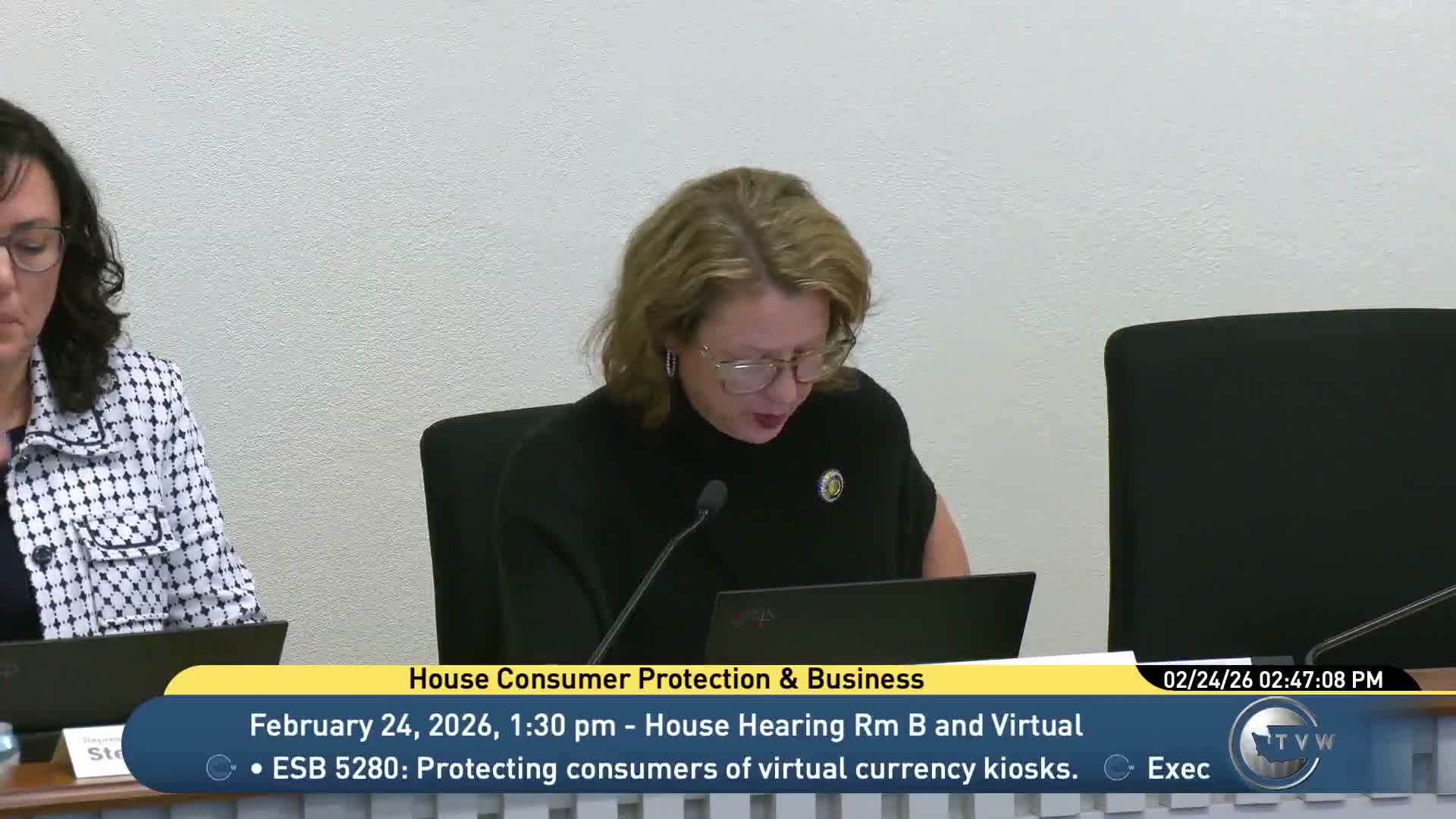
The committee received extensive testimony on Engrossed Senate Bill 5,280, which would add consumer protections for virtual-currency kiosks (crypto ATMs), including a daily transaction cap (proposed at $2,000), a fee cap (the greater of $5 or 15% of the transaction), pre-transaction disclosures, required receipts, and reporting of branch locations and authorized delegates to the Department of Financial Institutions (DFI).
Drew Bowden and JJ (Jinju) Choi from the Department of Financial Institutions described enforcement tools available under the Uniform Money Services Act — including license revocation or suspension, fines and restitution — and urged the bill because kiosk-related fraud often targets older adults. Assistant Attorney General Ben Breisack cited FBI/Treasury/FTC reports showing steep reported losses in 2024 and said the speed and irreversibility of crypto-ATM transactions makes recovery difficult.
Law enforcement witnesses provided emotional testimony about victims who lost life savings within minutes and asked for concrete friction and a cooling period to help victims reverse or recover funds when possible. “We see elderly folks losing their entire $10,000 life savings, and we have no way to recover those funds,” said Andy Caldwell of the Centralia Police Department.
Industry representatives opposed the bill as drafted. Amy Harris (Washington Technology Industry Association) said compliant kiosk operators already perform federal AML/KYC checks and that an across-the-board $2,000 cap could encourage scam stacking and fragmentation. Retail-host concerns were raised by Crystal Leatherman (Washington Retail Association) about undefined terms (authorized delegate, operate) that could expose host retailers who merely lease space. Kiosk operators (Bitcoin Depot, CoinFlip) argued for tiered limits that raise caps for established users, better blockchain analytics, and live customer service requirements rather than an inflexible daily cap.
Kiosk operators suggested bifurcated regimes used by other states: lower limits for new or unverified users and larger limits for established, verified customers; they also supported blockchain analytics and live customer-service access. Representatives asked DFI for data on enforcement outcomes and whether stronger restitution or notice requirements for hosts should be included.
The committee closed the public hearing after extensive testimony and signaled additional work will be needed to balance consumer protections with operational realities for kiosk operators and host retailers.
Drew Bowden and JJ (Jinju) Choi from the Department of Financial Institutions described enforcement tools available under the Uniform Money Services Act — including license revocation or suspension, fines and restitution — and urged the bill because kiosk-related fraud often targets older adults. Assistant Attorney General Ben Breisack cited FBI/Treasury/FTC reports showing steep reported losses in 2024 and said the speed and irreversibility of crypto-ATM transactions makes recovery difficult.
Law enforcement witnesses provided emotional testimony about victims who lost life savings within minutes and asked for concrete friction and a cooling period to help victims reverse or recover funds when possible. “We see elderly folks losing their entire $10,000 life savings, and we have no way to recover those funds,” said Andy Caldwell of the Centralia Police Department.
Industry representatives opposed the bill as drafted. Amy Harris (Washington Technology Industry Association) said compliant kiosk operators already perform federal AML/KYC checks and that an across-the-board $2,000 cap could encourage scam stacking and fragmentation. Retail-host concerns were raised by Crystal Leatherman (Washington Retail Association) about undefined terms (authorized delegate, operate) that could expose host retailers who merely lease space. Kiosk operators (Bitcoin Depot, CoinFlip) argued for tiered limits that raise caps for established users, better blockchain analytics, and live customer service requirements rather than an inflexible daily cap.
Kiosk operators suggested bifurcated regimes used by other states: lower limits for new or unverified users and larger limits for established, verified customers; they also supported blockchain analytics and live customer-service access. Representatives asked DFI for data on enforcement outcomes and whether stronger restitution or notice requirements for hosts should be included.
The committee closed the public hearing after extensive testimony and signaled additional work will be needed to balance consumer protections with operational realities for kiosk operators and host retailers.
Don't Miss a Word: See the Full Meeting!
Go beyond summaries. Unlock every video, transcript, and key insight with a Founder Membership.
✓
Get instant access to full meeting videos
✓
Search and clip any phrase from complete transcripts
✓
Receive AI-powered summaries & custom alerts
✓
Enjoy lifetime, unrestricted access to government data
30-day money-back guarantee
