Committee Hears Proponents and Safety Concerns on Bill Protecting Telehealth for Audiologists
February 24, 2026 | Legislative Sessions, Washington
This article was created by AI summarizing key points discussed. AI makes mistakes, so for full details and context, please refer to the video of the full meeting. Please report any errors so we can fix them. Report an error »
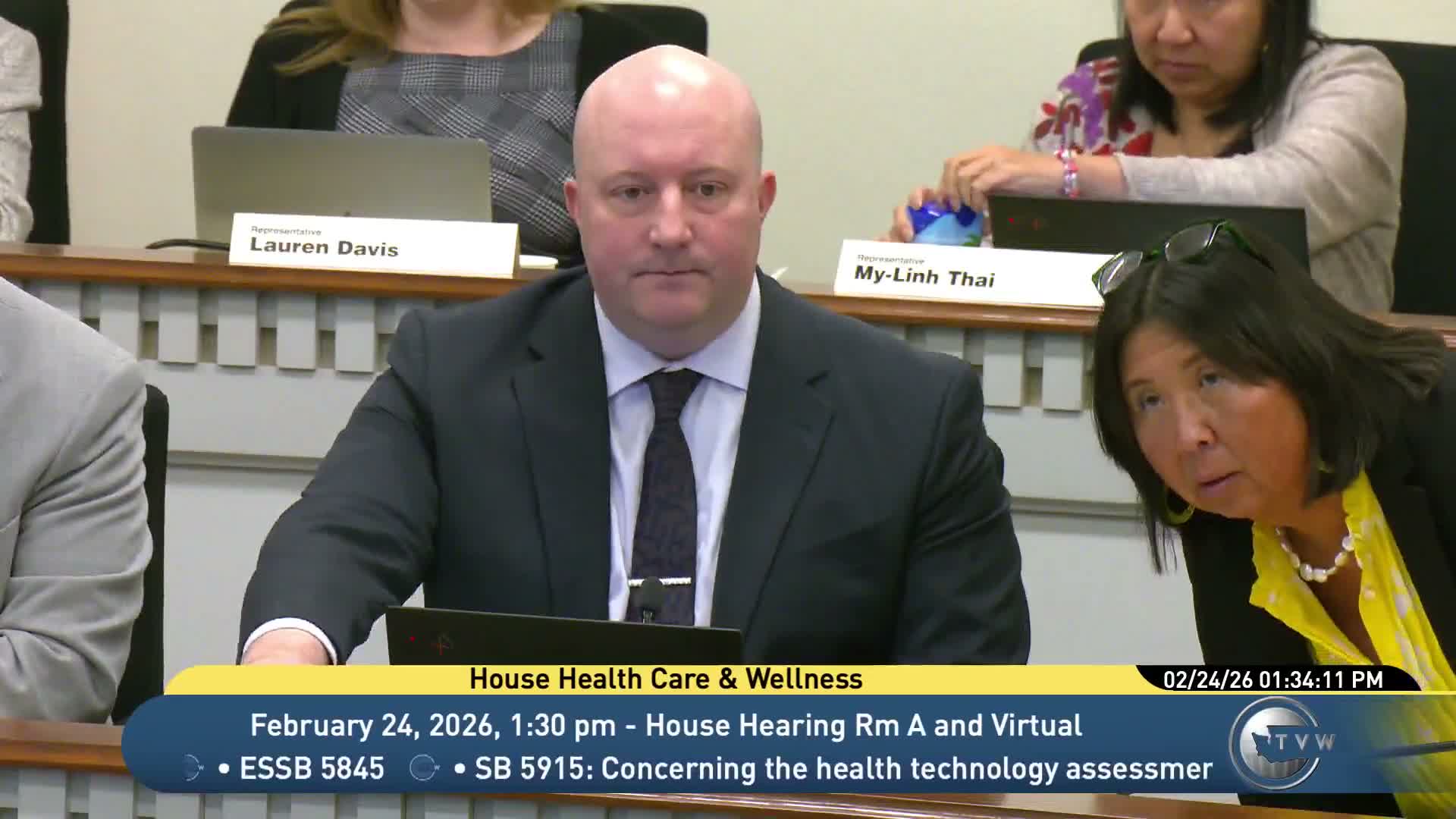
The House Healthcare and Wellness Committee heard Substitute Senate Bill 6,226, which limits the Board of Hearing and Speech's ability to adopt rules that would prevent audiologists, speech-language pathologists or hearing-aid specialists from using clinical judgment to select telehealth or in-person care.
Chris Blake, committee staff, explained that the Department of Health and the Board of Hearing and Speech jointly regulate audiologists, speech-language pathologists and hearing-aid specialists, and that SB 6,226 would ensure rules do not prevent clinicians from using their judgment about telehealth versus in-person visits. The bill language also preserves the board’s authority to adopt standards of care on competency, supervision and documentation so long as those rules do not curtail clinicians’ ability to select telehealth when clinically appropriate.
Senator Paul Harris, prime sponsor, described the bill as straightforward: it would allow licensed clinicians to decide whether telemedicine or in-person care is appropriate in each case.
Multiple witnesses testified in support. Abby Smelzer, representing hear.com, said the bill preserves access—especially for rural residents and people with mobility limitations—and noted SB 6,226 passed unanimously in the Senate. John DeSimone and Melanie Hecker, clinicians with tele-audiology experience, described remote fittings and software they use to evaluate and fit hearing instruments, saying telehealth can be equivalent to in-person care for many patients. Stephanie Chayeski, executive director of the Academy of Doctors of Audiology, said the association strongly supports the bill and warned that some suggested rule changes appeared motivated by competitive concerns.
At the same time, Richard Giles, legislative liaison for the Washington Hearing Society, said his group moved to neutral after negotiating an amendment but urged adding explicit, evidence-based patient-safety language—particularly for initial fittings and calibration procedures—and replacing the term "practitioner" with "professional" to align with other law. Nicole, a doctor of audiology and member of the Board of Hearing and Speech speaking for herself, urged a brief delay so stakeholders (providers, patient advocates, rural access representatives and consumer-protection voices) can evaluate guardrails for initial in-ear fittings and verify which elements can be done safely via telehealth.
Representative Valdez asked whether the bill was prompted by a board rule; Nicole confirmed a recent rule hearing had prompted stakeholder concerns and offered to provide language for possible exceptions or parameters around first fittings.
The committee closed public testimony on SB 6,226; no committee vote on the bill is recorded in the provided transcript.
Next steps: public testimony concluded and the committee moved to executive session on other bills.
Chris Blake, committee staff, explained that the Department of Health and the Board of Hearing and Speech jointly regulate audiologists, speech-language pathologists and hearing-aid specialists, and that SB 6,226 would ensure rules do not prevent clinicians from using their judgment about telehealth versus in-person visits. The bill language also preserves the board’s authority to adopt standards of care on competency, supervision and documentation so long as those rules do not curtail clinicians’ ability to select telehealth when clinically appropriate.
Senator Paul Harris, prime sponsor, described the bill as straightforward: it would allow licensed clinicians to decide whether telemedicine or in-person care is appropriate in each case.
Multiple witnesses testified in support. Abby Smelzer, representing hear.com, said the bill preserves access—especially for rural residents and people with mobility limitations—and noted SB 6,226 passed unanimously in the Senate. John DeSimone and Melanie Hecker, clinicians with tele-audiology experience, described remote fittings and software they use to evaluate and fit hearing instruments, saying telehealth can be equivalent to in-person care for many patients. Stephanie Chayeski, executive director of the Academy of Doctors of Audiology, said the association strongly supports the bill and warned that some suggested rule changes appeared motivated by competitive concerns.
At the same time, Richard Giles, legislative liaison for the Washington Hearing Society, said his group moved to neutral after negotiating an amendment but urged adding explicit, evidence-based patient-safety language—particularly for initial fittings and calibration procedures—and replacing the term "practitioner" with "professional" to align with other law. Nicole, a doctor of audiology and member of the Board of Hearing and Speech speaking for herself, urged a brief delay so stakeholders (providers, patient advocates, rural access representatives and consumer-protection voices) can evaluate guardrails for initial in-ear fittings and verify which elements can be done safely via telehealth.
Representative Valdez asked whether the bill was prompted by a board rule; Nicole confirmed a recent rule hearing had prompted stakeholder concerns and offered to provide language for possible exceptions or parameters around first fittings.
The committee closed public testimony on SB 6,226; no committee vote on the bill is recorded in the provided transcript.
Next steps: public testimony concluded and the committee moved to executive session on other bills.
View the Full Meeting & All Its Details
This article offers just a summary. Unlock complete video, transcripts, and insights as a Founder Member.
✓
Watch full, unedited meeting videos
✓
Search every word spoken in unlimited transcripts
✓
AI summaries & real-time alerts (all government levels)
✓
Permanent access to expanding government content
30-day money-back guarantee
