Senate committee advances bill to end Community Protection Program after amending technical references
February 24, 2026 | Legislative Sessions, Washington
This article was created by AI summarizing key points discussed. AI makes mistakes, so for full details and context, please refer to the video of the full meeting. Please report any errors so we can fix them. Report an error »
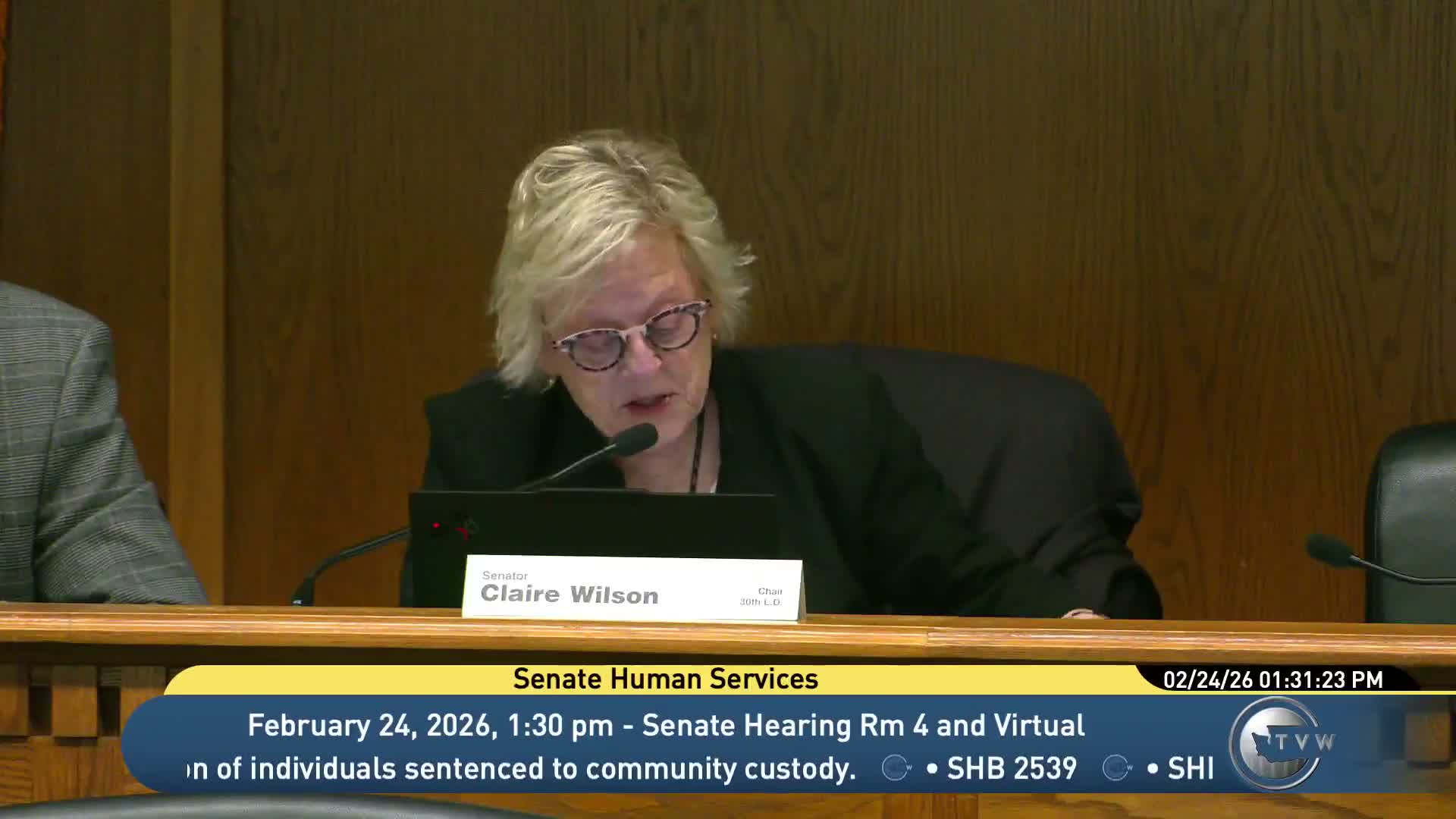
Substitute House Bill 1390, which would remove statutory references to the Community Protection Program (CPP) and require the Developmental Disabilities Administration to transition current participants into other services, was the focal point of a lengthy executive-session debate in the Senate Human Services Committee on Feb. 24.
Will Tronson, committee staff, said the bill would remove CPP references effective Jan. 1, 2026, and require DDA to develop and implement a plan to transition individuals by Dec. 31, 2025. Tronson noted the bill passed the House 52–44 and that 22 amendments had been filed ‘‘21 by Senator Christian and 1 by Senator Wilson,’’ which the committee reviewed.
Senator Christian framed many of the offered amendments as safeguards for community safety and implementation clarity. ‘‘This is a pretty major shift in policy,’’ Christian said, urging more study and protections. Christian moved a striking amendment (A1) to have the Joint Legislative Audit and Review Committee (JLARC) study the impacts of repealing CPP and consider safety and fiscal effects; that amendment failed on a voice vote.
Other amendments sought to add requirements including signed participant agreements (A2), a five-year annual reporting requirement on former participants (A3), risk or dangerousness assessments by qualified professionals (A4), buffers from schools or childcare facilities and notification to local law enforcement (A8–A10, A15–A16), creation of a hotline (A6), definitions for categories tied to criminal provisions (A13, A18), treble damages for providers (A21), and delayed effective dates or work groups to evaluate alternatives (A7, A20). Committee debate repeatedly contrasted individual civil-rights and disability-service considerations with community-safety concerns. Senator Freme cautioned that ‘‘everybody in this program is disabled’’ and recommended no on many amendments that she said would overreach or incorrectly characterize the population.
Most amendment motions offered by Senator Christian were rejected on voice votes. A technical amendment (A22) offered by Senator Wilson — updating the Developmental Disabilities Administration name to the Home and Community Living Administration and correcting statutory references and effective dates — was adopted. After final discussion, the committee voted by voice to roll the adopted technical change into a striking amendment and recommended the bill receive a due-pass and be sent to the rules committee; the clerk recorded that the bill "has passed subject to signatures." The committee did not record a roll-call tally in the transcript; advancement was by voice.
The debate reflected competing priorities: members pressing for additional study, reporting and placement safeguards, and others emphasizing the department’s work and civil-rights concerns for people with intellectual and developmental disabilities. The transcript records repeated calls for implementation details and for protections both for community safety and for program participants.
Next steps: the bill was sent to the rules committee with a due-pass recommendation; the committee did not adopt substantive policy amendments during the session and left most contested amendments unresolved.
Sources: Committee staff briefing and the committee’s executive-session debate as recorded in the Feb. 24 Senate Human Services Committee transcript.
Will Tronson, committee staff, said the bill would remove CPP references effective Jan. 1, 2026, and require DDA to develop and implement a plan to transition individuals by Dec. 31, 2025. Tronson noted the bill passed the House 52–44 and that 22 amendments had been filed ‘‘21 by Senator Christian and 1 by Senator Wilson,’’ which the committee reviewed.
Senator Christian framed many of the offered amendments as safeguards for community safety and implementation clarity. ‘‘This is a pretty major shift in policy,’’ Christian said, urging more study and protections. Christian moved a striking amendment (A1) to have the Joint Legislative Audit and Review Committee (JLARC) study the impacts of repealing CPP and consider safety and fiscal effects; that amendment failed on a voice vote.
Other amendments sought to add requirements including signed participant agreements (A2), a five-year annual reporting requirement on former participants (A3), risk or dangerousness assessments by qualified professionals (A4), buffers from schools or childcare facilities and notification to local law enforcement (A8–A10, A15–A16), creation of a hotline (A6), definitions for categories tied to criminal provisions (A13, A18), treble damages for providers (A21), and delayed effective dates or work groups to evaluate alternatives (A7, A20). Committee debate repeatedly contrasted individual civil-rights and disability-service considerations with community-safety concerns. Senator Freme cautioned that ‘‘everybody in this program is disabled’’ and recommended no on many amendments that she said would overreach or incorrectly characterize the population.
Most amendment motions offered by Senator Christian were rejected on voice votes. A technical amendment (A22) offered by Senator Wilson — updating the Developmental Disabilities Administration name to the Home and Community Living Administration and correcting statutory references and effective dates — was adopted. After final discussion, the committee voted by voice to roll the adopted technical change into a striking amendment and recommended the bill receive a due-pass and be sent to the rules committee; the clerk recorded that the bill "has passed subject to signatures." The committee did not record a roll-call tally in the transcript; advancement was by voice.
The debate reflected competing priorities: members pressing for additional study, reporting and placement safeguards, and others emphasizing the department’s work and civil-rights concerns for people with intellectual and developmental disabilities. The transcript records repeated calls for implementation details and for protections both for community safety and for program participants.
Next steps: the bill was sent to the rules committee with a due-pass recommendation; the committee did not adopt substantive policy amendments during the session and left most contested amendments unresolved.
Sources: Committee staff briefing and the committee’s executive-session debate as recorded in the Feb. 24 Senate Human Services Committee transcript.
View the Full Meeting & All Its Details
This article offers just a summary. Unlock complete video, transcripts, and insights as a Founder Member.
✓
Watch full, unedited meeting videos
✓
Search every word spoken in unlimited transcripts
✓
AI summaries & real-time alerts (all government levels)
✓
Permanent access to expanding government content
30-day money-back guarantee
