Committee Advances Three Bills: Veterans Benefits, Supply-Chain Program and AI Chatbot Rules
February 24, 2026 | Legislative Sessions, Washington
This article was created by AI summarizing key points discussed. AI makes mistakes, so for full details and context, please refer to the video of the full meeting. Please report any errors so we can fix them. Report an error »
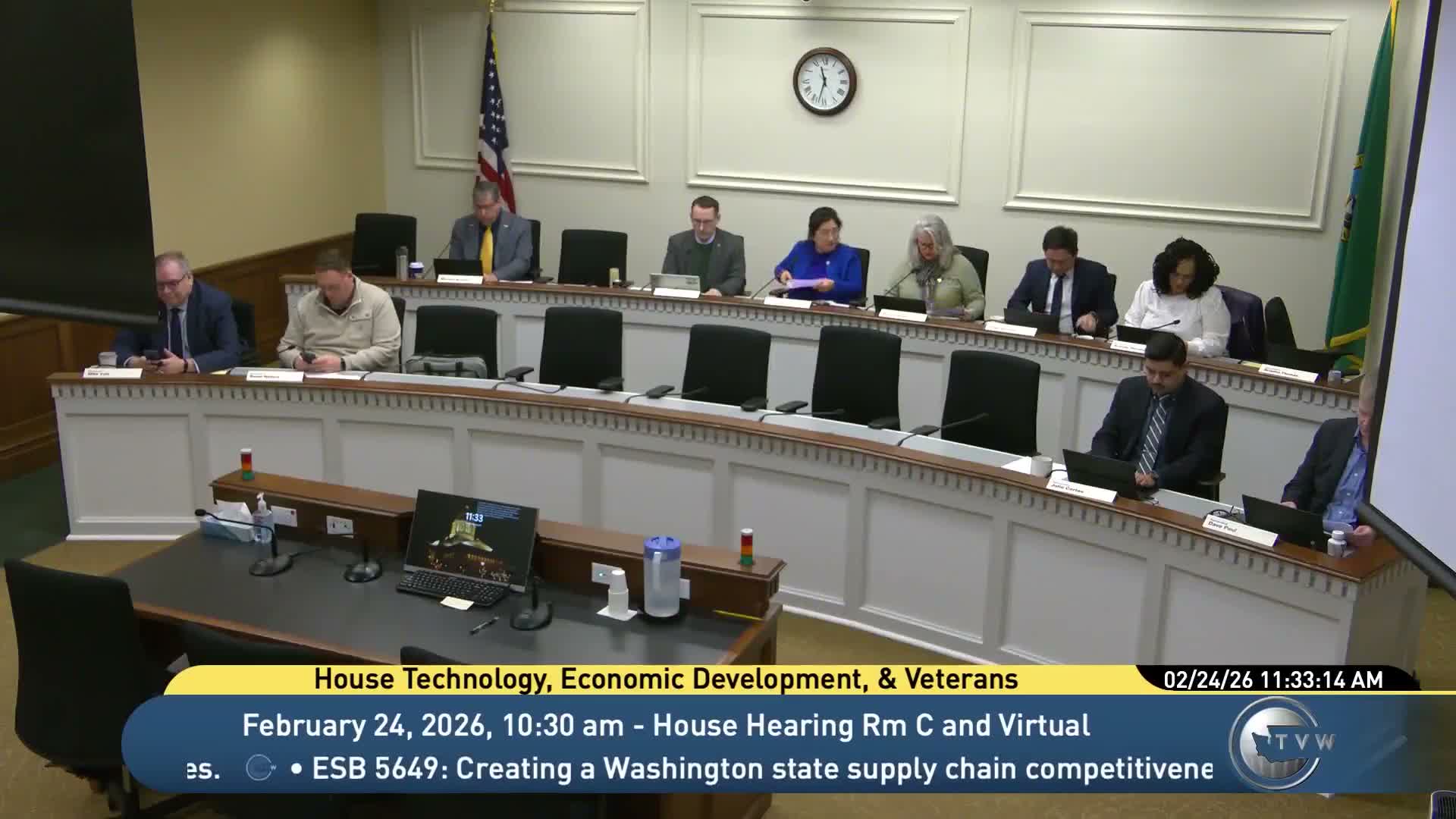
The Technology, Economic Development and Veterans Committee met in executive session to consider three bills and their amendments, and the committee reported all three out with due-pass recommendations.
Senate Bill 5,420 (veterans benefits): Vice Chair moved that substitute Senate Bill 5,420 be reported out of committee with a due-pass as amended recommendation. Representative Penner moved the striking amendment H 3,640.1, which staff explained changes certain references from a discharge for "physical reasons" to a "medical discharge with an honorable record" and defines qualifying discharge categories (honorable; general under honorable conditions; or discharge for reasons related to sexual orientation or gender). Debate noted that the change could widen eligibility by including mental-health-related medical discharges. The amendment was adopted by voice vote, and the committee voted to report SB 5,420 as amended (recorded tally: 12 ayes, 0 nays, 1 excused).
Senate Bill 56 49 (supply chain competitiveness infrastructure program): Staff described two amendments: WALE 397 (Rep. Penner) directing WSDOT to include performance metrics and allow scoring preference for projects that directly benefit in‑state production and supply-chain resilience; and WALE 392 (Rep. Ryu) restricting program eligibility to projects not eligible for Freight Mobility Strategic Investment Board funding. Members discussed supporting Washington agriculture and manufacturing and adopted the amendments. The committee reported the bill out as amended (recorded tally: 12 ayes, 0 nays, 1 excused).
Senate Bill 5,984 (AI companion chatbots): The committee considered several amendments that clarified gaming-system and educational-tool exclusions, limited operators from using sensitive personal data to infer or estimate age, added manipulative-engagement technique examples (such as personal pronouns and output implying a personal relationship), required data minimization for personal data collection, and removed an exemption for underlying general-purpose AI models. Representative Penner and others emphasized the risk that compliance could drive problematic data-collection practices and urged protections for privacy; Representative Klobuch and others emphasized youth and vulnerable-adult protections, citing cases where chatbots reinforced harmful ideation. Some amendments failed; others were adopted. The committee took a roll-call vote and reported SB 5,984 out of committee as amended (recorded tally: 8 ayes, 4 nays, 1 excused). Representative Penner registered a reluctant or 'nay without recommendation' on some motions and voiced privacy concerns during debate.
Record vote details are reflected in committee staff announcements and the roll call recorded in the transcript. The committee adjourned after the votes.
Senate Bill 5,420 (veterans benefits): Vice Chair moved that substitute Senate Bill 5,420 be reported out of committee with a due-pass as amended recommendation. Representative Penner moved the striking amendment H 3,640.1, which staff explained changes certain references from a discharge for "physical reasons" to a "medical discharge with an honorable record" and defines qualifying discharge categories (honorable; general under honorable conditions; or discharge for reasons related to sexual orientation or gender). Debate noted that the change could widen eligibility by including mental-health-related medical discharges. The amendment was adopted by voice vote, and the committee voted to report SB 5,420 as amended (recorded tally: 12 ayes, 0 nays, 1 excused).
Senate Bill 56 49 (supply chain competitiveness infrastructure program): Staff described two amendments: WALE 397 (Rep. Penner) directing WSDOT to include performance metrics and allow scoring preference for projects that directly benefit in‑state production and supply-chain resilience; and WALE 392 (Rep. Ryu) restricting program eligibility to projects not eligible for Freight Mobility Strategic Investment Board funding. Members discussed supporting Washington agriculture and manufacturing and adopted the amendments. The committee reported the bill out as amended (recorded tally: 12 ayes, 0 nays, 1 excused).
Senate Bill 5,984 (AI companion chatbots): The committee considered several amendments that clarified gaming-system and educational-tool exclusions, limited operators from using sensitive personal data to infer or estimate age, added manipulative-engagement technique examples (such as personal pronouns and output implying a personal relationship), required data minimization for personal data collection, and removed an exemption for underlying general-purpose AI models. Representative Penner and others emphasized the risk that compliance could drive problematic data-collection practices and urged protections for privacy; Representative Klobuch and others emphasized youth and vulnerable-adult protections, citing cases where chatbots reinforced harmful ideation. Some amendments failed; others were adopted. The committee took a roll-call vote and reported SB 5,984 out of committee as amended (recorded tally: 8 ayes, 4 nays, 1 excused). Representative Penner registered a reluctant or 'nay without recommendation' on some motions and voiced privacy concerns during debate.
Record vote details are reflected in committee staff announcements and the roll call recorded in the transcript. The committee adjourned after the votes.
View the Full Meeting & All Its Details
This article offers just a summary. Unlock complete video, transcripts, and insights as a Founder Member.
✓
Watch full, unedited meeting videos
✓
Search every word spoken in unlimited transcripts
✓
AI summaries & real-time alerts (all government levels)
✓
Permanent access to expanding government content
30-day money-back guarantee
