Fairhope BOA tables setback variance for 11 Greenbrier Lane pending geotechnical studies
February 23, 2026 | Fairhope City, Baldwin County, Alabama
This article was created by AI summarizing key points discussed. AI makes mistakes, so for full details and context, please refer to the video of the full meeting. Please report any errors so we can fix them. Report an error »
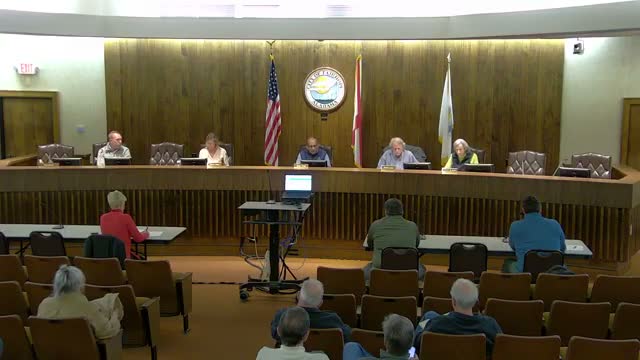
The Fairhope Board of Adjustment voted unanimously to table a request for a 15-foot front-yard setback variance for 11 Greenbrier Lane, giving the applicant up to six months to provide a topographic survey and a geotechnical engineer’s recommendation on a safe building distance from a gully on the lot.
Planning staff described the lot as a wooded, buildable R-1 parcel of about 0.38 acres in Greenbrier Subdivision and recommended denial of the variance. Staff noted existing drainage easements and a steep, roughly 15-foot-deep gully that complicates placement of the proposed home, and told the board the property could be developed without a variance using a different footprint. “As such, staff does recommend denial of BOA26.0111 Greenbrier Lane, request for 15 foot front yard setback variance,” staff said during the presentation.
Karen Rice, the property owner, told the board she seeks a 15-foot variance (which would create a 25-foot front-yard setback) so the proposed house and driveway will align more closely with adjacent homes in the cul-de-sac. Rice said she has delayed spending on engineering until she knew whether the board might approve a variance: “I haven’t spent money on anything else, engineers,” she said. She also said she would remove as few trees as possible and that she “love[s] the trees” and the lot.
Neighbors at the hearing raised concerns about erosion and loss of trees. Gerald Harshberger, who lives immediately north of the lot, warned that placing a house close to the gully “you’re gonna lose some trees. And when you do, that gulley is gonna get bigger,” and said tree loss could threaten adjoining properties. Leroy Sloan, another nearby homeowner, said any house built should “fit in, blend in with the other structures in the neighborhood.”
Board members pressed staff and the applicant on alternatives, including whether a smaller footprint could meet the 40-foot setback and how close construction safely could approach the gully. Staff said topographic surveys and geotechnical analyses are typically required during permitting where gullies or bluff edges are involved, that filling or altering a gully would require additional federal and local approvals, and that the city is finalizing guidance from prior geotechnical work. Staff also noted that a similar 15-foot variance had been granted for 95 Blue Island Avenue in 2006 but emphasized that each lot’s conditions differ.
After debate over whether a hardship had been demonstrated and what information would be necessary to make an informed decision, Board member Ryan Maker moved to table the request for up to six months so Rice could return with a survey showing the top edge of the gully and a geotechnical engineer’s recommendation on how far a structure must be from that edge. The motion was seconded and carried unanimously. The board clerk noted that if the application is denied rather than tabled, a new application for the same parcel generally may not be submitted within 365 days of the final decision.
Next steps: Rice may obtain a topographic survey and geotechnical report and return within the six-month window. The board did not grant the variance tonight; staff reiterated that, absent the requested technical data, its recommendation remained denial.
Planning staff described the lot as a wooded, buildable R-1 parcel of about 0.38 acres in Greenbrier Subdivision and recommended denial of the variance. Staff noted existing drainage easements and a steep, roughly 15-foot-deep gully that complicates placement of the proposed home, and told the board the property could be developed without a variance using a different footprint. “As such, staff does recommend denial of BOA26.0111 Greenbrier Lane, request for 15 foot front yard setback variance,” staff said during the presentation.
Karen Rice, the property owner, told the board she seeks a 15-foot variance (which would create a 25-foot front-yard setback) so the proposed house and driveway will align more closely with adjacent homes in the cul-de-sac. Rice said she has delayed spending on engineering until she knew whether the board might approve a variance: “I haven’t spent money on anything else, engineers,” she said. She also said she would remove as few trees as possible and that she “love[s] the trees” and the lot.
Neighbors at the hearing raised concerns about erosion and loss of trees. Gerald Harshberger, who lives immediately north of the lot, warned that placing a house close to the gully “you’re gonna lose some trees. And when you do, that gulley is gonna get bigger,” and said tree loss could threaten adjoining properties. Leroy Sloan, another nearby homeowner, said any house built should “fit in, blend in with the other structures in the neighborhood.”
Board members pressed staff and the applicant on alternatives, including whether a smaller footprint could meet the 40-foot setback and how close construction safely could approach the gully. Staff said topographic surveys and geotechnical analyses are typically required during permitting where gullies or bluff edges are involved, that filling or altering a gully would require additional federal and local approvals, and that the city is finalizing guidance from prior geotechnical work. Staff also noted that a similar 15-foot variance had been granted for 95 Blue Island Avenue in 2006 but emphasized that each lot’s conditions differ.
After debate over whether a hardship had been demonstrated and what information would be necessary to make an informed decision, Board member Ryan Maker moved to table the request for up to six months so Rice could return with a survey showing the top edge of the gully and a geotechnical engineer’s recommendation on how far a structure must be from that edge. The motion was seconded and carried unanimously. The board clerk noted that if the application is denied rather than tabled, a new application for the same parcel generally may not be submitted within 365 days of the final decision.
Next steps: Rice may obtain a topographic survey and geotechnical report and return within the six-month window. The board did not grant the variance tonight; staff reiterated that, absent the requested technical data, its recommendation remained denial.
Don't Miss a Word: See the Full Meeting!
Go beyond summaries. Unlock every video, transcript, and key insight with a Founder Membership.
✓
Get instant access to full meeting videos
✓
Search and clip any phrase from complete transcripts
✓
Receive AI-powered summaries & custom alerts
✓
Enjoy lifetime, unrestricted access to government data
30-day money-back guarantee
