Grandview Heights safety committee recommends Chapter 13 code updates, drops local contractor registration
February 23, 2026 | Grandview Heights, Franklin County, Ohio
This article was created by AI summarizing key points discussed. AI makes mistakes, so for full details and context, please refer to the video of the full meeting. Please report any errors so we can fix them. Report an error »
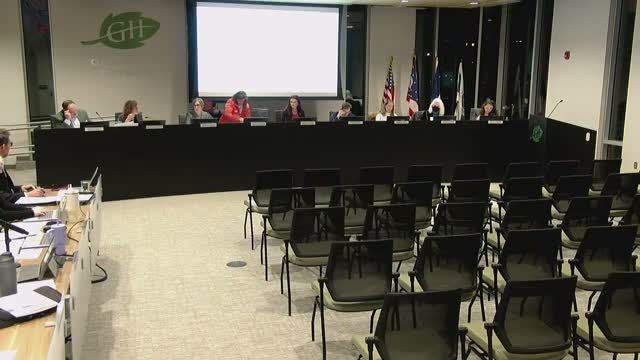
Grandview Heights' Safety Committee on Feb. 23 recommended that the City Council approve a package of changes to Chapter 13 of the codified ordinances meant to modernize building, property maintenance and contractor rules.
The committee's recommendation covers multiple revisions: adoption of the state's commercial and residential building codes and related mechanical codes; replacement of the city's residential housing language with the International Code Council (ICC) property maintenance code; removal of a local contractor-registration requirement; a nonpunitive initial enforcement strategy using door-hanger notices; updates to penalty language; delegating fee adjustments to the building/zoning director with mayoral approval; and a new local provision to hold a portion of insurance proceeds after serious fire damage until exterior repairs are completed.
Director Halsey, who led the presentation, said the package eliminates duplicative or antiquated local language because state and ICC codes now contain the required technical standards. "The state building codes ... are required to use for our certified department," he said, adding that the property maintenance code is already used by nearby jurisdictions such as Dublin, Upper Arlington, Hilliard, Grove City and Westerville.
On enforcement, Halsey described a softer first-year approach: "Rather than starting out by issuing everyone citations ... we're going to go with a door hanger more as a suggestion. We're not gonna do violations." He said the city would hire a full‑time property‑maintenance staff member to perform proactive outreach, list compliance issues on the hanger and provide a contact to discuss remedies.
The draft updates penalty language to current minor‑misdemeanor levels and specifies a fine of $250 per day where applicable under the code changes. Halsey also explained that the draft removes a local contractor-registration requirement (recently priced at $60 in city materials) because the registration did not meaningfully vet contractors beyond basic insurance or bonding; instead, the administration will publish a homeowner guidance document on the city website and create a voluntary contractor contact list for informational notices.
Halsey said the city will maintain required state licenses for mechanical, electrical and plumbing contractors but will not keep a mandatory local registry that he said could give homeowners a false sense of vetting. "People will hire their favorite contractor and the contract will not realize that they registered," he said, describing the registration as insufficient consumer protection.
The ordinance also adds a new fire‑loss mechanism modeled on similar provisions used elsewhere. Halsey said insurers would deposit a portion of proceeds with the city so officials can ensure the exterior of a fire‑damaged structure is secured and repaired rather than allowing an owner to take insurance money and abandon a partially demolished property. He cited Hilliard as a recent model for the language.
Council members asked how long the city would hold funds and when withheld money would be released. Halsey said funds would be held by the mayor/finance department until the building exterior is closed and "dried in," at which point remaining insurance proceeds could be released so owners can complete interior repairs.
After questions and public‑education discussion — including plans for town‑hall sessions and permit guidance emailed to applicants — the committee moved and seconded a recommendation for approval. The committee recorded voice approval and adjourned at 7:05 a.m.; the ordinance will be forwarded to the full City Council for final action.
What happens next: The Safety Committee's recommendation advances the draft ordinance to full council. If the council approves the same language, the city will implement the code adoptions, change the fee process, publish homeowner guidance, and begin the phased enforcement and outreach outlined by the administration.
The committee's recommendation covers multiple revisions: adoption of the state's commercial and residential building codes and related mechanical codes; replacement of the city's residential housing language with the International Code Council (ICC) property maintenance code; removal of a local contractor-registration requirement; a nonpunitive initial enforcement strategy using door-hanger notices; updates to penalty language; delegating fee adjustments to the building/zoning director with mayoral approval; and a new local provision to hold a portion of insurance proceeds after serious fire damage until exterior repairs are completed.
Director Halsey, who led the presentation, said the package eliminates duplicative or antiquated local language because state and ICC codes now contain the required technical standards. "The state building codes ... are required to use for our certified department," he said, adding that the property maintenance code is already used by nearby jurisdictions such as Dublin, Upper Arlington, Hilliard, Grove City and Westerville.
On enforcement, Halsey described a softer first-year approach: "Rather than starting out by issuing everyone citations ... we're going to go with a door hanger more as a suggestion. We're not gonna do violations." He said the city would hire a full‑time property‑maintenance staff member to perform proactive outreach, list compliance issues on the hanger and provide a contact to discuss remedies.
The draft updates penalty language to current minor‑misdemeanor levels and specifies a fine of $250 per day where applicable under the code changes. Halsey also explained that the draft removes a local contractor-registration requirement (recently priced at $60 in city materials) because the registration did not meaningfully vet contractors beyond basic insurance or bonding; instead, the administration will publish a homeowner guidance document on the city website and create a voluntary contractor contact list for informational notices.
Halsey said the city will maintain required state licenses for mechanical, electrical and plumbing contractors but will not keep a mandatory local registry that he said could give homeowners a false sense of vetting. "People will hire their favorite contractor and the contract will not realize that they registered," he said, describing the registration as insufficient consumer protection.
The ordinance also adds a new fire‑loss mechanism modeled on similar provisions used elsewhere. Halsey said insurers would deposit a portion of proceeds with the city so officials can ensure the exterior of a fire‑damaged structure is secured and repaired rather than allowing an owner to take insurance money and abandon a partially demolished property. He cited Hilliard as a recent model for the language.
Council members asked how long the city would hold funds and when withheld money would be released. Halsey said funds would be held by the mayor/finance department until the building exterior is closed and "dried in," at which point remaining insurance proceeds could be released so owners can complete interior repairs.
After questions and public‑education discussion — including plans for town‑hall sessions and permit guidance emailed to applicants — the committee moved and seconded a recommendation for approval. The committee recorded voice approval and adjourned at 7:05 a.m.; the ordinance will be forwarded to the full City Council for final action.
What happens next: The Safety Committee's recommendation advances the draft ordinance to full council. If the council approves the same language, the city will implement the code adoptions, change the fee process, publish homeowner guidance, and begin the phased enforcement and outreach outlined by the administration.
View the Full Meeting & All Its Details
This article offers just a summary. Unlock complete video, transcripts, and insights as a Founder Member.
✓
Watch full, unedited meeting videos
✓
Search every word spoken in unlimited transcripts
✓
AI summaries & real-time alerts (all government levels)
✓
Permanent access to expanding government content
30-day money-back guarantee
