Wheat Ridge staff propose six priority sidewalk-gap projects, Dover Street draws neighborhood concern
February 24, 2026 | Wheat Ridge City, Jefferson County, Colorado
This article was created by AI summarizing key points discussed. AI makes mistakes, so for full details and context, please refer to the video of the full meeting. Please report any errors so we can fix them. Report an error »
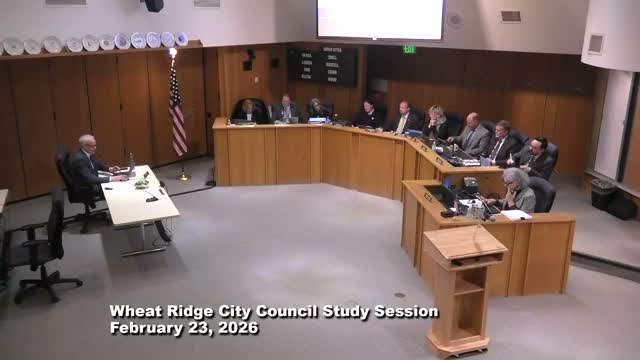
Wheat Ridge city staff presented a proposed first-phase package of sidewalk-gap projects funded by the 2J bond at a Feb. 23 special study session, asking council to endorse six segments for construction in 2026–27 and to pursue federal grants for two high-intensity activated crosswalks (HAWK signals).
City consultant and staff said the 2J bond—voter-approved half-cent sales tax extension plus bond authority—supports sidewalks, bike lanes and drainage. “We have 75,000,000,” staff noted as the bond authority, and the presentation said the city hopes to leverage grants to raise available funding to nearly $94 million. Staff listed roughly $42 million targeted for sidewalk and pipeline projects and gave a preliminary cost estimate for the first recommended segments of about $11.9 million.
The recommended near-term projects included short “quick wins” near schools and parks and larger corridor work: Parfette (near Prospect Valley School), Harlan (32nd–35th), Miller (45th–47th, serving Fruitdale Park and nearby schools), a 26th Avenue segment, Dover Street (38th–44th), and a long Pierce Street segment connecting local businesses and parks. Staff also proposed HAWK signals at two 44th Avenue locations and said the city will pursue a Highway Safety Improvement Program grant to offset the roughly $250,000 per HAWK installation.
The study session drew extended public comment and council questioning. Multiple Dover Street residents said they learned about proposed work only through neighbors or informal channels and urged earlier outreach. Candace Tomlinson said curb, sidewalk and gutter work would help chronic stormwater drainage problems but called the lack of communication “upsetting and frustrating.” Kim Calomino said the principal issue on Dover is uncontrolled stormwater causing repeated pavement damage and property impacts.
Staff said Dover was included because it presents an operational opportunity to pair planned mill‑and‑overlay road maintenance with drainage and sidewalk work. Public works staff said design alternatives are still open: “Maybe we don't need to put sidewalks everywhere. Maybe curb and gutter would be fine,” and noted engineers will evaluate options including pipe installation, swales or permeable solutions during design.
Council members asked staff to prioritize transparency and neighborhood meetings before design proceeds, to ensure project choices respond to local concerns and Vision Zero priorities. Staff said a design contract with the consultant Olson is planned to come back to council in March and that the city expects to advance 2–3 segments this year and the remainder in 2027, with final schedules tied to design, permitting and any right-of-way needs. The presentation also noted IRS rules require spending a large portion of bond proceeds within three years for tax‑exempt bond compliance.
Next steps: staff will refine design, pursue grant funding for HAWK signals, hold neighborhood outreach for Dover and other affected corridors, and return with more detailed scopes, costs and construction timelines.
City consultant and staff said the 2J bond—voter-approved half-cent sales tax extension plus bond authority—supports sidewalks, bike lanes and drainage. “We have 75,000,000,” staff noted as the bond authority, and the presentation said the city hopes to leverage grants to raise available funding to nearly $94 million. Staff listed roughly $42 million targeted for sidewalk and pipeline projects and gave a preliminary cost estimate for the first recommended segments of about $11.9 million.
The recommended near-term projects included short “quick wins” near schools and parks and larger corridor work: Parfette (near Prospect Valley School), Harlan (32nd–35th), Miller (45th–47th, serving Fruitdale Park and nearby schools), a 26th Avenue segment, Dover Street (38th–44th), and a long Pierce Street segment connecting local businesses and parks. Staff also proposed HAWK signals at two 44th Avenue locations and said the city will pursue a Highway Safety Improvement Program grant to offset the roughly $250,000 per HAWK installation.
The study session drew extended public comment and council questioning. Multiple Dover Street residents said they learned about proposed work only through neighbors or informal channels and urged earlier outreach. Candace Tomlinson said curb, sidewalk and gutter work would help chronic stormwater drainage problems but called the lack of communication “upsetting and frustrating.” Kim Calomino said the principal issue on Dover is uncontrolled stormwater causing repeated pavement damage and property impacts.
Staff said Dover was included because it presents an operational opportunity to pair planned mill‑and‑overlay road maintenance with drainage and sidewalk work. Public works staff said design alternatives are still open: “Maybe we don't need to put sidewalks everywhere. Maybe curb and gutter would be fine,” and noted engineers will evaluate options including pipe installation, swales or permeable solutions during design.
Council members asked staff to prioritize transparency and neighborhood meetings before design proceeds, to ensure project choices respond to local concerns and Vision Zero priorities. Staff said a design contract with the consultant Olson is planned to come back to council in March and that the city expects to advance 2–3 segments this year and the remainder in 2027, with final schedules tied to design, permitting and any right-of-way needs. The presentation also noted IRS rules require spending a large portion of bond proceeds within three years for tax‑exempt bond compliance.
Next steps: staff will refine design, pursue grant funding for HAWK signals, hold neighborhood outreach for Dover and other affected corridors, and return with more detailed scopes, costs and construction timelines.
Don't Miss a Word: See the Full Meeting!
Go beyond summaries. Unlock every video, transcript, and key insight with a Founder Membership.
✓
Get instant access to full meeting videos
✓
Search and clip any phrase from complete transcripts
✓
Receive AI-powered summaries & custom alerts
✓
Enjoy lifetime, unrestricted access to government data
30-day money-back guarantee
