Alaska committee hears call for federal term limits; sponsors cite broad public support
February 21, 2026 | 2026 Legislature Alaska, Alaska
This article was created by AI summarizing key points discussed. AI makes mistakes, so for full details and context, please refer to the video of the full meeting. Please report any errors so we can fix them. Report an error »
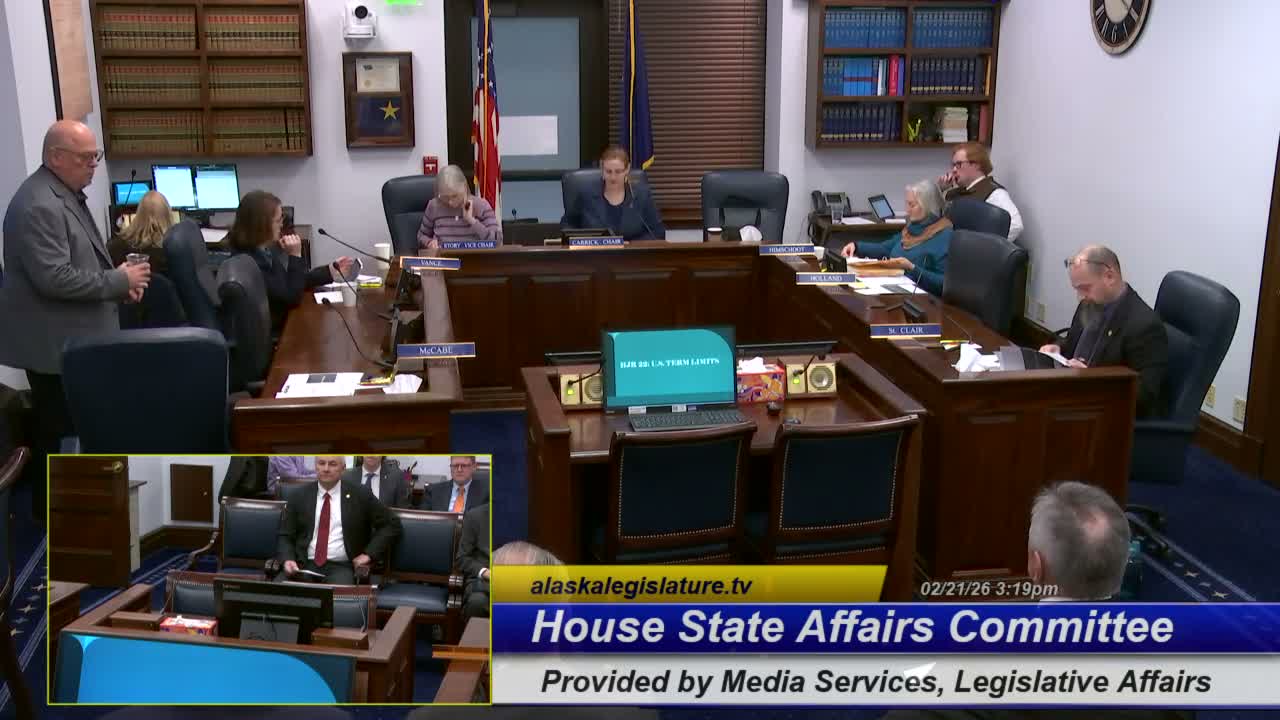
Representative Frank Tomaszewski introduced House Joint Resolution 22 on Saturday, asking Alaska to request a U.S. constitutional amendment that would limit how many terms a person may serve in the U.S. House and Senate and to call a convention of states for that single amendment. "House Joint Resolution 22 is a federal constitutional convention for term limits," Tomaszewski said.
Connor Mariner, staff to Rep. Tomaszewski, and Costin Carrard, western regional director for US Term Limits, presented the sponsor's case, telling the committee the proposal aims to "restore a citizen legislature," bring state and private-sector experience to Washington and reduce entrenched incumbency. Carrard cited a January 2025 poll he said showed 84% support among Alaskans for term limits and told members, "this is something that has very broad support."
Committee members pressed staff and the witness on the mechanics and risks. Vice Chair Storey asked whether a convention called by states could open the whole Constitution; Carrard responded the Article V mechanism can be limited to a single proposed amendment and that state ratification of any proposal provides an additional check. Representative Saint Clair asked how long a state resolution would remain in effect; committee testimony noted states typically leave such calls in place unless they rescind them.
Several members, including Representative Himshoo, raised concerns about how term limits could affect small or rural delegations that depend on seniority to secure resources such as ferries or highway work. "The only way that we really get a say ... is through that seniority system," Himshoo said, arguing caps could diminish rural influence. Carrard and other proponents said term limits can increase opportunities for subject-matter experts to serve and that staggered turnover gives delegations multiple chances to build influence.
Lawmakers also discussed alternative reforms, including campaign finance changes and primary systems, as ways to address incumbency advantages. No formal action was taken; the chair set HJR 22 aside for further consideration.
What happens next: HJR 22 was set aside with no vote and may be scheduled for additional hearings. If advanced, the resolution would be a request to Congress or a step toward joining a multistate convention under Article V of the U.S. Constitution.
Sources: Committee hearing testimony from Representative Frank Tomaszewski, Connor Mariner, and Costin Carrard; public testimony from Ed Martin.
Connor Mariner, staff to Rep. Tomaszewski, and Costin Carrard, western regional director for US Term Limits, presented the sponsor's case, telling the committee the proposal aims to "restore a citizen legislature," bring state and private-sector experience to Washington and reduce entrenched incumbency. Carrard cited a January 2025 poll he said showed 84% support among Alaskans for term limits and told members, "this is something that has very broad support."
Committee members pressed staff and the witness on the mechanics and risks. Vice Chair Storey asked whether a convention called by states could open the whole Constitution; Carrard responded the Article V mechanism can be limited to a single proposed amendment and that state ratification of any proposal provides an additional check. Representative Saint Clair asked how long a state resolution would remain in effect; committee testimony noted states typically leave such calls in place unless they rescind them.
Several members, including Representative Himshoo, raised concerns about how term limits could affect small or rural delegations that depend on seniority to secure resources such as ferries or highway work. "The only way that we really get a say ... is through that seniority system," Himshoo said, arguing caps could diminish rural influence. Carrard and other proponents said term limits can increase opportunities for subject-matter experts to serve and that staggered turnover gives delegations multiple chances to build influence.
Lawmakers also discussed alternative reforms, including campaign finance changes and primary systems, as ways to address incumbency advantages. No formal action was taken; the chair set HJR 22 aside for further consideration.
What happens next: HJR 22 was set aside with no vote and may be scheduled for additional hearings. If advanced, the resolution would be a request to Congress or a step toward joining a multistate convention under Article V of the U.S. Constitution.
Sources: Committee hearing testimony from Representative Frank Tomaszewski, Connor Mariner, and Costin Carrard; public testimony from Ed Martin.
View the Full Meeting & All Its Details
This article offers just a summary. Unlock complete video, transcripts, and insights as a Founder Member.
✓
Watch full, unedited meeting videos
✓
Search every word spoken in unlimited transcripts
✓
AI summaries & real-time alerts (all government levels)
✓
Permanent access to expanding government content
30-day money-back guarantee
