Committee hears sponsor argue constitutional change to require governor's balanced initial budget; details, limits debated
February 21, 2026 | 2026 Legislature Alaska, Alaska
This article was created by AI summarizing key points discussed. AI makes mistakes, so for full details and context, please refer to the video of the full meeting. Please report any errors so we can fix them. Report an error »
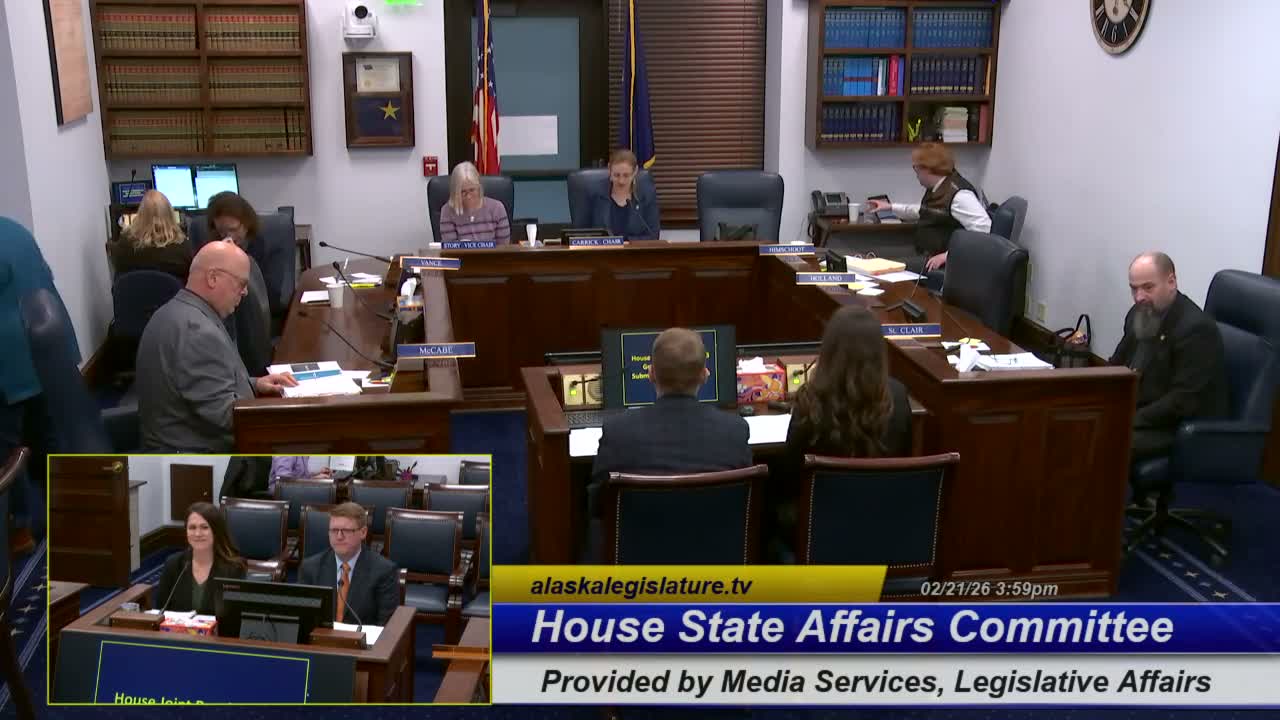
Representative Jubilee Underwood introduced House Joint Resolution 23 on Feb. 21, proposing a constitutional amendment to strengthen the structural rules governing Alaska's budget process. "This resolution does not set spending levels. It does not eliminate programs. It does not raise revenue," Underwood said, adding the proposal seeks to clarify how the budget process begins.
Buddy Witt, staff to Rep. Underwood, reviewed Article IX, Section 12 of the Alaska Constitution and the Alaska Budget Act (AS 37.07.020), including statutory requirements that the governor publish the budget by Dec. 15 and prepare a six‑year capital program and a 10‑year fiscal plan. Witt told the committee HJR 23 would require the governor's initial budget to be balanced and said anticipated revenue may not include the Constitutional Budget Reserve (CBR).
Members asked detailed technical questions. Representative Saint Clair asked which revenue baseline would be used (Legislative Finance or OMB); Witt said the resolution is structural and does not specify administrative revenue‑estimation detail, leaving those mechanics to future implementing steps. Representative Vance asked whether the proposal could be gamed by putting expenditures in supplemental bills; staff said the sponsor's intent is to reduce reliance on large supplemental budgets but conceded HJR 23 does not guarantee elimination of supplemental measures.
Public callers offered divergent views. Larissa Fonoff (Wasilla) and Ryan Sheldon (Talkeetna) supported the resolution as fiscal discipline; Ed Martin (Kenai) opposed it and urged attention to permanent fund governance and revenue production instead of constitutional amendments.
The committee set HJR 23 aside for further consideration and indicated the sponsor hopes to have the amendment on the November 2026 ballot if the legislative schedule permits.
Sources: Testimony from Representative Jubilee Underwood, Buddy Witt, and public callers Larissa Fonoff, Ryan Sheldon and Ed Martin.
Buddy Witt, staff to Rep. Underwood, reviewed Article IX, Section 12 of the Alaska Constitution and the Alaska Budget Act (AS 37.07.020), including statutory requirements that the governor publish the budget by Dec. 15 and prepare a six‑year capital program and a 10‑year fiscal plan. Witt told the committee HJR 23 would require the governor's initial budget to be balanced and said anticipated revenue may not include the Constitutional Budget Reserve (CBR).
Members asked detailed technical questions. Representative Saint Clair asked which revenue baseline would be used (Legislative Finance or OMB); Witt said the resolution is structural and does not specify administrative revenue‑estimation detail, leaving those mechanics to future implementing steps. Representative Vance asked whether the proposal could be gamed by putting expenditures in supplemental bills; staff said the sponsor's intent is to reduce reliance on large supplemental budgets but conceded HJR 23 does not guarantee elimination of supplemental measures.
Public callers offered divergent views. Larissa Fonoff (Wasilla) and Ryan Sheldon (Talkeetna) supported the resolution as fiscal discipline; Ed Martin (Kenai) opposed it and urged attention to permanent fund governance and revenue production instead of constitutional amendments.
The committee set HJR 23 aside for further consideration and indicated the sponsor hopes to have the amendment on the November 2026 ballot if the legislative schedule permits.
Sources: Testimony from Representative Jubilee Underwood, Buddy Witt, and public callers Larissa Fonoff, Ryan Sheldon and Ed Martin.
Don't Miss a Word: See the Full Meeting!
Go beyond summaries. Unlock every video, transcript, and key insight with a Founder Membership.
✓
Get instant access to full meeting videos
✓
Search and clip any phrase from complete transcripts
✓
Receive AI-powered summaries & custom alerts
✓
Enjoy lifetime, unrestricted access to government data
30-day money-back guarantee
