Committee reviews fiscal methodology behind proposed school funding changes in HB 261
February 23, 2026 | 2026 Legislature Alaska, Alaska
This article was created by AI summarizing key points discussed. AI makes mistakes, so for full details and context, please refer to the video of the full meeting. Please report any errors so we can fix them. Report an error »
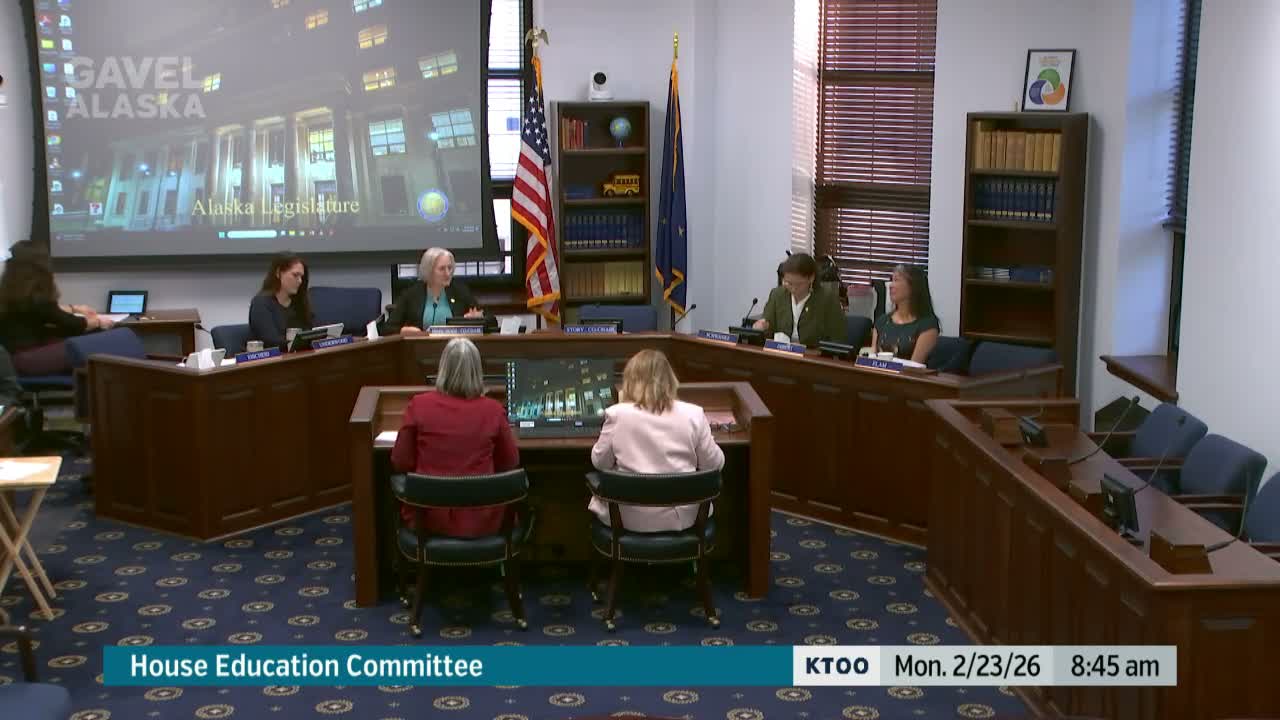
Representative Andy Story presented House Bill 261 to the House Education Committee on Feb. 23, asking for discussion of average daily membership (ADM) calculations and related school-funding changes.
Laurie Weed, school finance manager at the Department of Education and Early Development, told members that the fiscal note was generated by comparing each school's prior three-year average ADM (as defined in the bill) with the current preliminary October count and taking the greater of the two for each school, then applying school-size and other formula adjustments to arrive at district funding changes.
Weed said the method produces district- and school-dependent results and explained that components interact: removing a minimum ADM for alternative programs or changing how intensive-needs students are counted affects multiple formula pieces. She provided approximate component figures during the hearing: roughly $5.8 million for changes tied to alternative programs, approximately $43 million associated with the intensive-needs recalculation (the greater of the prior three-year average or the current count for those students), and a preliminary estimate that existing 'hold harmless' provisions cost the state roughly $12 million in state aid.
Committee members pressed for more transparent breakdowns and requested scenario runs to show districts that would experience large increases and those that would see decreases under the bill’s methodology. Representative Story and other members emphasized rural and very small districts’ vulnerability, recommending consideration of grandfathering or special protections for districts currently in hold-harmless status.
Laurie Weed agreed to provide scenarios and clarified that the fiscal-note modeling used FY27 projections in some comparisons and that providing separated component fiscal notes is feasible only as scenarios because results depend on initial ADM inputs.
After questions and requests for follow-up analysis, the committee set HB 261 aside pending DEED-provided scenarios and additional documentation.
Laurie Weed, school finance manager at the Department of Education and Early Development, told members that the fiscal note was generated by comparing each school's prior three-year average ADM (as defined in the bill) with the current preliminary October count and taking the greater of the two for each school, then applying school-size and other formula adjustments to arrive at district funding changes.
Weed said the method produces district- and school-dependent results and explained that components interact: removing a minimum ADM for alternative programs or changing how intensive-needs students are counted affects multiple formula pieces. She provided approximate component figures during the hearing: roughly $5.8 million for changes tied to alternative programs, approximately $43 million associated with the intensive-needs recalculation (the greater of the prior three-year average or the current count for those students), and a preliminary estimate that existing 'hold harmless' provisions cost the state roughly $12 million in state aid.
Committee members pressed for more transparent breakdowns and requested scenario runs to show districts that would experience large increases and those that would see decreases under the bill’s methodology. Representative Story and other members emphasized rural and very small districts’ vulnerability, recommending consideration of grandfathering or special protections for districts currently in hold-harmless status.
Laurie Weed agreed to provide scenarios and clarified that the fiscal-note modeling used FY27 projections in some comparisons and that providing separated component fiscal notes is feasible only as scenarios because results depend on initial ADM inputs.
After questions and requests for follow-up analysis, the committee set HB 261 aside pending DEED-provided scenarios and additional documentation.
View the Full Meeting & All Its Details
This article offers just a summary. Unlock complete video, transcripts, and insights as a Founder Member.
✓
Watch full, unedited meeting videos
✓
Search every word spoken in unlimited transcripts
✓
AI summaries & real-time alerts (all government levels)
✓
Permanent access to expanding government content
30-day money-back guarantee
