University of Alaska tells House Finance subcommittee student mental-health services are strained as FY27 funding is debated
February 23, 2026 | 2026 Legislature Alaska, Alaska
This article was created by AI summarizing key points discussed. AI makes mistakes, so for full details and context, please refer to the video of the full meeting. Please report any errors so we can fix them. Report an error »
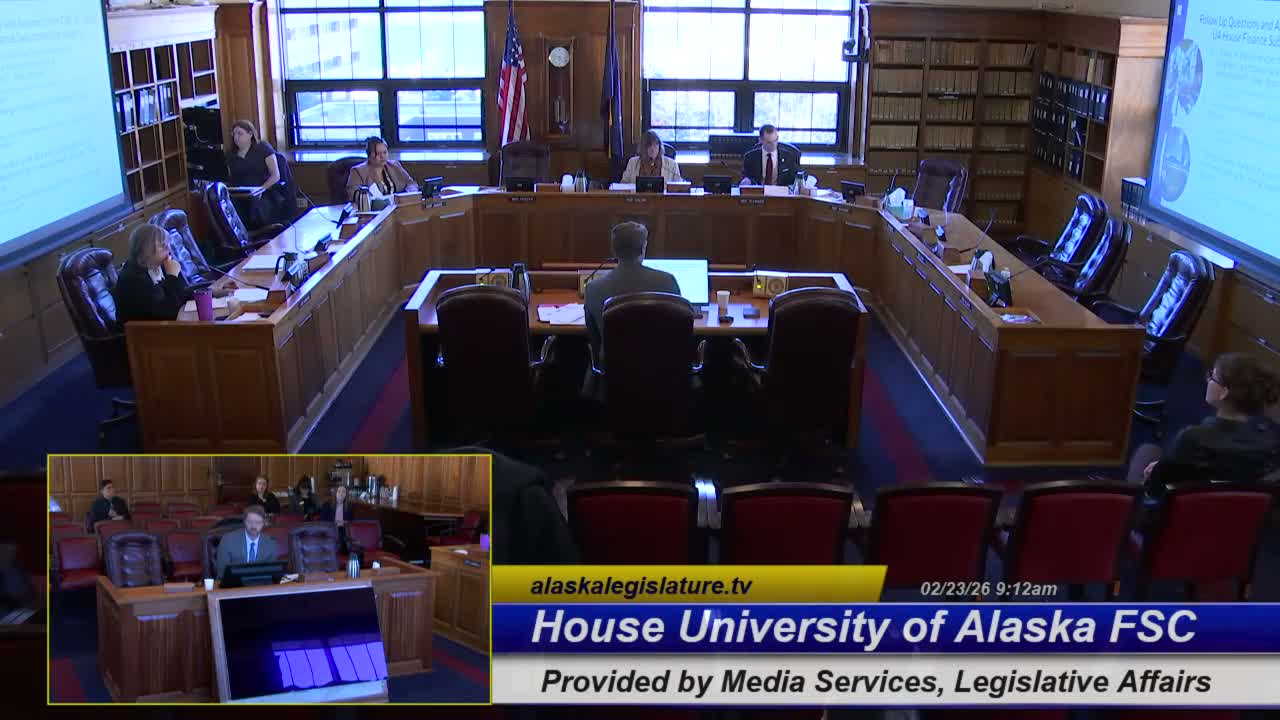
University of Alaska officials told a House Finance subcommittee on Monday that student mental-health services across the system are under strain and that additional funding requested in the FY27 budget is intended to expand counseling capacity and crisis response.
Chad Hutchison, UA state director for government relations, opened the discussion by framing mental health as a systemwide priority included in UA’s FY27 package. He asked campus vice chancellors to summarize demand and capacity so the committee could assess the request. "This was the point 9,000,000 that we referenced earlier," Hutchison said of the mental-health line in the materials, while also acknowledging variation in how the budget materials present the figure.
At the University of Alaska Anchorage, Vice Chancellor Ryan Buchholz told the committee the student health and counseling center and the CARE team have seen "significant growth since COVID," with the CARE team’s work up more than 37% in recent years. Buchholz said UA has lost counselors to higher-paying health-care employers nearby and has shifted to a hybrid model of in‑house counselors for crisis intervention plus telehealth to reduce multi‑week waits. "When it comes to suicidal ideation, 21 percent of our students who have responded to surveys have reported serious psychological distress," Buchholz said, adding that "30 percent of the students that seek mental-health support in our student health and counseling report having suicidal ideation." He estimated roughly 350 students had sought mental-health support at UAA.
Julie Queen, vice chancellor at the University of Alaska Fairbanks, described the Fairbanks campus as the largest residential campus and said increased enrollment has driven a demand that "far exceeds our current capacity." Hutchison supplied multi‑year appointment data from UAF’s counseling services, showing counseling appointments of roughly 2,609 in FY2022, 3,338 in FY2023 and 3,742 in FY2024, followed by a drop to 2,367 in FY2025 tied to unfilled positions and 1,346 appointments so far in FY2026.
UA Southeast vice chancellor John Luszynski said UAS operates with one full‑time counselor serving three campuses and that the institution is seeing hundreds of requests and a waitlist that the single counselor cannot meet. He provided campus percentages indicating rising suicidal ideation among students (25% in 2024, 32% in 2025 and 38% so far in 2026 among those who reached out to counseling services).
Alicia Krekenberg, director of the University of Alaska budget, told the committee that some FY27 increases shown in the governor’s amended budget are expressed as receipt authority (budget authority to spend money if received) rather than identified general‑fund dollars. "That’s correct. We do not know at this time where that money will come from," Krekenberg said about a separate $3.3 million compensation increase cited in the materials, explaining that receipt authority can reflect anticipated tuition or other receipts and that implementation may require reallocations and not filling vacancies.
Committee members pressed for clarity on the amount UA is requesting for mental‑health services and on how the governor’s amended budget treats those requests. Presenters and documents used inconsistent numeric formats in the hearing materials; presenters repeatedly tied the request to increasing counseling staffing and crisis response capacity rather than to a single, immediately-identified revenue source.
The subcommittee members said they intend to follow up with additional data requests and email exchanges; Chair Representative Galvin asked UA to provide the athletics slide and further detail by email and scheduled the next subcommittee meeting for March 2, 2026.
Ending: The committee did not vote on funding at the hearing; presenters provided numerical detail and asked for follow-up clarifications before the subcommittee’s closeout meeting.
Chad Hutchison, UA state director for government relations, opened the discussion by framing mental health as a systemwide priority included in UA’s FY27 package. He asked campus vice chancellors to summarize demand and capacity so the committee could assess the request. "This was the point 9,000,000 that we referenced earlier," Hutchison said of the mental-health line in the materials, while also acknowledging variation in how the budget materials present the figure.
At the University of Alaska Anchorage, Vice Chancellor Ryan Buchholz told the committee the student health and counseling center and the CARE team have seen "significant growth since COVID," with the CARE team’s work up more than 37% in recent years. Buchholz said UA has lost counselors to higher-paying health-care employers nearby and has shifted to a hybrid model of in‑house counselors for crisis intervention plus telehealth to reduce multi‑week waits. "When it comes to suicidal ideation, 21 percent of our students who have responded to surveys have reported serious psychological distress," Buchholz said, adding that "30 percent of the students that seek mental-health support in our student health and counseling report having suicidal ideation." He estimated roughly 350 students had sought mental-health support at UAA.
Julie Queen, vice chancellor at the University of Alaska Fairbanks, described the Fairbanks campus as the largest residential campus and said increased enrollment has driven a demand that "far exceeds our current capacity." Hutchison supplied multi‑year appointment data from UAF’s counseling services, showing counseling appointments of roughly 2,609 in FY2022, 3,338 in FY2023 and 3,742 in FY2024, followed by a drop to 2,367 in FY2025 tied to unfilled positions and 1,346 appointments so far in FY2026.
UA Southeast vice chancellor John Luszynski said UAS operates with one full‑time counselor serving three campuses and that the institution is seeing hundreds of requests and a waitlist that the single counselor cannot meet. He provided campus percentages indicating rising suicidal ideation among students (25% in 2024, 32% in 2025 and 38% so far in 2026 among those who reached out to counseling services).
Alicia Krekenberg, director of the University of Alaska budget, told the committee that some FY27 increases shown in the governor’s amended budget are expressed as receipt authority (budget authority to spend money if received) rather than identified general‑fund dollars. "That’s correct. We do not know at this time where that money will come from," Krekenberg said about a separate $3.3 million compensation increase cited in the materials, explaining that receipt authority can reflect anticipated tuition or other receipts and that implementation may require reallocations and not filling vacancies.
Committee members pressed for clarity on the amount UA is requesting for mental‑health services and on how the governor’s amended budget treats those requests. Presenters and documents used inconsistent numeric formats in the hearing materials; presenters repeatedly tied the request to increasing counseling staffing and crisis response capacity rather than to a single, immediately-identified revenue source.
The subcommittee members said they intend to follow up with additional data requests and email exchanges; Chair Representative Galvin asked UA to provide the athletics slide and further detail by email and scheduled the next subcommittee meeting for March 2, 2026.
Ending: The committee did not vote on funding at the hearing; presenters provided numerical detail and asked for follow-up clarifications before the subcommittee’s closeout meeting.
View the Full Meeting & All Its Details
This article offers just a summary. Unlock complete video, transcripts, and insights as a Founder Member.
✓
Watch full, unedited meeting videos
✓
Search every word spoken in unlimited transcripts
✓
AI summaries & real-time alerts (all government levels)
✓
Permanent access to expanding government content
30-day money-back guarantee
