University of Alaska outlines workforce gains and teacher pipeline shortfalls to House Finance subcommittee
February 23, 2026 | 2026 Legislature Alaska, Alaska
This article was created by AI summarizing key points discussed. AI makes mistakes, so for full details and context, please refer to the video of the full meeting. Please report any errors so we can fix them. Report an error »
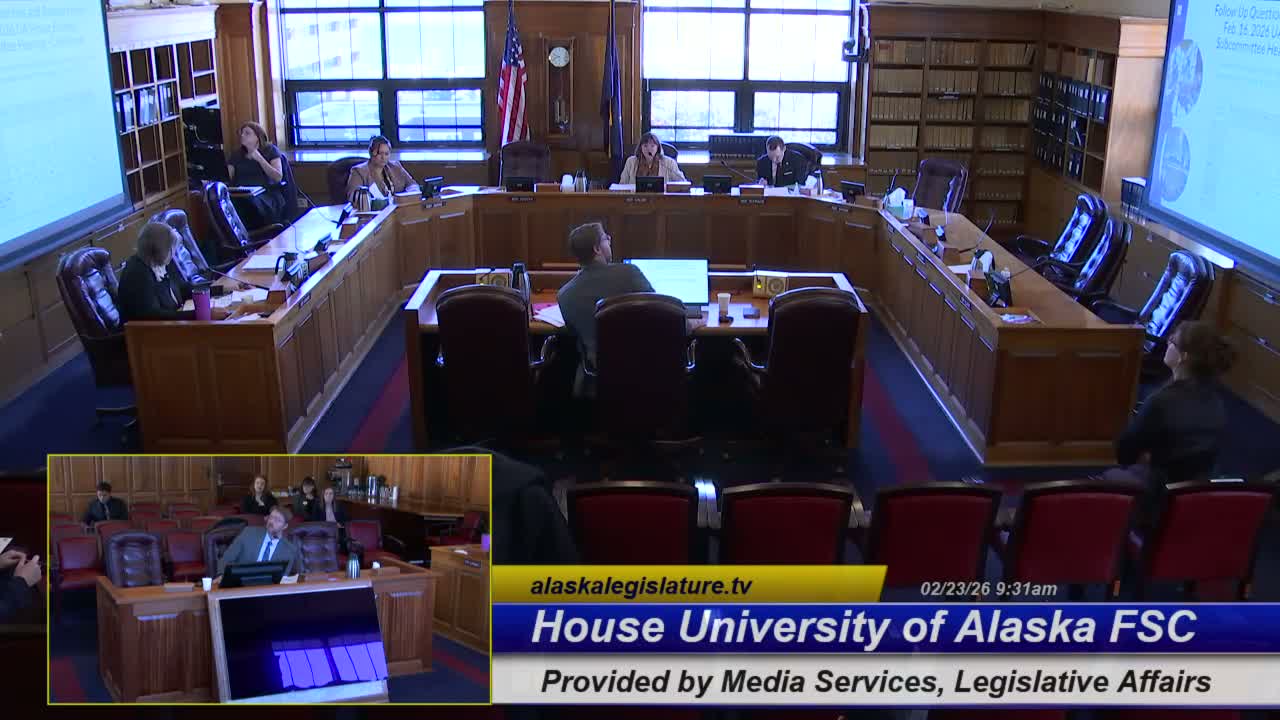
University of Alaska officials told the House Finance subcommittee on Feb. 23 that systemwide workforce programs produce graduates who largely remain in Alaska, but that teacher production and capacity for specialized trades face constraints that the FY27 budget seeks to address.
Terry Coughran, associate vice president for academic and student affairs, said UA serves more than 20,000 students and that 45% access education through 13 community campuses and technical colleges. "More than 90% of our graduates stay in Alaska," Coughran said, and noted that graduates earn roughly "26 to 35% above national medians." He highlighted health care as the largest growing sector and said recent investments aim to graduate an additional 100 healthcare workers annually.
Committee members then probed teacher production. Bridget Weiss, liaison to the Alaska College of Education Consortium, presented five-year initial‑licensure totals and attributed low production at UAA in part to a reaccreditation process that temporarily redirected students to other campuses. Weiss said UAA previously produced ‘‘over a hundred’’ initial licensures and that disruption contributed to declines at the system level. She described outreach programs (Ed Rising, Grow Your Own) and reported the university spends about $1,000,000 annually to support teacher candidates; Weiss said UA supported nearly 100 candidates this year and "turned down approximately 15 students" because of program criteria and capacity limits.
The committee also discussed maritime and trades training at UA Southeast. Vice Chancellor John Luszynski described associate degrees and continuing education in marine transportation, and the Maritime Training Center in Ketchikan, which he said is the largest USCG‑approved training center in the region. He told the committee that further expansion will require more space, housing and updated training equipment.
Members pressed whether state policy or funding could expand teacher pipelines and retention. Weiss said financial barriers persist and that some states fully support initial licensure during internships; she recommended state support to allow candidates to focus on training rather than costs. Representative Galvin emphasized classroom vacancies: "we began the school year with 319 classrooms without a teacher," Galvin said, adding that the shortfall disproportionately affects rural Alaska.
Ending: The subcommittee asked UA to provide additional data on workforce gaps and teacher-production trends and indicated it will consider those details in its closeout deliberations.
Terry Coughran, associate vice president for academic and student affairs, said UA serves more than 20,000 students and that 45% access education through 13 community campuses and technical colleges. "More than 90% of our graduates stay in Alaska," Coughran said, and noted that graduates earn roughly "26 to 35% above national medians." He highlighted health care as the largest growing sector and said recent investments aim to graduate an additional 100 healthcare workers annually.
Committee members then probed teacher production. Bridget Weiss, liaison to the Alaska College of Education Consortium, presented five-year initial‑licensure totals and attributed low production at UAA in part to a reaccreditation process that temporarily redirected students to other campuses. Weiss said UAA previously produced ‘‘over a hundred’’ initial licensures and that disruption contributed to declines at the system level. She described outreach programs (Ed Rising, Grow Your Own) and reported the university spends about $1,000,000 annually to support teacher candidates; Weiss said UA supported nearly 100 candidates this year and "turned down approximately 15 students" because of program criteria and capacity limits.
The committee also discussed maritime and trades training at UA Southeast. Vice Chancellor John Luszynski described associate degrees and continuing education in marine transportation, and the Maritime Training Center in Ketchikan, which he said is the largest USCG‑approved training center in the region. He told the committee that further expansion will require more space, housing and updated training equipment.
Members pressed whether state policy or funding could expand teacher pipelines and retention. Weiss said financial barriers persist and that some states fully support initial licensure during internships; she recommended state support to allow candidates to focus on training rather than costs. Representative Galvin emphasized classroom vacancies: "we began the school year with 319 classrooms without a teacher," Galvin said, adding that the shortfall disproportionately affects rural Alaska.
Ending: The subcommittee asked UA to provide additional data on workforce gaps and teacher-production trends and indicated it will consider those details in its closeout deliberations.
View the Full Meeting & All Its Details
This article offers just a summary. Unlock complete video, transcripts, and insights as a Founder Member.
✓
Watch full, unedited meeting videos
✓
Search every word spoken in unlimited transcripts
✓
AI summaries & real-time alerts (all government levels)
✓
Permanent access to expanding government content
30-day money-back guarantee
