Legislative fiscal office: FY26 post-transfer deficit $336.8M; oil price swings could materially change outlook
February 23, 2026 | 2026 Legislature Alaska, Alaska
This article was created by AI summarizing key points discussed. AI makes mistakes, so for full details and context, please refer to the video of the full meeting. Please report any errors so we can fix them. Report an error »
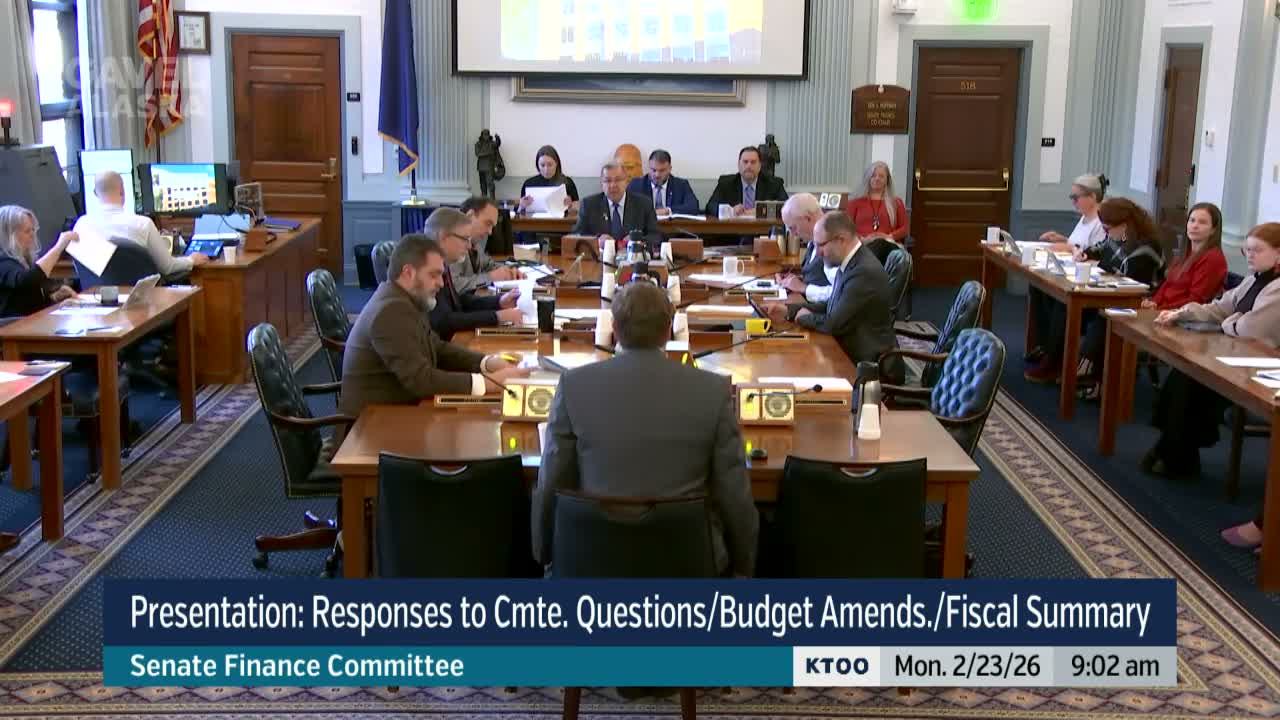
Lehi Painter, the Legislative Fiscal Analyst, told the Senate Finance Committee on Feb. 23 that the state’s post-transfer deficit for fiscal 2026 stands at $336.8 million and that a transfer to recapitalize the higher education fund would raise the total Constitutional Budget Reserve (CBR) draw to about $466.4 million.
Painter said the governor’s February supplementals net roughly $41.7 million in additional spending, with the largest single addition for fire suppression. He also highlighted a downward revision to Medicaid projections that appears small on summary slides but represents about a $12 million reduction in the projection once timing and separations are separated from the total.
Why it matters: Painter told senators that while recent higher oil receipts have improved near-term results, they do not cover the larger supplemental requests and structural pressures that push the FY27 shortfall to roughly $1.6 billion under the governor’s amended budget. ‘‘If you add that to the total CBR draw, then the total number is, 466,400,000.0 that would come out of the CBR,’’ Painter said, summarizing the larger fiscal exposure.
Painter reviewed a range of technical adjustments that reduce Unrestricted General Fund (UGF) revenue when the governor’s budget spends program receipts that otherwise would have lapsed. He cited a mining, land and water capital project (about $4.5 million) and a Commerce proposal using roughly $4.2 million in business licensing receipts as examples. ‘‘So spending those instead of lapsing them would reduce UGF revenue and therefore be the same from a deficit standpoint as spending UGF,’’ Painter said.
Senator Stedman pressed Painter on sensitivity to oil prices; Painter said that using futures prices as of the previous Friday (roughly $67–68 per barrel) would change an earlier FY26 $51 million deficit estimate into about a $30 million surplus, though it would not be sufficient to fund the supplemental package pending in the other chamber. He agreed to provide a sensitivity table showing outcomes at varying oil-price averages.
Painter also flagged outstanding contingent items likely to affect the budget: pending bargaining-unit adjustments for FY27 (five units are negotiating cost-of-living adjustments, with two agreements known but not yet in amendment form), a SNAP penalty from FY24 now in appeal, and the unresolved federal K–12 disparity test appeal that could increase school formula funding by roughly $78–79 million in FY26 (about $70M in FY27) if the state’s appeal fails.
Next steps: Painter said the key date for revenue forecasting is March 13, when the spring forecast will be released; legislators said they want a clear sensitivity table showing how different oil-price scenarios change the projected deficits. The committee moved on after questions and the fiscal briefing concluded.
Painter said the governor’s February supplementals net roughly $41.7 million in additional spending, with the largest single addition for fire suppression. He also highlighted a downward revision to Medicaid projections that appears small on summary slides but represents about a $12 million reduction in the projection once timing and separations are separated from the total.
Why it matters: Painter told senators that while recent higher oil receipts have improved near-term results, they do not cover the larger supplemental requests and structural pressures that push the FY27 shortfall to roughly $1.6 billion under the governor’s amended budget. ‘‘If you add that to the total CBR draw, then the total number is, 466,400,000.0 that would come out of the CBR,’’ Painter said, summarizing the larger fiscal exposure.
Painter reviewed a range of technical adjustments that reduce Unrestricted General Fund (UGF) revenue when the governor’s budget spends program receipts that otherwise would have lapsed. He cited a mining, land and water capital project (about $4.5 million) and a Commerce proposal using roughly $4.2 million in business licensing receipts as examples. ‘‘So spending those instead of lapsing them would reduce UGF revenue and therefore be the same from a deficit standpoint as spending UGF,’’ Painter said.
Senator Stedman pressed Painter on sensitivity to oil prices; Painter said that using futures prices as of the previous Friday (roughly $67–68 per barrel) would change an earlier FY26 $51 million deficit estimate into about a $30 million surplus, though it would not be sufficient to fund the supplemental package pending in the other chamber. He agreed to provide a sensitivity table showing outcomes at varying oil-price averages.
Painter also flagged outstanding contingent items likely to affect the budget: pending bargaining-unit adjustments for FY27 (five units are negotiating cost-of-living adjustments, with two agreements known but not yet in amendment form), a SNAP penalty from FY24 now in appeal, and the unresolved federal K–12 disparity test appeal that could increase school formula funding by roughly $78–79 million in FY26 (about $70M in FY27) if the state’s appeal fails.
Next steps: Painter said the key date for revenue forecasting is March 13, when the spring forecast will be released; legislators said they want a clear sensitivity table showing how different oil-price scenarios change the projected deficits. The committee moved on after questions and the fiscal briefing concluded.
View the Full Meeting & All Its Details
This article offers just a summary. Unlock complete video, transcripts, and insights as a Founder Member.
✓
Watch full, unedited meeting videos
✓
Search every word spoken in unlimited transcripts
✓
AI summaries & real-time alerts (all government levels)
✓
Permanent access to expanding government content
30-day money-back guarantee
