Alaska lawmakers press federal agencies after ICE detains family including young child
February 23, 2026 | 2026 Legislature Alaska, Alaska
This article was created by AI summarizing key points discussed. AI makes mistakes, so for full details and context, please refer to the video of the full meeting. Please report any errors so we can fix them. Report an error »
ANCHORAGE — Alaska’s House Judiciary Committee on Monday heard testimony from clergy, immigration lawyers and state law‑enforcement officials about recent U.S. Immigration and Customs Enforcement (ICE) activity in the state after a Soldotna family was detained and the mother and three children were removed to Mexico.
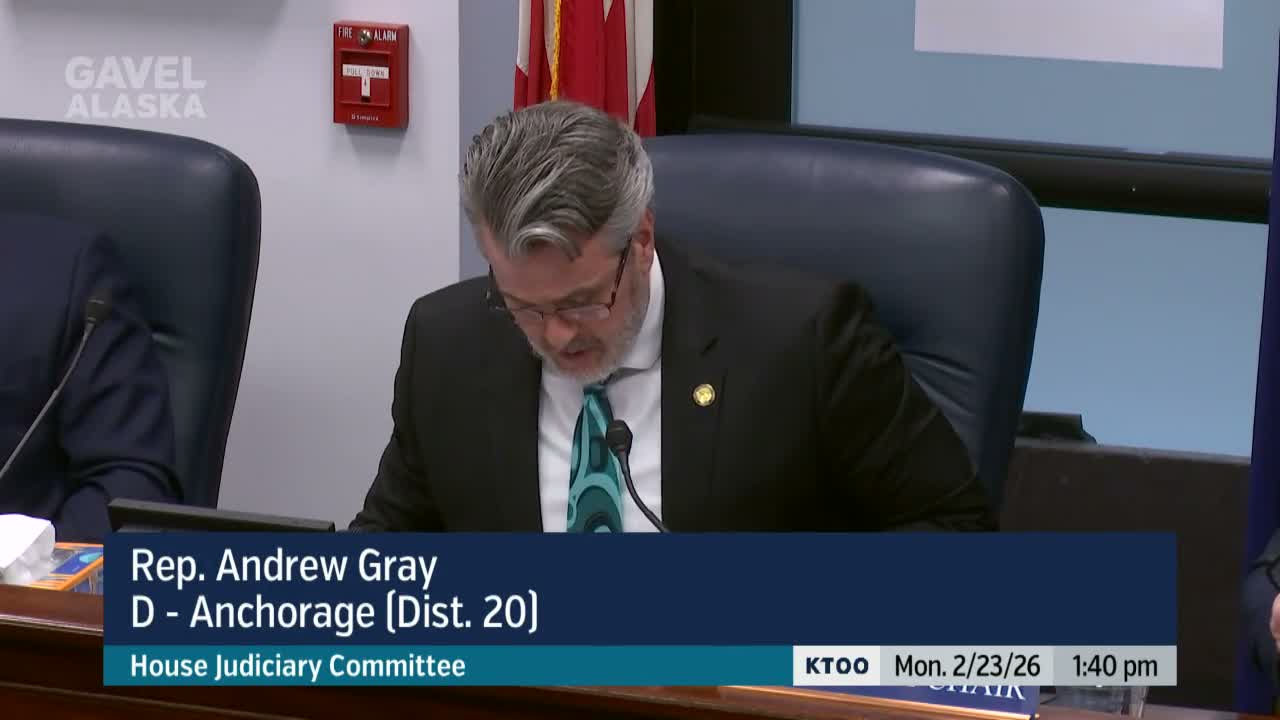
Representative Gray, chair of the committee, opened the hearing by citing historical and constitutional protections that frame immigration enforcement and said the committee wants answers about whether children’s protections under the Flores settlement agreement were followed in the Soldotna case.
Reverend Michael Burke, president of the Alaska Christian Conference, described calls he received after ICE officers in tactical gear appeared at the family’s home. "The 5‑year‑old was taken from his brother’s arms crying for his mother," Burke said, and he told lawmakers the family had no criminal history.
Allison Flack, a parent and classroom volunteer who said she knew the 5‑year‑old kindergartner, testified the child "was flourishing" academically and that parents and teachers were left panicked and searching for answers after the removal.
Elora Mukherjee, director of Columbia Law School’s Immigrants Rights Clinic, described nationwide enforcement changes since March 2025 and detailed conditions at the Dilley family detention facility in Texas, saying families have been held for months and that, from January to October 2025, "at least 3,800 children, including 20 infants, were detained by U.S. immigration authorities." Mukherjee warned that litigation is underway about the Flores settlement agreement and that termination would remove core protections for children.
Anna Taylor, executive director of the Alaska Institute for Justice, walked lawmakers through immigration status categories and administrative barriers in Alaska — including limited immigration legal services and a recent requirement for in‑person interpretation by U.S. Citizenship and Immigration Services — that can hinder immigrants’ ability to comply with administrative and court processes.
Jen Winkelman, commissioner of the Alaska Department of Corrections, and Zane Niswonger, DOC director of institutions, told the committee that DOC may temporarily hold civil federal detainees under contract and that ICE holds at the Anchorage Correctional Complex typically last about 72 hours before federal transfer. Niswonger said ICE detainees are kept separate from the criminal population and have standard visitation and phone access.
Deputy Commissioner Leon Morgan of the Department of Public Safety said DPS does not conduct Title‑8 immigration enforcement and is not a 287(g) signatory. Morgan declined to confirm whether ICE used a state trooper post to transfer the Soldotna family but said he would follow up if the committee requested more details.
Throughout the hearing, witnesses and committee members raised due‑process concerns. Mukherjee said rapid removals without meaningful opportunity to be heard — and protracted detention of children in facilities like Dilley — raise constitutional and humanitarian issues. "Detaining immigrant children is unjust," she said, and urged states to pursue measures to limit local involvement in detention and to demand federal accountability.
Chair Gray closed the hearing by saying the committee will draft a resolution asking the federal delegation to pursue immigration reform and formally requested written answers from ICE and DHS by 5 p.m. Friday, Feb. 27, warning the panel may pursue other options to compel testimony if agencies do not respond. The hearing adjourned at 3:37 p.m.
What happens next: The committee’s requested responses from ICE and the Department of Homeland Security are due Feb. 27; the committee signaled it may consider further measures, including a formal resolution, depending on the federal reply.
Representative Gray, chair of the committee, opened the hearing by citing historical and constitutional protections that frame immigration enforcement and said the committee wants answers about whether children’s protections under the Flores settlement agreement were followed in the Soldotna case.
Reverend Michael Burke, president of the Alaska Christian Conference, described calls he received after ICE officers in tactical gear appeared at the family’s home. "The 5‑year‑old was taken from his brother’s arms crying for his mother," Burke said, and he told lawmakers the family had no criminal history.
Allison Flack, a parent and classroom volunteer who said she knew the 5‑year‑old kindergartner, testified the child "was flourishing" academically and that parents and teachers were left panicked and searching for answers after the removal.
Elora Mukherjee, director of Columbia Law School’s Immigrants Rights Clinic, described nationwide enforcement changes since March 2025 and detailed conditions at the Dilley family detention facility in Texas, saying families have been held for months and that, from January to October 2025, "at least 3,800 children, including 20 infants, were detained by U.S. immigration authorities." Mukherjee warned that litigation is underway about the Flores settlement agreement and that termination would remove core protections for children.
Anna Taylor, executive director of the Alaska Institute for Justice, walked lawmakers through immigration status categories and administrative barriers in Alaska — including limited immigration legal services and a recent requirement for in‑person interpretation by U.S. Citizenship and Immigration Services — that can hinder immigrants’ ability to comply with administrative and court processes.
Jen Winkelman, commissioner of the Alaska Department of Corrections, and Zane Niswonger, DOC director of institutions, told the committee that DOC may temporarily hold civil federal detainees under contract and that ICE holds at the Anchorage Correctional Complex typically last about 72 hours before federal transfer. Niswonger said ICE detainees are kept separate from the criminal population and have standard visitation and phone access.
Deputy Commissioner Leon Morgan of the Department of Public Safety said DPS does not conduct Title‑8 immigration enforcement and is not a 287(g) signatory. Morgan declined to confirm whether ICE used a state trooper post to transfer the Soldotna family but said he would follow up if the committee requested more details.
Throughout the hearing, witnesses and committee members raised due‑process concerns. Mukherjee said rapid removals without meaningful opportunity to be heard — and protracted detention of children in facilities like Dilley — raise constitutional and humanitarian issues. "Detaining immigrant children is unjust," she said, and urged states to pursue measures to limit local involvement in detention and to demand federal accountability.
Chair Gray closed the hearing by saying the committee will draft a resolution asking the federal delegation to pursue immigration reform and formally requested written answers from ICE and DHS by 5 p.m. Friday, Feb. 27, warning the panel may pursue other options to compel testimony if agencies do not respond. The hearing adjourned at 3:37 p.m.
What happens next: The committee’s requested responses from ICE and the Department of Homeland Security are due Feb. 27; the committee signaled it may consider further measures, including a formal resolution, depending on the federal reply.
View the Full Meeting & All Its Details
This article offers just a summary. Unlock complete video, transcripts, and insights as a Founder Member.
✓
Watch full, unedited meeting videos
✓
Search every word spoken in unlimited transcripts
✓
AI summaries & real-time alerts (all government levels)
✓
Permanent access to expanding government content
30-day money-back guarantee
