Alaska Judicial Council tells Senate Judiciary Committee recidivism stats reflect measurement limits
February 23, 2026 | 2026 Legislature Alaska, Alaska
This article was created by AI summarizing key points discussed. AI makes mistakes, so for full details and context, please refer to the video of the full meeting. Please report any errors so we can fix them. Report an error »
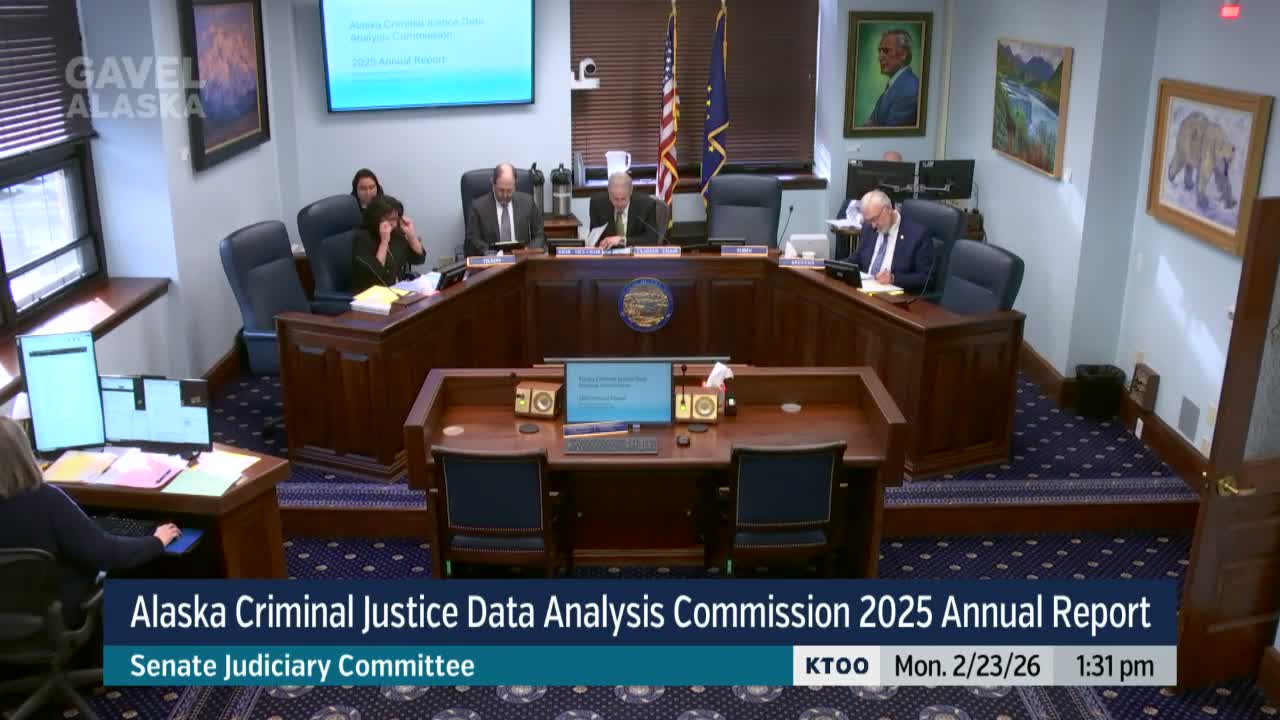
Suzanne DiPietro, executive director of the Alaska Judicial Council, told the Senate Judiciary Committee on Feb. 23 that measured recidivism reflects the limits of available data and the operations of the criminal justice system.
"We can only measure the data that we have," DiPietro said, explaining that official counts capture arrests, convictions and returns to correctional facilities but do not necessarily reflect all criminal behavior. She said the commission follows previously convicted cohorts for three years after conviction (or for three years after release from prison) to record bookings and returns to custody.
DiPietro described multiple recidivism metrics'1 rearrest, reconviction and reincarceration'1 and warned they can produce different results. She noted that dismissals and prosecutorial decisions affect reconviction-based rates and that local law-enforcement practices and prosecution policies can shape measured outcomes.
Committee members observed that the most recent cohort (2022) appeared to show reduced recidivism compared with prior years. DiPietro said pandemic-era changes in court and corrections operations, and smaller cohort sizes, could explain part of the decline and recommended continued monitoring and follow-up analyses.
The presentation included a review of probation and parole data. DiPietro said about 3,200 people were on supervised probation or parole in Alaska and that 714 people were released to parole in 2024, of whom 655 were mandatory parole releases and 59 were discretionary parole releases. She added that geriatric and special-medical parole categories exist in statute but were not common in the most recent snapshot and that she would check with the Board of Parole for historical use rates.
DiPietro described a 2017 law change that mandated parole hearings for newly eligible people, producing a large spike in discretionary-parole hearings, and a later 2019 reversal that required an application and narrowed eligibility, after which hearings and grants declined.
Committee members requested a breakdown of recidivism by offense type (misdemeanor versus felony); DiPietro said she would follow up with that disaggregation. She urged the committee to treat recidivism trends cautiously given measurement constraints and the interaction of individual behavior and system practices.
The committee closed the discussion with an offer to submit follow-up questions to the Judicial Council and Department of Public Health staff for additional data and clarification.
"We can only measure the data that we have," DiPietro said, explaining that official counts capture arrests, convictions and returns to correctional facilities but do not necessarily reflect all criminal behavior. She said the commission follows previously convicted cohorts for three years after conviction (or for three years after release from prison) to record bookings and returns to custody.
DiPietro described multiple recidivism metrics'1 rearrest, reconviction and reincarceration'1 and warned they can produce different results. She noted that dismissals and prosecutorial decisions affect reconviction-based rates and that local law-enforcement practices and prosecution policies can shape measured outcomes.
Committee members observed that the most recent cohort (2022) appeared to show reduced recidivism compared with prior years. DiPietro said pandemic-era changes in court and corrections operations, and smaller cohort sizes, could explain part of the decline and recommended continued monitoring and follow-up analyses.
The presentation included a review of probation and parole data. DiPietro said about 3,200 people were on supervised probation or parole in Alaska and that 714 people were released to parole in 2024, of whom 655 were mandatory parole releases and 59 were discretionary parole releases. She added that geriatric and special-medical parole categories exist in statute but were not common in the most recent snapshot and that she would check with the Board of Parole for historical use rates.
DiPietro described a 2017 law change that mandated parole hearings for newly eligible people, producing a large spike in discretionary-parole hearings, and a later 2019 reversal that required an application and narrowed eligibility, after which hearings and grants declined.
Committee members requested a breakdown of recidivism by offense type (misdemeanor versus felony); DiPietro said she would follow up with that disaggregation. She urged the committee to treat recidivism trends cautiously given measurement constraints and the interaction of individual behavior and system practices.
The committee closed the discussion with an offer to submit follow-up questions to the Judicial Council and Department of Public Health staff for additional data and clarification.
View the Full Meeting & All Its Details
This article offers just a summary. Unlock complete video, transcripts, and insights as a Founder Member.
✓
Watch full, unedited meeting videos
✓
Search every word spoken in unlimited transcripts
✓
AI summaries & real-time alerts (all government levels)
✓
Permanent access to expanding government content
30-day money-back guarantee
