Alaska committee adopts substitute to ease physician assistant administrative burdens
February 23, 2026 | 2026 Legislature Alaska, Alaska
This article was created by AI summarizing key points discussed. AI makes mistakes, so for full details and context, please refer to the video of the full meeting. Please report any errors so we can fix them. Report an error »
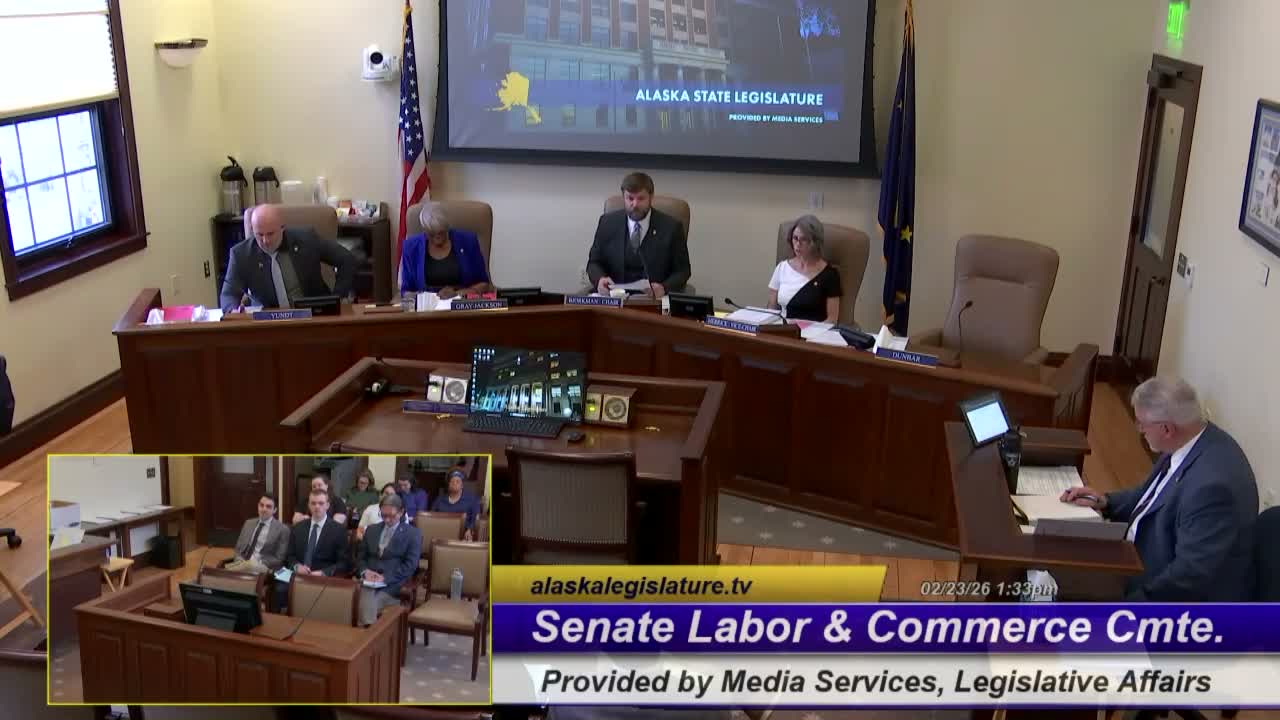
The Alaska Senate Labor and Commerce Committee on Feb. 23 adopted a committee substitute for Senate Bill 89, a measure the sponsor said is intended "to reduce the significant administrative burden on physician assistants to allow them to work to the maximum scope of their licensure." The committee later voted to report the bill from committee with individual recommendations and attached fiscal notes.
Sen. Lukey Gail Tobin, sponsor of SB 89, told the committee the new substitute reflects a compromise reached with stakeholder groups and replaces an earlier national approach with language tailored to Alaska. "We found that the legislation that we were considering took a national approach," Tobin said, arguing the rewrite "Alaskanize[s] our approach" and prioritizes continued patient access to care.
Staff explained the substitute (version W in the committee packet) preserves collaborative agreements for PAs practicing outside a set of enumerated facility types but allows PAs who practice at certain locations to operate without a separate collaborating agreement. Those facility types include sites directed by a licensed physician, facilities licensed by the Department of Health, federally operated facilities, tribal organizations, federally qualified health centers or rural health clinics in qualifying communities, and military or veterans facilities. Mackenzie Pope, staff to the sponsor, said the change "maintains the collaborative agreement for physician assistants" while narrowing the pool of PAs who must seek individual collaborating signatures.
The sponsor noted prior testimony that some physician assistants paid "upwards of $50,000" for collaborating agreements, a cost he said the bill seeks to reduce. Committee members asked how the substitute would affect PAs who own independent private practices; staff said such practices would generally remain under the existing collaborative agreement regime unless the State Medical Board granted an exception after an application.
A committee member moved to adopt the substitute, and after brief discussion the committee adopted the substitute and later moved to report SB 89 from committee with individual recommendations and attached fiscal notes. The transcript records no roll‑call vote; the chair announced the report after hearing no objections.
The committee took no final floor action on implementation details; the sponsor and staff said the State Medical Board retains discretion to consider exceptions. The bill will move forward with the committee substitute and is expected to appear in subsequent committee or floor calendars.
Sen. Lukey Gail Tobin, sponsor of SB 89, told the committee the new substitute reflects a compromise reached with stakeholder groups and replaces an earlier national approach with language tailored to Alaska. "We found that the legislation that we were considering took a national approach," Tobin said, arguing the rewrite "Alaskanize[s] our approach" and prioritizes continued patient access to care.
Staff explained the substitute (version W in the committee packet) preserves collaborative agreements for PAs practicing outside a set of enumerated facility types but allows PAs who practice at certain locations to operate without a separate collaborating agreement. Those facility types include sites directed by a licensed physician, facilities licensed by the Department of Health, federally operated facilities, tribal organizations, federally qualified health centers or rural health clinics in qualifying communities, and military or veterans facilities. Mackenzie Pope, staff to the sponsor, said the change "maintains the collaborative agreement for physician assistants" while narrowing the pool of PAs who must seek individual collaborating signatures.
The sponsor noted prior testimony that some physician assistants paid "upwards of $50,000" for collaborating agreements, a cost he said the bill seeks to reduce. Committee members asked how the substitute would affect PAs who own independent private practices; staff said such practices would generally remain under the existing collaborative agreement regime unless the State Medical Board granted an exception after an application.
A committee member moved to adopt the substitute, and after brief discussion the committee adopted the substitute and later moved to report SB 89 from committee with individual recommendations and attached fiscal notes. The transcript records no roll‑call vote; the chair announced the report after hearing no objections.
The committee took no final floor action on implementation details; the sponsor and staff said the State Medical Board retains discretion to consider exceptions. The bill will move forward with the committee substitute and is expected to appear in subsequent committee or floor calendars.
Don't Miss a Word: See the Full Meeting!
Go beyond summaries. Unlock every video, transcript, and key insight with a Founder Membership.
✓
Get instant access to full meeting videos
✓
Search and clip any phrase from complete transcripts
✓
Receive AI-powered summaries & custom alerts
✓
Enjoy lifetime, unrestricted access to government data
30-day money-back guarantee
