House Finance Committee reexamines bill to create Alaska Innovation Council amid budget concerns
February 23, 2026 | 2026 Legislature Alaska, Alaska
This article was created by AI summarizing key points discussed. AI makes mistakes, so for full details and context, please refer to the video of the full meeting. Please report any errors so we can fix them. Report an error »
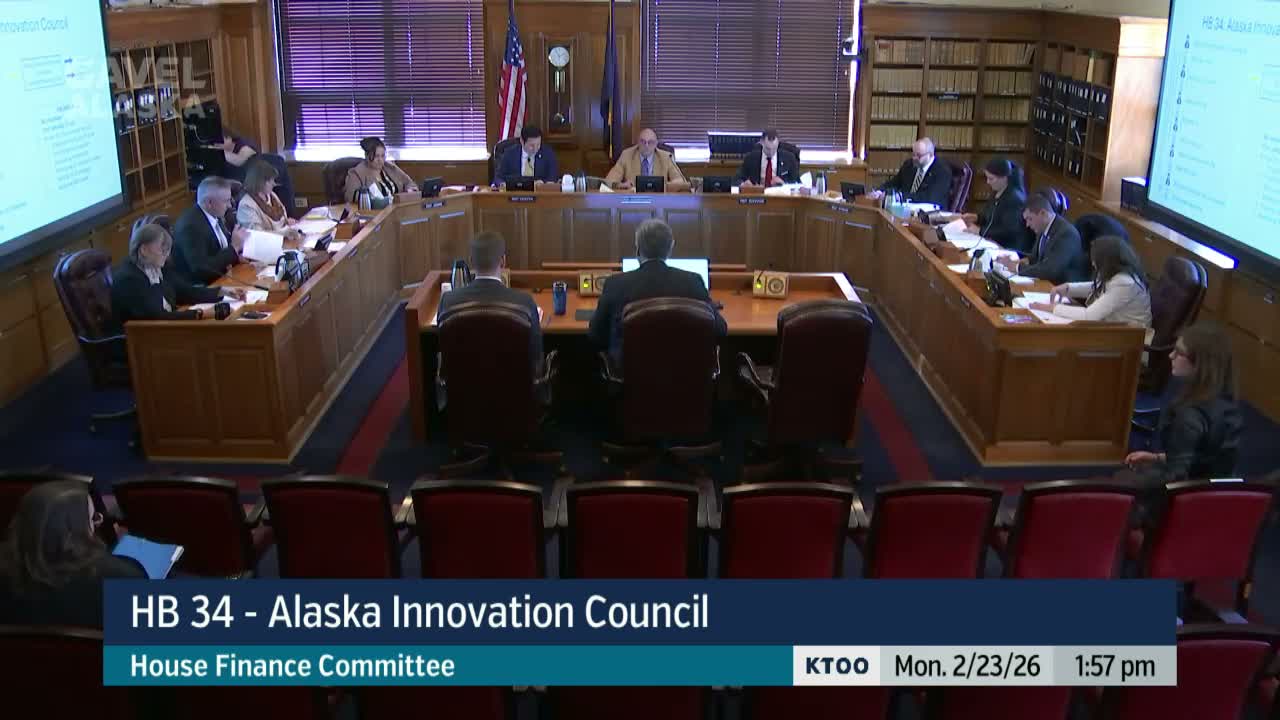
Representative Kai Holland reintroduced House Bill 34 to the House Finance Committee on Feb. 23, 2026, saying the bill would create an Alaska Innovation Council to advise the governor, Legislature, researchers and the private sector and produce an annual innovation and economic-competitiveness plan.
The sponsor and his staff, including Tim Truer, said the council would be embedded in the Department of Commerce, Community and Economic Development (DCCED), would have 12 members drawn from private sector, state government, academia, labor and economic development organizations, and would produce an annual “innovation and economic competitiveness plan.” Truer summarized structural changes from last session: membership was reduced from 19 to 12, legislative members were removed, meetings were moved online and stipends for members were removed.
DCCED Administrative Director Hannah Lager reviewed the department’s fiscal note, saying the commissioner's office submitted one change (a $1,000 increase in personal services to reflect contractual rates) and listing line items: $166,500 in personal services, $175,000 in services and $10,000 in commodities. Lager later explained that the personal services line funds one program manager (range 21, step C, fully loaded) and that services include about $150,000 for contracted research, data collection and analytics, $25,000 for statewide core services and $10,000 for start-up equipment.
“I think the position would support the board activities, and also take the assignments from the board and actually enact them in the timeframe,” Lager said, explaining staff would advance council work between meetings.
Several members pressed on the fiscal trade-offs. Representative Ballard said the committee should avoid adding recurring costs while large numbers of state positions remain vacant, stating, “Anything with the fiscal note is screaming, no.” Representative Ballard and others asked whether DCCED could perform the work without creating a separate council; Holland and Lager said the department no longer has staff capacity for that role because prior economic-development lines and positions were drawn down or zeroed in recent budgets.
Lawmakers sought measurable success criteria. Holland and others said early performance metrics would include private capital deployment, formation of new businesses and number of jobs created; the sponsor cited the Oregon model and a UAA Center for Economic Development study showing high growth among young firms. Holland said he would judge success by whether the council helps reverse net out-migration and create jobs that keep young Alaskans in the state.
Procedural steps: Co Chair Foster set an amendment deadline for HB34 for March 2, 2026, at 5:00 p.m., and committee staff were directed to accept amendments. The bill was then placed aside for future consideration.
The committee discussion left open several follow-ups requested by members, including more documentation of past DCCED performance and clearer short-term metrics for the council’s work. Representative Holland closed by urging the panel to consider the role of public investment in fostering innovation and long-term economic growth.
The sponsor and his staff, including Tim Truer, said the council would be embedded in the Department of Commerce, Community and Economic Development (DCCED), would have 12 members drawn from private sector, state government, academia, labor and economic development organizations, and would produce an annual “innovation and economic competitiveness plan.” Truer summarized structural changes from last session: membership was reduced from 19 to 12, legislative members were removed, meetings were moved online and stipends for members were removed.
DCCED Administrative Director Hannah Lager reviewed the department’s fiscal note, saying the commissioner's office submitted one change (a $1,000 increase in personal services to reflect contractual rates) and listing line items: $166,500 in personal services, $175,000 in services and $10,000 in commodities. Lager later explained that the personal services line funds one program manager (range 21, step C, fully loaded) and that services include about $150,000 for contracted research, data collection and analytics, $25,000 for statewide core services and $10,000 for start-up equipment.
“I think the position would support the board activities, and also take the assignments from the board and actually enact them in the timeframe,” Lager said, explaining staff would advance council work between meetings.
Several members pressed on the fiscal trade-offs. Representative Ballard said the committee should avoid adding recurring costs while large numbers of state positions remain vacant, stating, “Anything with the fiscal note is screaming, no.” Representative Ballard and others asked whether DCCED could perform the work without creating a separate council; Holland and Lager said the department no longer has staff capacity for that role because prior economic-development lines and positions were drawn down or zeroed in recent budgets.
Lawmakers sought measurable success criteria. Holland and others said early performance metrics would include private capital deployment, formation of new businesses and number of jobs created; the sponsor cited the Oregon model and a UAA Center for Economic Development study showing high growth among young firms. Holland said he would judge success by whether the council helps reverse net out-migration and create jobs that keep young Alaskans in the state.
Procedural steps: Co Chair Foster set an amendment deadline for HB34 for March 2, 2026, at 5:00 p.m., and committee staff were directed to accept amendments. The bill was then placed aside for future consideration.
The committee discussion left open several follow-ups requested by members, including more documentation of past DCCED performance and clearer short-term metrics for the council’s work. Representative Holland closed by urging the panel to consider the role of public investment in fostering innovation and long-term economic growth.
View the Full Meeting & All Its Details
This article offers just a summary. Unlock complete video, transcripts, and insights as a Founder Member.
✓
Watch full, unedited meeting videos
✓
Search every word spoken in unlimited transcripts
✓
AI summaries & real-time alerts (all government levels)
✓
Permanent access to expanding government content
30-day money-back guarantee
