Task force hears that Alaska special education funding and staffing are outpaced by rising needs
February 23, 2026 | 2026 Legislature Alaska, Alaska
This article was created by AI summarizing key points discussed. AI makes mistakes, so for full details and context, please refer to the video of the full meeting. Please report any errors so we can fix them. Report an error »
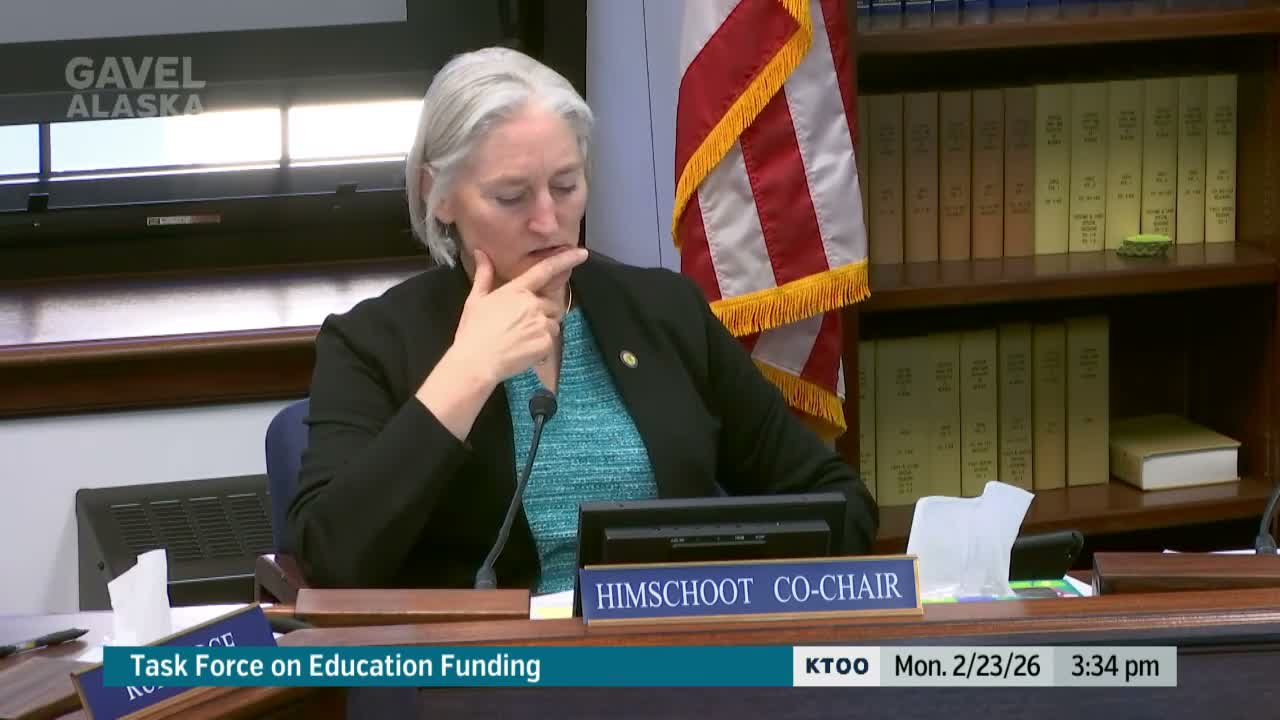
The Legislative Task Force on Education Funding heard on Feb. 23 in Juneau that Alaska’s special education system is straining under growing student need and funding that does not match costs. Presenters from districts, the statewide school business association, the Special Education Service Agency (CESA), and the Department of Education and Early Development said staffing shortages, timing of intensive funding, and limitations of the foundation formula are causing districts to shift general funds and reduce programs.
Kim Saunders, assistant superintendent for the Kodiak Island Borough School District, told the task force that Individualized Education Programs (IEPs) set legally required services and that ‘‘that funding amount has not kept up even remotely, quite frankly, with the cost of actually educating students in special education’’ and that the shortfall is often covered from general fund dollars. Saunders described a recent rural placement where meeting a student’s IEP after the October count required flying substitute staff, housing and frequent travel; she estimated the district could spend ‘‘probably 500,000 to deliver that one student's educational program in a rural site’’ when a student moved into Old Harbor mid‑year.
Jada Kahl, an occupational therapist with the Juneau School District, distinguished caseload (direct service minutes) from workload (documentation, collaboration, progress reporting and related duties). Using an example, she showed how direct minutes that sum to roughly 13 hours of service per week can expand to 37.5 hours of workload once paperwork, meetings and preparation are counted, and she said many related‑service providers in districts are contractors, increasing turnover and costs.
Katie Parrott, president of the Alaska Association of School Business Officials, reviewed the ‘‘special needs factor’’ in the foundation formula (commonly referenced as the 0.2 factor) and presented FY2024 district comparisons. Parrott said the 0.2 factor is a 20% multiplier applied to adjusted ADM and administered as a flexible block grant (citing AS 14.17.421), but in many districts that increment does not cover documented special education and intensive needs expenditures once optional chart‑of‑accounts coding and federal/deduction effects are considered. ‘‘If the BSA is not increased overtime, that 0.2 factor will never increase,’’ she told members, warning that declining enrollment can shrink the revenue even as special education populations grow.
Olivia Yancey, executive director of the Special Education Service Agency (CESA), described how CESA provides consultative teams, a statewide lending library and targeted site visits for low‑incidence disabilities — services she said save rural districts money by avoiding the cost of hiring full‑time specialists. Yancey said CESA’s caseload limits and travel needs create wait lists for some services.
From the Department of Education and Early Development (DEED), Dr. Monica Goyette and Deb Riddle summarized federal and state funding flows and reporting obligations. DEED reported about 20,578 students with IEPs in 2024–25 (about 16% of enrolled students), described IDEA Part B grants and monitoring responsibilities, and said IDEA funds are distributed by formula. DEED staff and federal grant administrators on the line said that federal IDEA funding has historically fallen short of the statutory commitment to cover the full cost of IDEA obligations and that maintenance‑of‑effort rules require states and districts to sustain prior support levels.
Lawmakers pressed presenters on specifics: how coding and vacancies can mask unmet needs, whether reduced base services (counseling, early intervention) drives later growth in intensive classifications, and which workload tasks require licensed professionals. Presenters repeatedly urged the task force to consider the timing of intensive funding, improved expenditure disaggregation, adjustments to the BSA or special‑needs multiplier, and targeted investments in recruitment and retention.
The task force did not take formal action at the meeting. Members set the next meeting for March 9 to address major maintenance issues and funding; a joint House Education Committee session with the State Board of Education is scheduled for March 11.
Kim Saunders, assistant superintendent for the Kodiak Island Borough School District, told the task force that Individualized Education Programs (IEPs) set legally required services and that ‘‘that funding amount has not kept up even remotely, quite frankly, with the cost of actually educating students in special education’’ and that the shortfall is often covered from general fund dollars. Saunders described a recent rural placement where meeting a student’s IEP after the October count required flying substitute staff, housing and frequent travel; she estimated the district could spend ‘‘probably 500,000 to deliver that one student's educational program in a rural site’’ when a student moved into Old Harbor mid‑year.
Jada Kahl, an occupational therapist with the Juneau School District, distinguished caseload (direct service minutes) from workload (documentation, collaboration, progress reporting and related duties). Using an example, she showed how direct minutes that sum to roughly 13 hours of service per week can expand to 37.5 hours of workload once paperwork, meetings and preparation are counted, and she said many related‑service providers in districts are contractors, increasing turnover and costs.
Katie Parrott, president of the Alaska Association of School Business Officials, reviewed the ‘‘special needs factor’’ in the foundation formula (commonly referenced as the 0.2 factor) and presented FY2024 district comparisons. Parrott said the 0.2 factor is a 20% multiplier applied to adjusted ADM and administered as a flexible block grant (citing AS 14.17.421), but in many districts that increment does not cover documented special education and intensive needs expenditures once optional chart‑of‑accounts coding and federal/deduction effects are considered. ‘‘If the BSA is not increased overtime, that 0.2 factor will never increase,’’ she told members, warning that declining enrollment can shrink the revenue even as special education populations grow.
Olivia Yancey, executive director of the Special Education Service Agency (CESA), described how CESA provides consultative teams, a statewide lending library and targeted site visits for low‑incidence disabilities — services she said save rural districts money by avoiding the cost of hiring full‑time specialists. Yancey said CESA’s caseload limits and travel needs create wait lists for some services.
From the Department of Education and Early Development (DEED), Dr. Monica Goyette and Deb Riddle summarized federal and state funding flows and reporting obligations. DEED reported about 20,578 students with IEPs in 2024–25 (about 16% of enrolled students), described IDEA Part B grants and monitoring responsibilities, and said IDEA funds are distributed by formula. DEED staff and federal grant administrators on the line said that federal IDEA funding has historically fallen short of the statutory commitment to cover the full cost of IDEA obligations and that maintenance‑of‑effort rules require states and districts to sustain prior support levels.
Lawmakers pressed presenters on specifics: how coding and vacancies can mask unmet needs, whether reduced base services (counseling, early intervention) drives later growth in intensive classifications, and which workload tasks require licensed professionals. Presenters repeatedly urged the task force to consider the timing of intensive funding, improved expenditure disaggregation, adjustments to the BSA or special‑needs multiplier, and targeted investments in recruitment and retention.
The task force did not take formal action at the meeting. Members set the next meeting for March 9 to address major maintenance issues and funding; a joint House Education Committee session with the State Board of Education is scheduled for March 11.
View the Full Meeting & All Its Details
This article offers just a summary. Unlock complete video, transcripts, and insights as a Founder Member.
✓
Watch full, unedited meeting videos
✓
Search every word spoken in unlimited transcripts
✓
AI summaries & real-time alerts (all government levels)
✓
Permanent access to expanding government content
30-day money-back guarantee
