Analysis presented to legislature finds Alaska’s 0.2 special‑needs multiplier often falls short
February 23, 2026 | 2026 Legislature Alaska, Alaska
This article was created by AI summarizing key points discussed. AI makes mistakes, so for full details and context, please refer to the video of the full meeting. Please report any errors so we can fix them. Report an error »
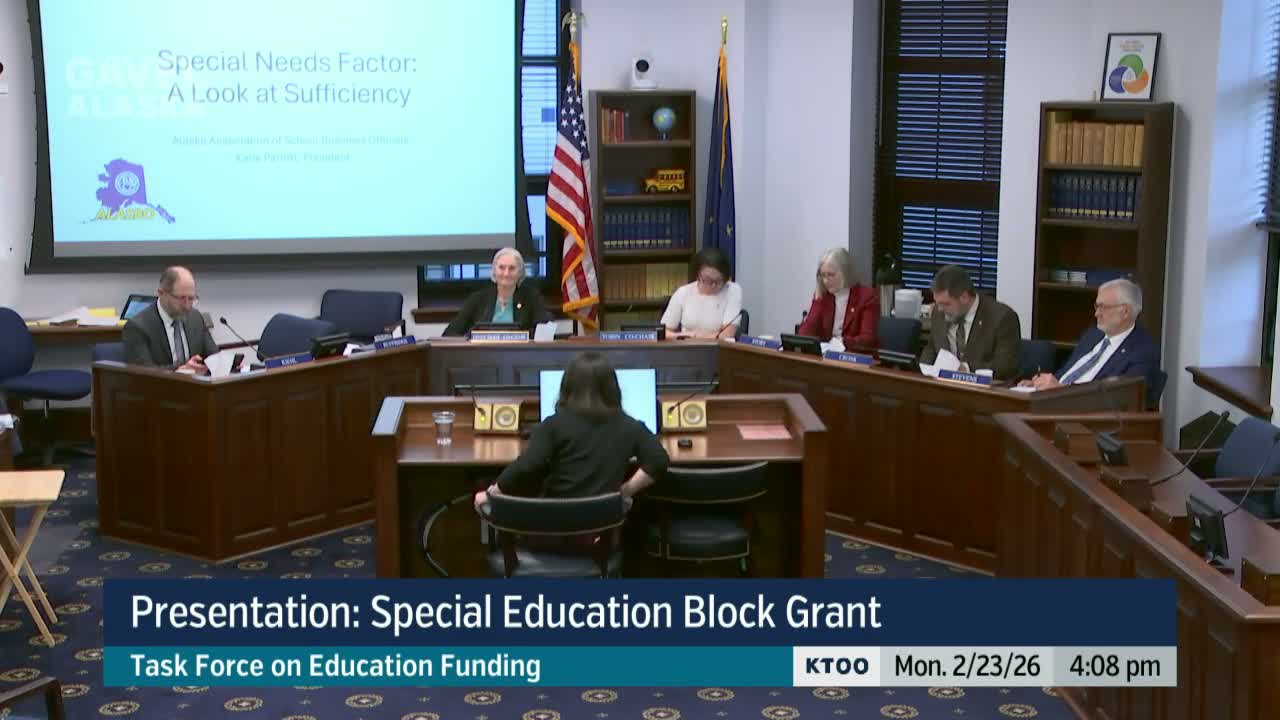
At a Feb. 23 task force hearing in Juneau, Katie Parrott, president of the Alaska Association of School Business Officials (ElASBO), presented a sufficiency analysis of the special needs factor (the 0.2 multiplier) in the state’s foundation formula. Parrott said the factor is designed as a flexible block grant under AS 14.17.421 and provides a 20% increment to adjusted ADM, but that increment does not consistently cover districts’ documented special education and related expenditures.
Using FY2024 data and a methodology that isolated the revenue generated by the 0.2 multiplier (without adjusting for proportional reductions such as required local contribution or deductible federal impact aid), Parrott compared revenue to reported expenditures in several districts. She said Juneau, North Slope and Anchorage showed deficits once related function expenditures (counselors, mental‑health supports and other functions outside the core special education code) were included. Lake and Peninsula appeared balanced on paper, Parrott said, but staff retiree rehires, prior cuts to counselors and reliance on grant funding complicate the interpretation.
Parrott explained coding limitations in the Alaska Uniform Chart of Accounts and that optional categories for bilingual, gifted and vocational services are not uniformly used, which reduces the ability to disaggregate expenditures for the special‑needs factor. She told the committee, "we didn't want to adjust revenue for proportional reductions...we felt it was a better analysis to look at that on the face of it," and warned that if the base student allocation (BSA) is not increased, the 0.2 increment will effectively shrink as enrollment falls.
Lawmakers asked whether reduced early interventions or counseling could increase future intensive classifications; Parrott said early intervention does heavy lifting for later problems and she recommended that any sufficiency review consider the full foundation formula dynamics and deductions that reduce net revenue.
Parrott closed by urging better expenditure disaggregation, consideration of BSA adjustments, and caution about relying on optional coding practices to judge program health.
Using FY2024 data and a methodology that isolated the revenue generated by the 0.2 multiplier (without adjusting for proportional reductions such as required local contribution or deductible federal impact aid), Parrott compared revenue to reported expenditures in several districts. She said Juneau, North Slope and Anchorage showed deficits once related function expenditures (counselors, mental‑health supports and other functions outside the core special education code) were included. Lake and Peninsula appeared balanced on paper, Parrott said, but staff retiree rehires, prior cuts to counselors and reliance on grant funding complicate the interpretation.
Parrott explained coding limitations in the Alaska Uniform Chart of Accounts and that optional categories for bilingual, gifted and vocational services are not uniformly used, which reduces the ability to disaggregate expenditures for the special‑needs factor. She told the committee, "we didn't want to adjust revenue for proportional reductions...we felt it was a better analysis to look at that on the face of it," and warned that if the base student allocation (BSA) is not increased, the 0.2 increment will effectively shrink as enrollment falls.
Lawmakers asked whether reduced early interventions or counseling could increase future intensive classifications; Parrott said early intervention does heavy lifting for later problems and she recommended that any sufficiency review consider the full foundation formula dynamics and deductions that reduce net revenue.
Parrott closed by urging better expenditure disaggregation, consideration of BSA adjustments, and caution about relying on optional coding practices to judge program health.
View the Full Meeting & All Its Details
This article offers just a summary. Unlock complete video, transcripts, and insights as a Founder Member.
✓
Watch full, unedited meeting videos
✓
Search every word spoken in unlimited transcripts
✓
AI summaries & real-time alerts (all government levels)
✓
Permanent access to expanding government content
30-day money-back guarantee
