CESA leaders tell lawmakers their consultative model saves rural districts money but capacity is limited
February 23, 2026 | 2026 Legislature Alaska, Alaska
This article was created by AI summarizing key points discussed. AI makes mistakes, so for full details and context, please refer to the video of the full meeting. Please report any errors so we can fix them. Report an error »
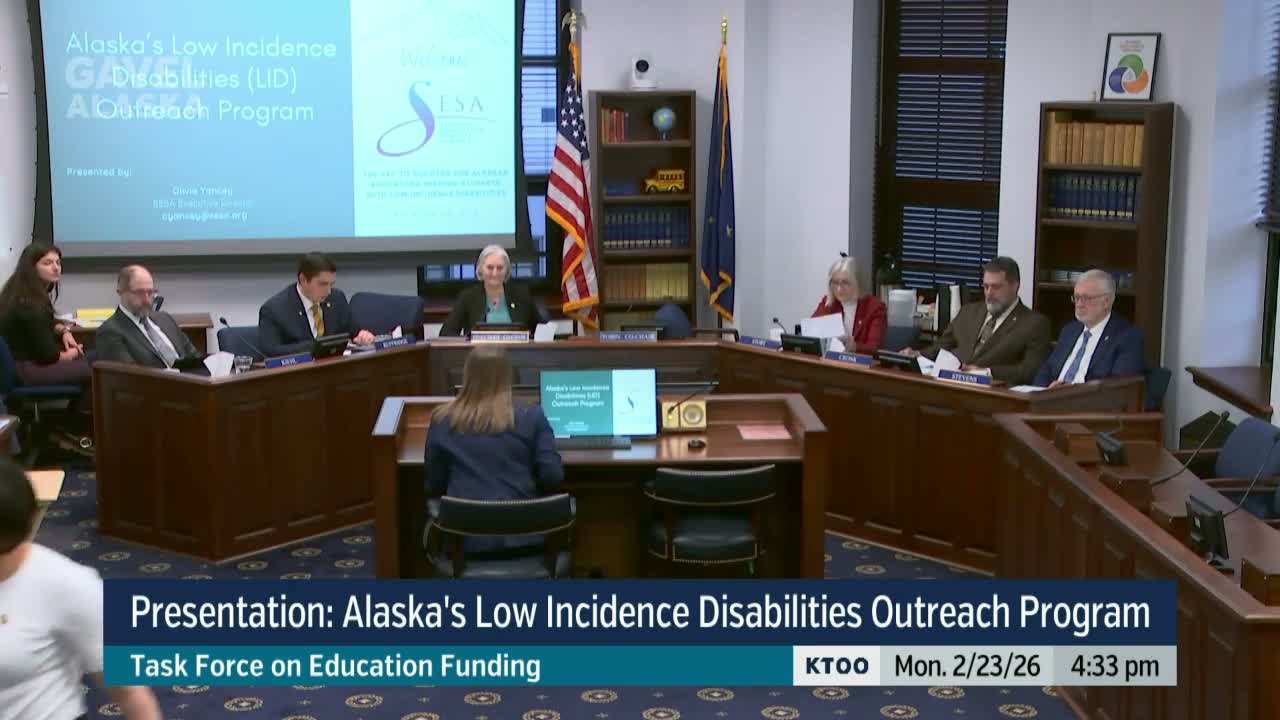
The Special Education Service Agency (CESA) told the Legislative Task Force on Feb. 23 that its consultative model is a cost‑saving substitute for full‑time specialized hires in rural and remote Alaska.
Olivia Yancey, CESA executive director, said CESA provides technical assistance, coaching and a statewide lending library for low‑incidence disabilities (autism, deaf‑blind, vision impairment and multiple disabilities). She said the agency served 49 school districts so far this school year, has a caseload rule of roughly 40 students per specialist that contributes to wait lists, and executes about two site visits per year plus coaching by distance.
Asked whether CESA delivers direct services or coaches local teams, Yancey said the agency typically coaches district staff and brings specialized materials for local teams to implement. "We are not direct service providers...we work directly with the team," she said, explaining that CESA staff observe, demonstrate and leave materials and written recommendations for local providers.
Yancey told legislators that without CESA’s statewide supports some rural districts would be unable to provide legally required services or would have to hire expensive specialists and that CESA’s model helps districts preserve scarce funds while building local capacity.
Members praised the agency’s work and asked follow‑ups about how savings are realized and about CESA’s funding formula and limits; Yancey cited the agency’s state statutory funding and per‑ADM rate used to calculate outreach dollars and suggested capacity would expand with sustained funding.
No formal action was taken.
Olivia Yancey, CESA executive director, said CESA provides technical assistance, coaching and a statewide lending library for low‑incidence disabilities (autism, deaf‑blind, vision impairment and multiple disabilities). She said the agency served 49 school districts so far this school year, has a caseload rule of roughly 40 students per specialist that contributes to wait lists, and executes about two site visits per year plus coaching by distance.
Asked whether CESA delivers direct services or coaches local teams, Yancey said the agency typically coaches district staff and brings specialized materials for local teams to implement. "We are not direct service providers...we work directly with the team," she said, explaining that CESA staff observe, demonstrate and leave materials and written recommendations for local providers.
Yancey told legislators that without CESA’s statewide supports some rural districts would be unable to provide legally required services or would have to hire expensive specialists and that CESA’s model helps districts preserve scarce funds while building local capacity.
Members praised the agency’s work and asked follow‑ups about how savings are realized and about CESA’s funding formula and limits; Yancey cited the agency’s state statutory funding and per‑ADM rate used to calculate outreach dollars and suggested capacity would expand with sustained funding.
No formal action was taken.
View the Full Meeting & All Its Details
This article offers just a summary. Unlock complete video, transcripts, and insights as a Founder Member.
✓
Watch full, unedited meeting videos
✓
Search every word spoken in unlimited transcripts
✓
AI summaries & real-time alerts (all government levels)
✓
Permanent access to expanding government content
30-day money-back guarantee
