House committee backs bill moving water‑share transfer rules to corporate code
February 23, 2026 | 2026 Utah Legislature, Utah Legislature, Utah Legislative Branch, Utah
This article was created by AI summarizing key points discussed. AI makes mistakes, so for full details and context, please refer to the video of the full meeting. Please report any errors so we can fix them. Report an error »
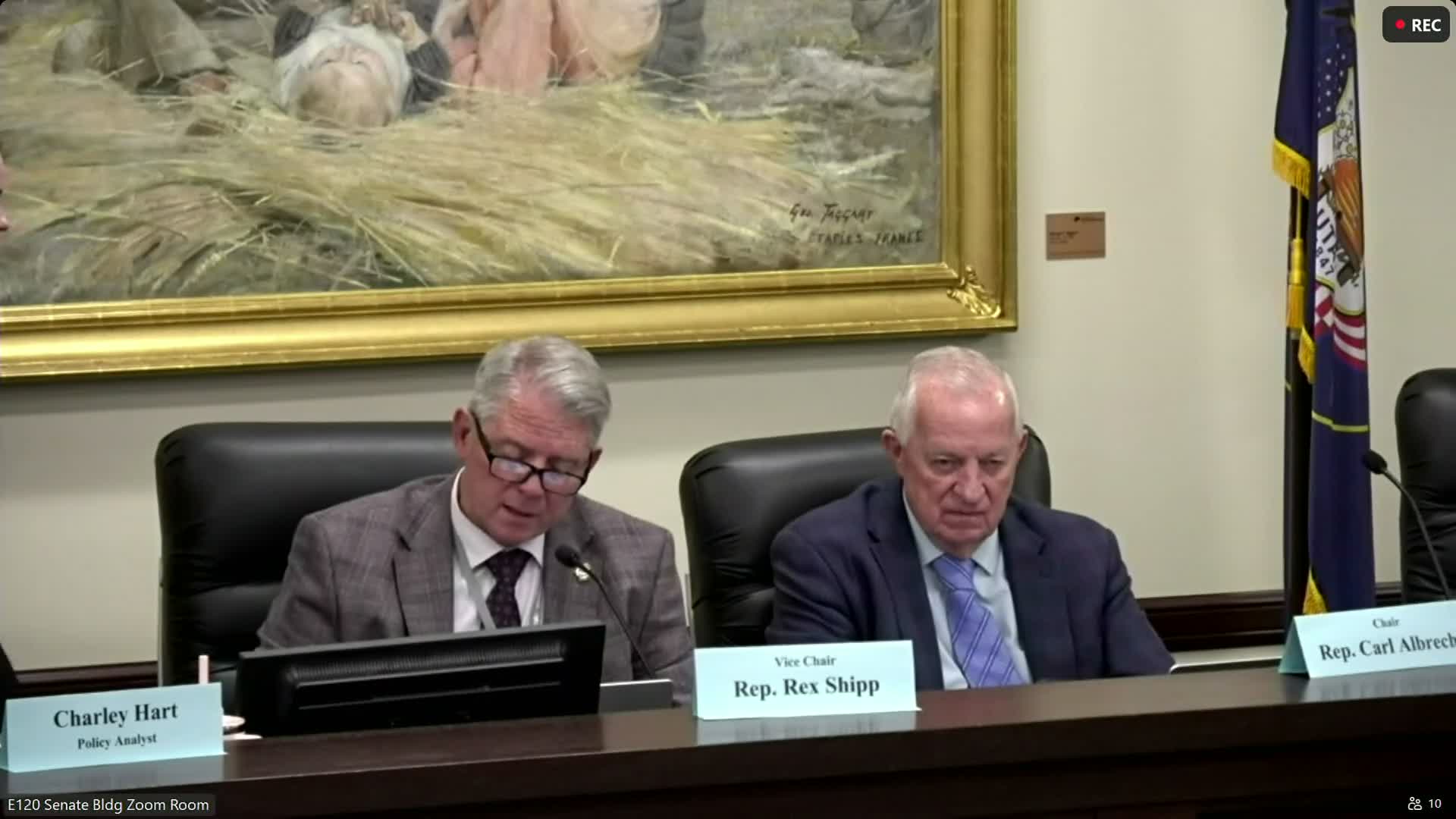
The House Natural Resources, Agriculture and Environment Standing Committee voted Feb. 23 to give HB 494 a favorable recommendation after adopting a technical amendment.
The bill, presented as a cleanup measure by the Utah Farm Bureau Federation and sponsored in committee, moves statutory provisions dealing with transfers of shares in irrigation and water companies from the water code into the corporate code. Theresa Wilhelmsen, State Engineer and Director of the Division of Water Rights, told the committee the change is intended to keep share‑ownership and title issues with the companies that administer stock and to avoid confusing water‑right administration with corporate stock transfers.
Warren Peterson, speaking for the Utah Farm Bureau Federation, said water shares are corporate stock that entitle shareholders to delivery of water but do not convey title to a water right. He told the committee the current placement of the transfer provisions in the water code has led courts to conflate stock transfers with land interests and that moving them to the corporate code (Title 16 provisions) will clarify the legal pathway for about 1,200 irrigation and water companies across the state.
Representative Chu pressed the sponsor and the state engineer on whether participating in programs that lease or bank a percentage of a shareholder's water (for example, leasing 40% of entitlements on a 100‑acre farm) would force the shareholder to specify particular acreage to which that percentage is attached and whether continuing on‑the‑ground irrigation (such as running a center pivot) would be restricted. Wilhelmsen explained that the bill clarifies company recordkeeping and that any relocation of place‑of‑use or permanent transfers that change state‑engineer records would require a shareholder change application under the state engineer’s change process and could require retirement of acreage to match the reduced entitlement.
Committee members adopted House Amendment 2 to restore an earlier drafting term (a correction the sponsor and state engineer described as technical) and then passed HB 494 as amended by voice vote. Representative Chu said he would vote in favor but intends to work offline with the sponsor to resolve remaining technical concerns before the bill reaches the House floor.
The committee recorded no roll‑call tally; the amendment and final recommendation were approved by voice vote.
The bill, presented as a cleanup measure by the Utah Farm Bureau Federation and sponsored in committee, moves statutory provisions dealing with transfers of shares in irrigation and water companies from the water code into the corporate code. Theresa Wilhelmsen, State Engineer and Director of the Division of Water Rights, told the committee the change is intended to keep share‑ownership and title issues with the companies that administer stock and to avoid confusing water‑right administration with corporate stock transfers.
Warren Peterson, speaking for the Utah Farm Bureau Federation, said water shares are corporate stock that entitle shareholders to delivery of water but do not convey title to a water right. He told the committee the current placement of the transfer provisions in the water code has led courts to conflate stock transfers with land interests and that moving them to the corporate code (Title 16 provisions) will clarify the legal pathway for about 1,200 irrigation and water companies across the state.
Representative Chu pressed the sponsor and the state engineer on whether participating in programs that lease or bank a percentage of a shareholder's water (for example, leasing 40% of entitlements on a 100‑acre farm) would force the shareholder to specify particular acreage to which that percentage is attached and whether continuing on‑the‑ground irrigation (such as running a center pivot) would be restricted. Wilhelmsen explained that the bill clarifies company recordkeeping and that any relocation of place‑of‑use or permanent transfers that change state‑engineer records would require a shareholder change application under the state engineer’s change process and could require retirement of acreage to match the reduced entitlement.
Committee members adopted House Amendment 2 to restore an earlier drafting term (a correction the sponsor and state engineer described as technical) and then passed HB 494 as amended by voice vote. Representative Chu said he would vote in favor but intends to work offline with the sponsor to resolve remaining technical concerns before the bill reaches the House floor.
The committee recorded no roll‑call tally; the amendment and final recommendation were approved by voice vote.
View the Full Meeting & All Its Details
This article offers just a summary. Unlock complete video, transcripts, and insights as a Founder Member.
✓
Watch full, unedited meeting videos
✓
Search every word spoken in unlimited transcripts
✓
AI summaries & real-time alerts (all government levels)
✓
Permanent access to expanding government content
30-day money-back guarantee
