Utah Senate committee tables Johnson’s bill to register large single‑family rental portfolios after administrative pushback
February 23, 2026 | 2026 Utah Legislature, Utah Legislature, Utah Legislative Branch, Utah
This article was created by AI summarizing key points discussed. AI makes mistakes, so for full details and context, please refer to the video of the full meeting. Please report any errors so we can fix them. Report an error »
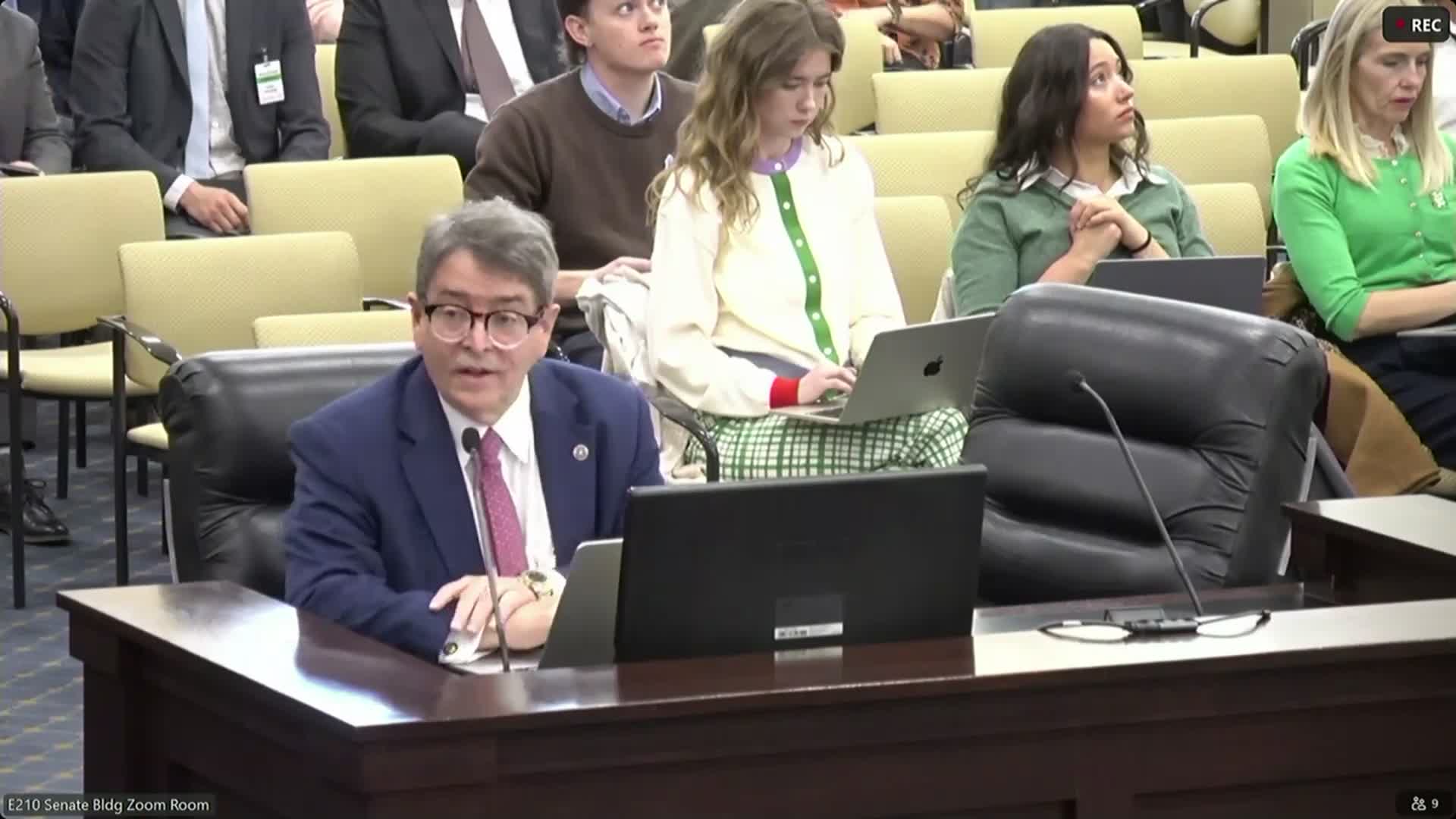
Sen. Johnson introduced Senate Bill 309 as a targeted response to declining first‑time homeownership, arguing that concentrated institutional purchases of entry‑level detached homes are reducing resale velocity and pricing out first‑time buyers.
Johnson described three linked elements in the bill: a statewide registration for owners of single‑family rental homes (deadline in text: 10/01/2026); a tiered annual excise tax on large portfolios (owners of 25 or more single‑family homes would pay $2,000 per home at the 25–29 bracket, scaling to $6,000 per home above 50 in the bill text); and a revenue‑recycling grant program (Housing Transition and Redevelopment Fund) administered by the Governor’s Office of Economic Opportunity with a 10% cap on overhead to help municipalities convert properties for owner‑occupancy.
Johnson framed the measure as ‘‘modest friction at scale’’ rather than a ban on institutional ownership, saying the package would create visibility, impose targeted cost disincentives at large scale and fund local buy‑and‑convert strategies. ‘‘Registration identifies where institutional ownership concentrates. The excise tax generates revenue while creating friction on further acquisitions. Municipalities use that revenue to rezone and transition properties,’’ he said.
The Utah State Tax Commission raised detailed implementation concerns. Commissioner John Valentine told the committee the bill, as drafted, is ‘‘not administrable’’ because ownership aggregation across multilayer LLCs is difficult without unique identifiers, and disclosure could create privacy issues. Commissioner Rebecca Rockwell said a new tax type would require programming and staffing and warned investors could reorganize portfolios under 25 units to avoid the threshold, making revenue projections indeterminate.
Industry groups also testified against the bill in its current form. Justin Allen of the Rental Housing Association expressed concerns that the legislation could harm rental supply and affordability, and Adrian Toddman, CEO of the National Rental Home Council, said managed single‑family rentals provide housing options for families, military and transient workers and urged the legislature to focus on adding supply.
In response, Johnson said he had drafted amendments to address administrative questions, including using federal beneficial‑ownership identifiers (FinCEN identifiers) for aggregation and protecting any sensitive owner data through a secure, non‑public portal. He asked the committee to evaluate the policy’s objective and structural approach while acknowledging the bill would need refinement.
After extended questioning and public comment, Sen. Cullimore moved to take the bill to the next agenda item to allow further work on administrative fixes. The committee approved that motion, effectively tabling the bill for additional amendment work and review.
The committee did not take a final recommendation on SB 309; staff and stakeholders will continue negotiations about owner‑identification methods, fiscal impacts and whether to prioritize registration before tax or grant components.
Johnson described three linked elements in the bill: a statewide registration for owners of single‑family rental homes (deadline in text: 10/01/2026); a tiered annual excise tax on large portfolios (owners of 25 or more single‑family homes would pay $2,000 per home at the 25–29 bracket, scaling to $6,000 per home above 50 in the bill text); and a revenue‑recycling grant program (Housing Transition and Redevelopment Fund) administered by the Governor’s Office of Economic Opportunity with a 10% cap on overhead to help municipalities convert properties for owner‑occupancy.
Johnson framed the measure as ‘‘modest friction at scale’’ rather than a ban on institutional ownership, saying the package would create visibility, impose targeted cost disincentives at large scale and fund local buy‑and‑convert strategies. ‘‘Registration identifies where institutional ownership concentrates. The excise tax generates revenue while creating friction on further acquisitions. Municipalities use that revenue to rezone and transition properties,’’ he said.
The Utah State Tax Commission raised detailed implementation concerns. Commissioner John Valentine told the committee the bill, as drafted, is ‘‘not administrable’’ because ownership aggregation across multilayer LLCs is difficult without unique identifiers, and disclosure could create privacy issues. Commissioner Rebecca Rockwell said a new tax type would require programming and staffing and warned investors could reorganize portfolios under 25 units to avoid the threshold, making revenue projections indeterminate.
Industry groups also testified against the bill in its current form. Justin Allen of the Rental Housing Association expressed concerns that the legislation could harm rental supply and affordability, and Adrian Toddman, CEO of the National Rental Home Council, said managed single‑family rentals provide housing options for families, military and transient workers and urged the legislature to focus on adding supply.
In response, Johnson said he had drafted amendments to address administrative questions, including using federal beneficial‑ownership identifiers (FinCEN identifiers) for aggregation and protecting any sensitive owner data through a secure, non‑public portal. He asked the committee to evaluate the policy’s objective and structural approach while acknowledging the bill would need refinement.
After extended questioning and public comment, Sen. Cullimore moved to take the bill to the next agenda item to allow further work on administrative fixes. The committee approved that motion, effectively tabling the bill for additional amendment work and review.
The committee did not take a final recommendation on SB 309; staff and stakeholders will continue negotiations about owner‑identification methods, fiscal impacts and whether to prioritize registration before tax or grant components.
View the Full Meeting & All Its Details
This article offers just a summary. Unlock complete video, transcripts, and insights as a Founder Member.
✓
Watch full, unedited meeting videos
✓
Search every word spoken in unlimited transcripts
✓
AI summaries & real-time alerts (all government levels)
✓
Permanent access to expanding government content
30-day money-back guarantee
