Oregon City planning panel continues Park Place 2 hearing after hours of safety and environmental testimony
February 23, 2026 | Oregon City, Clackamas County, Oregon
This article was created by AI summarizing key points discussed. AI makes mistakes, so for full details and context, please refer to the video of the full meeting. Please report any errors so we can fix them. Report an error »
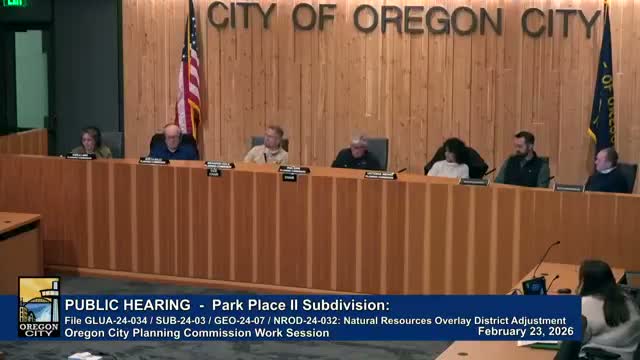
Oregon City — The Oregon City Planning Commission voted unanimously on Feb. 23 to continue the public hearing on the Park Place 2 subdivision to April 13, 2026, leaving the record open for additional written testimony and directing staff to return with further Natural Resources Committee comments and refined mitigation analysis.
Pete Walter, planning manager for the City of Oregon City Community Development Department, told commissioners the application before them includes a Natural Resource Overlay District (NROD) adjustment, subdivision and related files (file nos. GLUA24034 / SUB2403 / GEO2407 / NROD24032). Walter said the request triggers a type 3 discretionary review under Oregon City Municipal Code chapter 17.49 because the proposal would cross mapped stream corridors and would place a stormwater facility and a sewer crossing within regulated buffers.
"This is a discretionary review by the planning commission concerning a protected natural resource," Walter said, summarizing staff analysis and recommended conditions, including bridged/sleeved pipe construction, public utility easements, updated mitigation calculations before issuance of construction permits, and conservation easements or protective covenants for resource areas. Walter also disclosed the city will present the project to the Natural Resources Committee on March 11 and return NRC comments to the commission prior to the continued hearing.
The applicant described the project as roughly 59 acres with 219 lots and about 16 acres of open space. Harlan Barrow, land development and acquisition manager for ICON Construction, and Hayden Wooten of AMEREO Design presented the concept and mitigation plans. Wooten said the developer’s current plan places the water-quality facility at a low point in the site and proposes a bridged sewer crossing of Tour Creek to connect to an existing manhole in Holcomb Ridge subdivision.
"The proposal right now is the shortest route," Barrow said when asked why the sewer alignment proposes a bridged crossing instead of routing around the ravine. He described other alignment options considered — a roughly 1.5–2 mile route down to Abernathy Road, a new line along Redland, or a pump station — and said the bridged crossing was found to be feasible from a preliminary engineering standpoint.
Commissioners pressed the team for technical detail: how a roughly 350–400 foot arch-type bridge would be installed with cranes, how the sewer would be sleeved to protect against leakage, where public utility easements would be recorded, and whether infiltration was feasible given geotechnical constraints. The applicant confirmed engineering plans remain preliminary and said detailed engineering typically follows land-use approval.
Dozens of neighbors — many representing the Park Place Neighborhood Association and longtime residents — spoke during a packed public-comment period, urging the commission to delay or deny the application. Speakers repeatedly cited the 2020 wildfire evacuation that caused severe gridlock on Holcomb Boulevard and warned adding hundreds of homes without additional egress would increase public-safety risk.
Tom Guile, vice president of the Park Place Neighborhood Association and a former planning commissioner, said: "This creates a catastrophic single point of failure for thousands of residents." Eddie Pasadori, an HOA manager and local developer, told commissioners the application lacks required alternative analyses and fails to demonstrate that the proposed crossing would result in "fewer adverse impacts" required by the NROD adjustment standard (OCMC 17.49.200).
Residents raised other concerns about constructability and long-term maintenance on steep slopes, risks of failure if trees or debris strike a suspended sewer, the absence of a recorded public utility easement for portions of the alignment, and the adequacy of preliminary mitigation proposals. Several speakers asked the commission to require the Holly Lane connection shown in the Park Place concept plan before allowing additional development, citing emergency egress needs.
Developer and staff representatives responded that the application will be refined during the engineering review and that the project carries proportional-share transportation obligations and planned contributions toward improvements, and that the record would benefit from Natural Resources Committee input.
After public testimony and discussion, Commissioner LaSalle moved to continue the hearing to April 13, 2026; the motion passed unanimously. The commission left the record open for additional written testimony and required that NRC comments and updated mitigation analyses be submitted ahead of the continued hearing. The city announced the continuance details: April 13 at 7 p.m. in the Hanlon Commission Chambers at the Lipkey Public Safety Facility.
What’s next: The planning commission will reconvene on April 13 to consider the NROD adjustment and subdivision after receiving additional NRC review, any supplemental engineering details from the applicant, and any further public comments. The record will remain open until the continued hearing.
Pete Walter, planning manager for the City of Oregon City Community Development Department, told commissioners the application before them includes a Natural Resource Overlay District (NROD) adjustment, subdivision and related files (file nos. GLUA24034 / SUB2403 / GEO2407 / NROD24032). Walter said the request triggers a type 3 discretionary review under Oregon City Municipal Code chapter 17.49 because the proposal would cross mapped stream corridors and would place a stormwater facility and a sewer crossing within regulated buffers.
"This is a discretionary review by the planning commission concerning a protected natural resource," Walter said, summarizing staff analysis and recommended conditions, including bridged/sleeved pipe construction, public utility easements, updated mitigation calculations before issuance of construction permits, and conservation easements or protective covenants for resource areas. Walter also disclosed the city will present the project to the Natural Resources Committee on March 11 and return NRC comments to the commission prior to the continued hearing.
The applicant described the project as roughly 59 acres with 219 lots and about 16 acres of open space. Harlan Barrow, land development and acquisition manager for ICON Construction, and Hayden Wooten of AMEREO Design presented the concept and mitigation plans. Wooten said the developer’s current plan places the water-quality facility at a low point in the site and proposes a bridged sewer crossing of Tour Creek to connect to an existing manhole in Holcomb Ridge subdivision.
"The proposal right now is the shortest route," Barrow said when asked why the sewer alignment proposes a bridged crossing instead of routing around the ravine. He described other alignment options considered — a roughly 1.5–2 mile route down to Abernathy Road, a new line along Redland, or a pump station — and said the bridged crossing was found to be feasible from a preliminary engineering standpoint.
Commissioners pressed the team for technical detail: how a roughly 350–400 foot arch-type bridge would be installed with cranes, how the sewer would be sleeved to protect against leakage, where public utility easements would be recorded, and whether infiltration was feasible given geotechnical constraints. The applicant confirmed engineering plans remain preliminary and said detailed engineering typically follows land-use approval.
Dozens of neighbors — many representing the Park Place Neighborhood Association and longtime residents — spoke during a packed public-comment period, urging the commission to delay or deny the application. Speakers repeatedly cited the 2020 wildfire evacuation that caused severe gridlock on Holcomb Boulevard and warned adding hundreds of homes without additional egress would increase public-safety risk.
Tom Guile, vice president of the Park Place Neighborhood Association and a former planning commissioner, said: "This creates a catastrophic single point of failure for thousands of residents." Eddie Pasadori, an HOA manager and local developer, told commissioners the application lacks required alternative analyses and fails to demonstrate that the proposed crossing would result in "fewer adverse impacts" required by the NROD adjustment standard (OCMC 17.49.200).
Residents raised other concerns about constructability and long-term maintenance on steep slopes, risks of failure if trees or debris strike a suspended sewer, the absence of a recorded public utility easement for portions of the alignment, and the adequacy of preliminary mitigation proposals. Several speakers asked the commission to require the Holly Lane connection shown in the Park Place concept plan before allowing additional development, citing emergency egress needs.
Developer and staff representatives responded that the application will be refined during the engineering review and that the project carries proportional-share transportation obligations and planned contributions toward improvements, and that the record would benefit from Natural Resources Committee input.
After public testimony and discussion, Commissioner LaSalle moved to continue the hearing to April 13, 2026; the motion passed unanimously. The commission left the record open for additional written testimony and required that NRC comments and updated mitigation analyses be submitted ahead of the continued hearing. The city announced the continuance details: April 13 at 7 p.m. in the Hanlon Commission Chambers at the Lipkey Public Safety Facility.
What’s next: The planning commission will reconvene on April 13 to consider the NROD adjustment and subdivision after receiving additional NRC review, any supplemental engineering details from the applicant, and any further public comments. The record will remain open until the continued hearing.
View the Full Meeting & All Its Details
This article offers just a summary. Unlock complete video, transcripts, and insights as a Founder Member.
✓
Watch full, unedited meeting videos
✓
Search every word spoken in unlimited transcripts
✓
AI summaries & real-time alerts (all government levels)
✓
Permanent access to expanding government content
30-day money-back guarantee
