Beavercreek finance staff outlines income‑tax and property‑tax scenarios, warns of transition deficits
February 23, 2026 | Beavercreek, Greene County, Ohio
This article was created by AI summarizing key points discussed. AI makes mistakes, so for full details and context, please refer to the video of the full meeting. Please report any errors so we can fix them. Report an error »
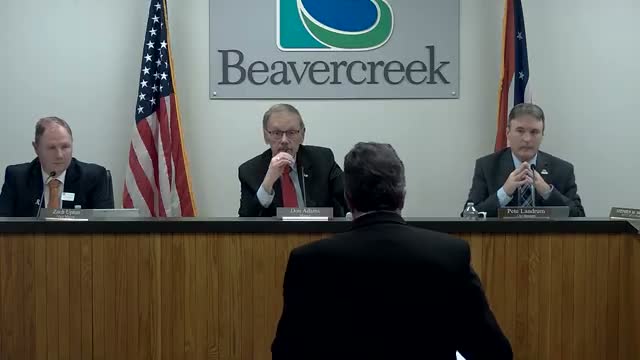
David Graham presented an extensive review of Beavercreek's revenue picture and two scenarios to diversify revenue if state law reduces or eliminates property taxes.
Graham said the city currently gets roughly 64% of its operating revenue from property taxes and noted recent state legislative changes that cap inside‑millage growth and give county budget commissions new authority to reduce rates. Citing a Miami University estimate, he said a 1% income tax could be expected to generate about $19.6 million annually in a steady state, with collection ramping up over several years (60% of projection in year one, 85% in year two, approaching full collection in year three).
Under a scenario that removes 50% of property tax levies and enacts a 1% city income tax, Graham's model projected a multi‑year transition deficit (an estimated $3.5 million shortfall in 2028–29 before full collection rates). A doomsday scenario—elimination of all property taxes with no income tax in place—would create far larger gaps; staff estimated the city could be left with roughly $2 million to fund operations against a $35 million operating budget without replacement revenue, forcing immediate and deep service reductions.
Graham outlined two specific proposals: a 1% income tax timed to take effect July 1, 2027, paired with eliminating selected levies to reach a 50% property‑tax reduction; and a 2.9% income tax to replace all property taxes in the event of a statewide elimination. He said the 2.9% figure was chosen to approach a break‑even point if property taxes went away and the city also assumed responsibility for additional services such as fire and EMS.
Council members asked for details on assumptions and timing; Graham reiterated that projections are estimates, sensitive to collection rates and economic performance. He and council agreed the next procedural step is a public hearing and an ordinance on March 9 to consider the income tax code if council decides to advance that option.
The presentation provided council with projected millage impacts, estimated household costs per $100,000 of assessed value, and cautions about revenue volatility in income‑tax models versus the relative stability of property taxes.
Graham said the city currently gets roughly 64% of its operating revenue from property taxes and noted recent state legislative changes that cap inside‑millage growth and give county budget commissions new authority to reduce rates. Citing a Miami University estimate, he said a 1% income tax could be expected to generate about $19.6 million annually in a steady state, with collection ramping up over several years (60% of projection in year one, 85% in year two, approaching full collection in year three).
Under a scenario that removes 50% of property tax levies and enacts a 1% city income tax, Graham's model projected a multi‑year transition deficit (an estimated $3.5 million shortfall in 2028–29 before full collection rates). A doomsday scenario—elimination of all property taxes with no income tax in place—would create far larger gaps; staff estimated the city could be left with roughly $2 million to fund operations against a $35 million operating budget without replacement revenue, forcing immediate and deep service reductions.
Graham outlined two specific proposals: a 1% income tax timed to take effect July 1, 2027, paired with eliminating selected levies to reach a 50% property‑tax reduction; and a 2.9% income tax to replace all property taxes in the event of a statewide elimination. He said the 2.9% figure was chosen to approach a break‑even point if property taxes went away and the city also assumed responsibility for additional services such as fire and EMS.
Council members asked for details on assumptions and timing; Graham reiterated that projections are estimates, sensitive to collection rates and economic performance. He and council agreed the next procedural step is a public hearing and an ordinance on March 9 to consider the income tax code if council decides to advance that option.
The presentation provided council with projected millage impacts, estimated household costs per $100,000 of assessed value, and cautions about revenue volatility in income‑tax models versus the relative stability of property taxes.
View the Full Meeting & All Its Details
This article offers just a summary. Unlock complete video, transcripts, and insights as a Founder Member.
✓
Watch full, unedited meeting videos
✓
Search every word spoken in unlimited transcripts
✓
AI summaries & real-time alerts (all government levels)
✓
Permanent access to expanding government content
30-day money-back guarantee
