Catalyst Energy outlines Bright Ridge plan, pledges decommissioning bonds and local outreach
May 21, 2024 | Washington County, Virginia
This article was created by AI summarizing key points discussed. AI makes mistakes, so for full details and context, please refer to the video of the full meeting. Please report any errors so we can fix them. Report an error »
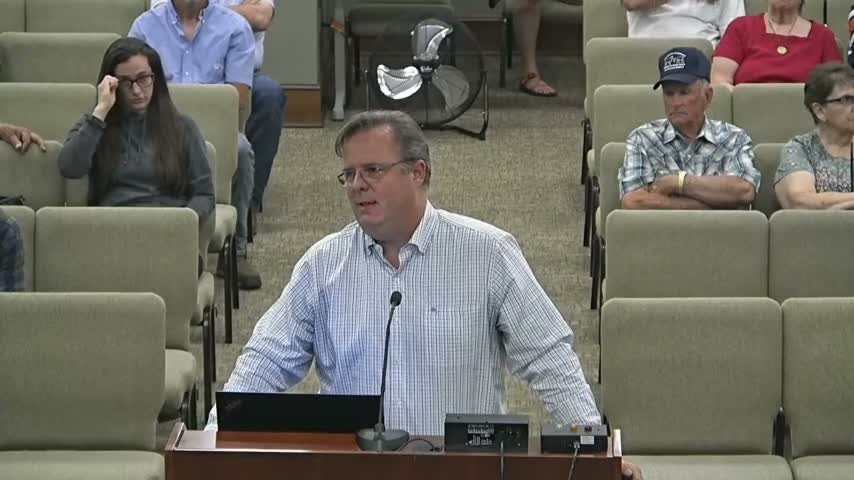
Steve Melnyte, president of Catalyst Energy Partners, told the Washington County Planning Commission on May 21 that his company plans a large-scale solar development colocated with an existing natural‑gas power plant and presented technical, financial and community‑engagement details.
Melnyte said Catalyst, founded in 2020, is led by CEO Matt Cheney and other executives with decades of renewable‑energy experience. He described a strategy of building solar adjacent to existing gas plants to avoid costly new long‑distance transmission and to support grid reliability. "We are really founded on a very different premise than many renewable energy developers," Melnyte said, adding that the approach reduces the need to build long transmission lines.
On project scope, Melnyte said Catalyst has negotiated about nine leases covering a little over 1,800 acres in Washington County and expects the installations to operate roughly 30 to 35 years. "Once we turn the plant on, we hope to operate it for about 35 years," he said. He estimated the project would represent "hundreds of millions of dollars" of investment, generate "north of $20,000,000" in tax benefits for the community and create more than 300 construction jobs.
Melnyte addressed decommissioning and end‑of‑life handling for panels: leases and the decommissioning plan will require returning land to its prior condition, and Catalyst plans to post bankruptcy‑protected security ("bonds that are bankruptcy protected") or acceptable surety instruments such as a surety bond or a letter of credit. He said recycling markets for panels and steel will exist when panels are retired. "We will be posting bonds that are bankruptcy protected and ensure other protections so that the resources are available and lockboxed to make sure the project can be decommissioned," Melnyte said.
On agricultural uses and visual impacts, Melnyte said the firm intends to build with minimal grading, use grazing (sheep) for vegetation control and preserve topography where possible. "We will absolutely be utilizing grazing underneath these panels," he said, and added that, per the county ordinance, Catalyst will provide visual simulations and screening measures where feasible. Melnyte also cited county figures while explaining scale: Washington County has about 245,000 acres in land use and he said the project represents less than 1% of that acreage.
Commissioners asked a range of technical and policy questions including whether panels would be domestically sourced, how long leases would last, who would monitor construction compliance and what financial guarantees would exist for decommissioning. Melnyte said Catalyst has not finalized supplier contracts; the company will source panels once permitting and interconnection timing are clearer and noted a market shift toward U.S. manufacturing. "We have not yet signed an agreement for contracting for all the panels," he said. He also said landowner leases and permit conditions will remain enforceable if the project changes ownership.
Melnyte invited ongoing public input: Catalyst held an open house on May 1 (about 50–60 attendees) and planned another at John Battle High School on May 30 from 6–9 p.m., with topic stations and experts available. He said a mid‑June open house and an energy education camp for middle‑school students were also planned.
Next steps: Catalyst said it will submit a special‑exemption permit application to the planning commission at the June meeting and expects additional permitting steps, interconnection studies and further public outreach before formal siting decisions are made.
Melnyte said Catalyst, founded in 2020, is led by CEO Matt Cheney and other executives with decades of renewable‑energy experience. He described a strategy of building solar adjacent to existing gas plants to avoid costly new long‑distance transmission and to support grid reliability. "We are really founded on a very different premise than many renewable energy developers," Melnyte said, adding that the approach reduces the need to build long transmission lines.
On project scope, Melnyte said Catalyst has negotiated about nine leases covering a little over 1,800 acres in Washington County and expects the installations to operate roughly 30 to 35 years. "Once we turn the plant on, we hope to operate it for about 35 years," he said. He estimated the project would represent "hundreds of millions of dollars" of investment, generate "north of $20,000,000" in tax benefits for the community and create more than 300 construction jobs.
Melnyte addressed decommissioning and end‑of‑life handling for panels: leases and the decommissioning plan will require returning land to its prior condition, and Catalyst plans to post bankruptcy‑protected security ("bonds that are bankruptcy protected") or acceptable surety instruments such as a surety bond or a letter of credit. He said recycling markets for panels and steel will exist when panels are retired. "We will be posting bonds that are bankruptcy protected and ensure other protections so that the resources are available and lockboxed to make sure the project can be decommissioned," Melnyte said.
On agricultural uses and visual impacts, Melnyte said the firm intends to build with minimal grading, use grazing (sheep) for vegetation control and preserve topography where possible. "We will absolutely be utilizing grazing underneath these panels," he said, and added that, per the county ordinance, Catalyst will provide visual simulations and screening measures where feasible. Melnyte also cited county figures while explaining scale: Washington County has about 245,000 acres in land use and he said the project represents less than 1% of that acreage.
Commissioners asked a range of technical and policy questions including whether panels would be domestically sourced, how long leases would last, who would monitor construction compliance and what financial guarantees would exist for decommissioning. Melnyte said Catalyst has not finalized supplier contracts; the company will source panels once permitting and interconnection timing are clearer and noted a market shift toward U.S. manufacturing. "We have not yet signed an agreement for contracting for all the panels," he said. He also said landowner leases and permit conditions will remain enforceable if the project changes ownership.
Melnyte invited ongoing public input: Catalyst held an open house on May 1 (about 50–60 attendees) and planned another at John Battle High School on May 30 from 6–9 p.m., with topic stations and experts available. He said a mid‑June open house and an energy education camp for middle‑school students were also planned.
Next steps: Catalyst said it will submit a special‑exemption permit application to the planning commission at the June meeting and expects additional permitting steps, interconnection studies and further public outreach before formal siting decisions are made.
View the Full Meeting & All Its Details
This article offers just a summary. Unlock complete video, transcripts, and insights as a Founder Member.
✓
Watch full, unedited meeting videos
✓
Search every word spoken in unlimited transcripts
✓
AI summaries & real-time alerts (all government levels)
✓
Permanent access to expanding government content
30-day money-back guarantee
