Committee hears bill to declare long-term institutional care an "essential" service amid payment and definition concerns
February 21, 2026 | House of Representatives, House, Committees, Legislative, Puerto Rico, International
This article was created by AI summarizing key points discussed. AI makes mistakes, so for full details and context, please refer to the video of the full meeting. Please report any errors so we can fix them. Report an error »
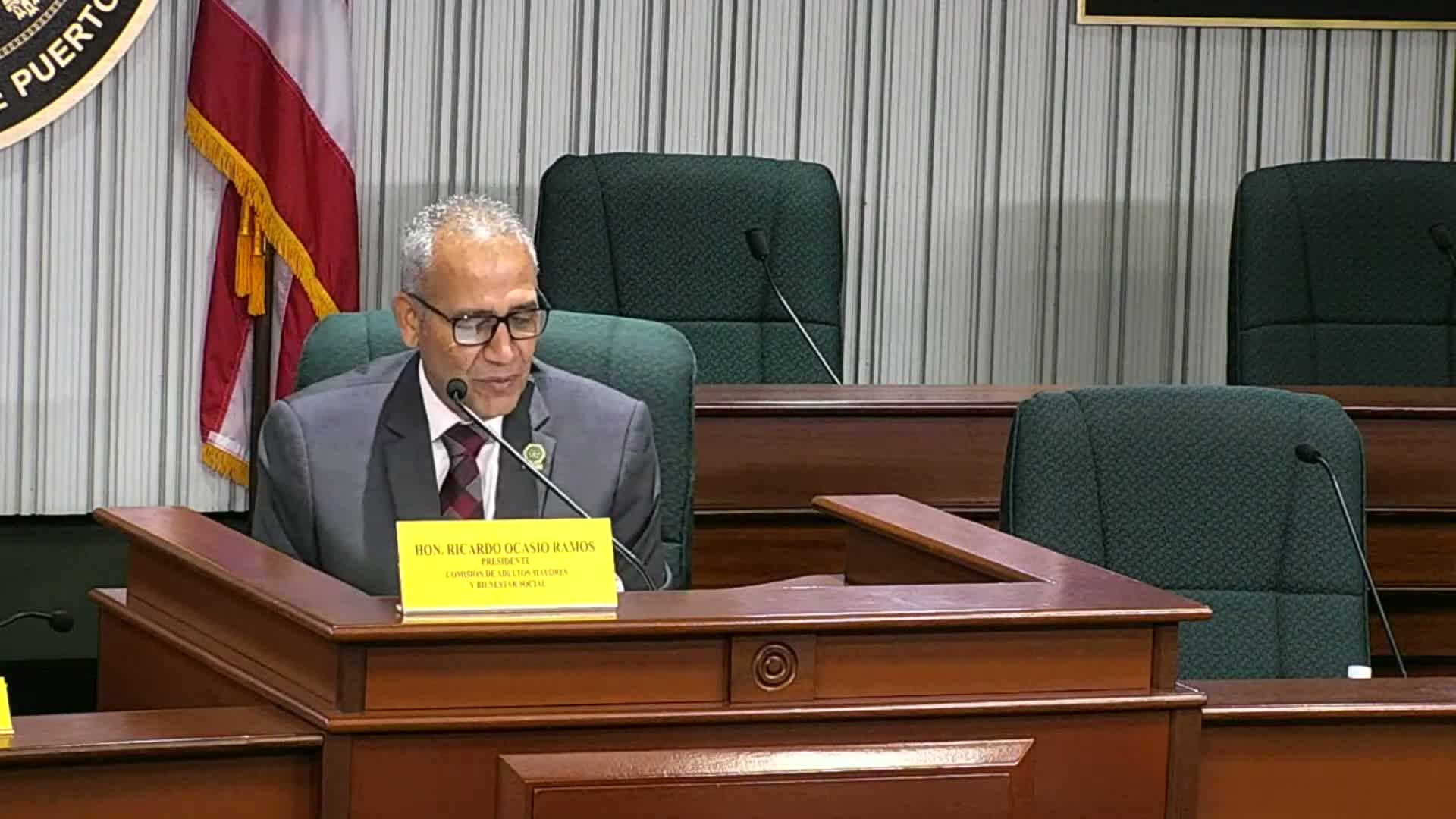
San Juan — The House of Representatives' Commission on Older Adults and Social Welfare held a public hearing on Proyecto de la Cámara 998, a bill that would designate institutional long-term care for older adults and people with functional diversity as an essential service, potentially speeding government payments and unlocking exemptions and priority treatment during declared emergencies.
Department of Health representative Dr. Luis Olmedo said the agency supports the bill as a way to "asegurar la continuidad y accesibilidad de los servicios de cuidado prolongado" and urged lawmakers to use person-centered language in the statute. "Es importante y recomendable que nuestros estatutos mantengan los principios de respeto y dignidad humana utilizando un lenguaje centrado en la persona," he said during his presentation.
The Association of Owners of Long-Term Care Centers, represented by Dr. Minerva Gómez, strongly backed the measure, arguing facilities provide continuous, nonoptional care and that payment delays threaten residents' homes. "La clasificación del cuido prolongado institucionalizado como servicio esencial no constituye la creación de un privilegio para una industria privada, sino la formalización jurídica de una función pública que el propio estado ha delegado," Gómez said, adding that delays in state disbursements put facilities at operational risk. The association said it has recorded "atrasos significativos en los desembolsos" and urged a fixed payment timeline.
Lic. Nicole Báez, of the Department of the Family (AFAN), described the agency's current programs and usage statistics: as of Jan. 31, 2026 AFAN was serving 1,555 adults through local offices, operates 9 CAMPEA centers, and had 6,225 adults subsidized by the department. Báez said the department favors the bill but recommended revising certain definitions (notably the term "institucionalización") and aligning statutory terms with existing regulatory categories such as "establecimiento."
Lawmakers pressed witnesses on details lawmakers will need to implement the policy. Several representatives asked whether changing the bill's definitions to the broader word "establecimiento" would make day centers, substitute homes and their staff automatically 'essential,' with attendant operational consequences during emergencies (priority for power, water, logistics) and potential fiscal costs. One legislator warned that broad essentiality could expand the set of workers who would be considered essential during an emergency.
Officials and industry representatives also discussed government payments. The association and witnesses cited both multi-year outstanding balances and recent six-month delays in reimbursements for subsidized residents; Báez acknowledged longstanding administrative and billing issues but said the department has advanced processes and is working with the Treasury Department. Báez gave an estimate cited in testimony that the monthly payroll related to substitute-care services had "aumentaba casi 10000000 de dólares mensual" in recent months and said the department would provide a more detailed report.
Chair Representative Ricardo Chino Reyes Casio Ramos requested, and departmental witnesses agreed, to provide the commission with updated documentation: the Department of the Family will deliver a detailed list of centers with payments processed within 30 days and an explanation for late payments, to be provided to the commission "en los próximos 10 días;" the Department of Health agreed to provide existing emergency-protocol materials within five days.
Witnesses and lawmakers agreed the bill is a policy step toward protecting vulnerable residents, but they signaled that implementation requires coordination with Hacienda (the Treasury), emergency-management authorities and regulators to assess costs and operational impacts. Representatives asked the committee to invite officials from the Treasury and the island's emergency-management office for follow-up testimony.
The hearing concluded after members discussed outstanding data requests and noted that some invited offices (the Treasury Department and the Office of the Ombudsperson for Older Adults) submitted written memoranda instead of appearing. The public hearing ended at 10:27 a.m.
What’s next: The commission has requested the promised reports and additional agency witnesses; lawmakers said the information will inform potential redrafting of definitions and fiscal provisions before any vote on the measure.
Department of Health representative Dr. Luis Olmedo said the agency supports the bill as a way to "asegurar la continuidad y accesibilidad de los servicios de cuidado prolongado" and urged lawmakers to use person-centered language in the statute. "Es importante y recomendable que nuestros estatutos mantengan los principios de respeto y dignidad humana utilizando un lenguaje centrado en la persona," he said during his presentation.
The Association of Owners of Long-Term Care Centers, represented by Dr. Minerva Gómez, strongly backed the measure, arguing facilities provide continuous, nonoptional care and that payment delays threaten residents' homes. "La clasificación del cuido prolongado institucionalizado como servicio esencial no constituye la creación de un privilegio para una industria privada, sino la formalización jurídica de una función pública que el propio estado ha delegado," Gómez said, adding that delays in state disbursements put facilities at operational risk. The association said it has recorded "atrasos significativos en los desembolsos" and urged a fixed payment timeline.
Lic. Nicole Báez, of the Department of the Family (AFAN), described the agency's current programs and usage statistics: as of Jan. 31, 2026 AFAN was serving 1,555 adults through local offices, operates 9 CAMPEA centers, and had 6,225 adults subsidized by the department. Báez said the department favors the bill but recommended revising certain definitions (notably the term "institucionalización") and aligning statutory terms with existing regulatory categories such as "establecimiento."
Lawmakers pressed witnesses on details lawmakers will need to implement the policy. Several representatives asked whether changing the bill's definitions to the broader word "establecimiento" would make day centers, substitute homes and their staff automatically 'essential,' with attendant operational consequences during emergencies (priority for power, water, logistics) and potential fiscal costs. One legislator warned that broad essentiality could expand the set of workers who would be considered essential during an emergency.
Officials and industry representatives also discussed government payments. The association and witnesses cited both multi-year outstanding balances and recent six-month delays in reimbursements for subsidized residents; Báez acknowledged longstanding administrative and billing issues but said the department has advanced processes and is working with the Treasury Department. Báez gave an estimate cited in testimony that the monthly payroll related to substitute-care services had "aumentaba casi 10000000 de dólares mensual" in recent months and said the department would provide a more detailed report.
Chair Representative Ricardo Chino Reyes Casio Ramos requested, and departmental witnesses agreed, to provide the commission with updated documentation: the Department of the Family will deliver a detailed list of centers with payments processed within 30 days and an explanation for late payments, to be provided to the commission "en los próximos 10 días;" the Department of Health agreed to provide existing emergency-protocol materials within five days.
Witnesses and lawmakers agreed the bill is a policy step toward protecting vulnerable residents, but they signaled that implementation requires coordination with Hacienda (the Treasury), emergency-management authorities and regulators to assess costs and operational impacts. Representatives asked the committee to invite officials from the Treasury and the island's emergency-management office for follow-up testimony.
The hearing concluded after members discussed outstanding data requests and noted that some invited offices (the Treasury Department and the Office of the Ombudsperson for Older Adults) submitted written memoranda instead of appearing. The public hearing ended at 10:27 a.m.
What’s next: The commission has requested the promised reports and additional agency witnesses; lawmakers said the information will inform potential redrafting of definitions and fiscal provisions before any vote on the measure.
Don't Miss a Word: See the Full Meeting!
Go beyond summaries. Unlock every video, transcript, and key insight with a Founder Membership.
✓
Get instant access to full meeting videos
✓
Search and clip any phrase from complete transcripts
✓
Receive AI-powered summaries & custom alerts
✓
Enjoy lifetime, unrestricted access to government data
30-day money-back guarantee
