Committee advances bill aimed at guarding against 'debanking' but banks warn of litigation risk
February 20, 2026 | 2026 Legislature SD, South Dakota
This article was created by AI summarizing key points discussed. AI makes mistakes, so for full details and context, please refer to the video of the full meeting. Please report any errors so we can fix them. Report an error »
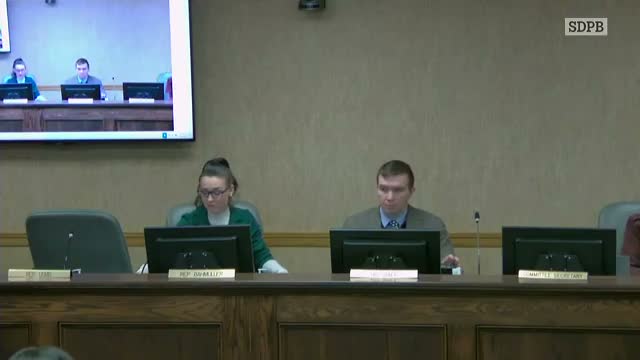
The House Commerce and Energy Committee voted 9-4 to advance House Bill 1224, legislation that would bar certain financial institutions from denying services or closing accounts based on a customer’s religious exercise, speech or participation in lawful economic activity and would require a written explanation for adverse actions.
Representative Lembs, prime sponsor of the bill, said the measure targets large institutions and is intended to stop what proponents call "debanking": "This is specific to banks that have transactions of over $100,000,000,000 per year," Lembs said, adding the bill would give affected citizens a right to a written reason and protect lawful activity. Proponents, including Don Hager of Americans for Prosperity South Dakota and Matt Sharp of ADF Action, urged the committee to give the bill a due‑pass recommendation and emphasized transparency and permanent state protections if federal measures change.
Opponents pushed back. Brett Aftall of the South Dakota Division of Banking told the committee the state already has a comprehensive regulatory framework and argued HB1224’s definitions and burden‑shifting would invite litigation and compliance costs. "Why would we create new criminal penalties and civil causes of action for a new and expansive definition of discrimination which places the burden of proof on the financial institution in every instance?" Aftall asked. Dave Rosenboom, president of First Premier Bank, said the bank’s ACH volume and other services could put it within the bill’s reach despite proponents’ stated threshold and warned of unintended market consequences. Carl Adam of the South Dakota Bankers Association said federal law already provides remedies and that layering a state cause of action could reduce access and raise costs.
In rebuttal, Matt Sharp said the bill mirrors an executive order and is narrowly tailored to protect First Amendment activity while leaving legitimate risk‑based decisions intact. After committee questioning on definitions, coverage and complaint tracking, Representative Weisgram moved to advance the bill to the "40 first day"; Representative Duffy seconded and the motion carried by roll call, 9 yeas to 4 nays.
The committee did not adopt final amendments in this hearing; advancing the bill sends it to the next procedural step for further consideration.
Representative Lembs, prime sponsor of the bill, said the measure targets large institutions and is intended to stop what proponents call "debanking": "This is specific to banks that have transactions of over $100,000,000,000 per year," Lembs said, adding the bill would give affected citizens a right to a written reason and protect lawful activity. Proponents, including Don Hager of Americans for Prosperity South Dakota and Matt Sharp of ADF Action, urged the committee to give the bill a due‑pass recommendation and emphasized transparency and permanent state protections if federal measures change.
Opponents pushed back. Brett Aftall of the South Dakota Division of Banking told the committee the state already has a comprehensive regulatory framework and argued HB1224’s definitions and burden‑shifting would invite litigation and compliance costs. "Why would we create new criminal penalties and civil causes of action for a new and expansive definition of discrimination which places the burden of proof on the financial institution in every instance?" Aftall asked. Dave Rosenboom, president of First Premier Bank, said the bank’s ACH volume and other services could put it within the bill’s reach despite proponents’ stated threshold and warned of unintended market consequences. Carl Adam of the South Dakota Bankers Association said federal law already provides remedies and that layering a state cause of action could reduce access and raise costs.
In rebuttal, Matt Sharp said the bill mirrors an executive order and is narrowly tailored to protect First Amendment activity while leaving legitimate risk‑based decisions intact. After committee questioning on definitions, coverage and complaint tracking, Representative Weisgram moved to advance the bill to the "40 first day"; Representative Duffy seconded and the motion carried by roll call, 9 yeas to 4 nays.
The committee did not adopt final amendments in this hearing; advancing the bill sends it to the next procedural step for further consideration.
View the Full Meeting & All Its Details
This article offers just a summary. Unlock complete video, transcripts, and insights as a Founder Member.
✓
Watch full, unedited meeting videos
✓
Search every word spoken in unlimited transcripts
✓
AI summaries & real-time alerts (all government levels)
✓
Permanent access to expanding government content
30-day money-back guarantee
