Appropriations Committee reserves five bills for public hearings, advances 12 raise-bill concepts
February 21, 2026 | Appropriations, House of Representatives, Committees, Legislative, Connecticut
This article was created by AI summarizing key points discussed. AI makes mistakes, so for full details and context, please refer to the video of the full meeting. Please report any errors so we can fix them. Report an error »
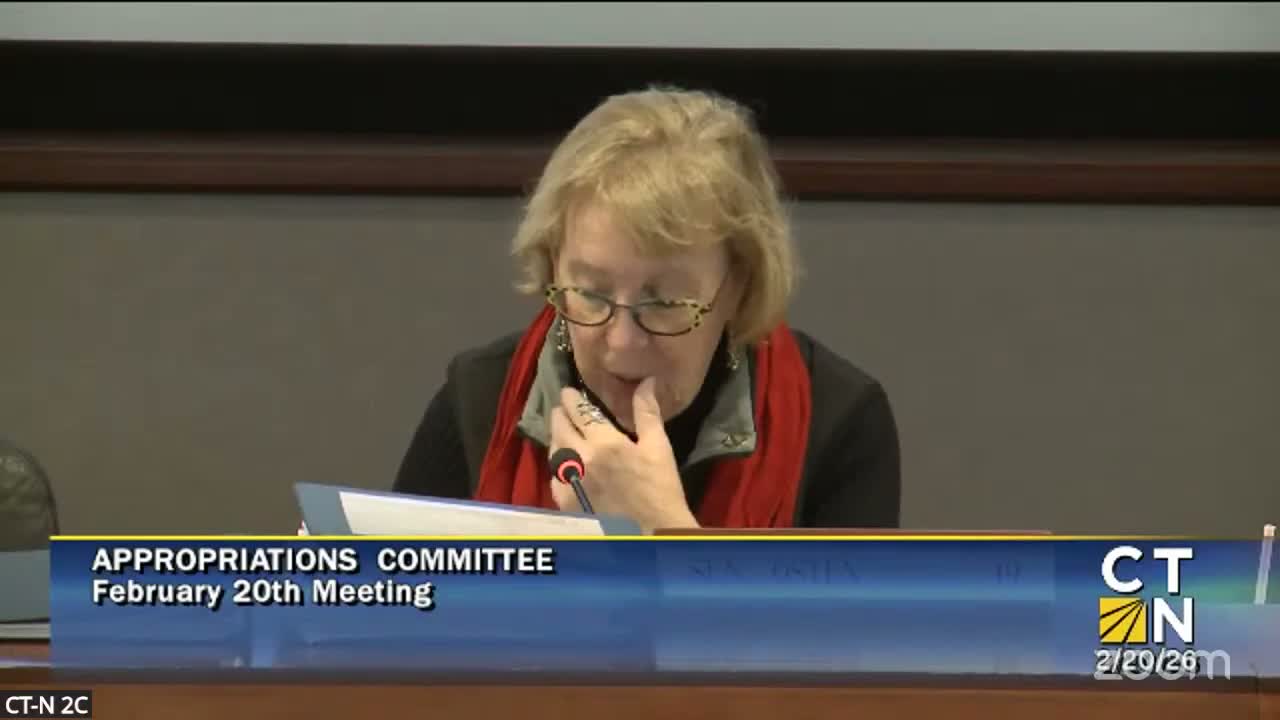
The Appropriations Committee voted by voice to reserve five bills for subject-matter public hearings and to advance a package of 12 "raise bill" concepts at a meeting convened by the committee chair on Friday, February 20, at 11:00 a.m. The chair said the voice votes would remain open for attendance recording until agency briefings begin at 1:00 p.m.
Representative Walker moved "that we raise all the bills with one motion," and Representative Nuccio seconded. After brief descriptions of the measures, the committee conducted a voice vote; the chair declared the motions carried and instructed staff to keep the votes open for attendance purposes.
The five bills reserved for subject-matter public hearings include: Senate Bill 19, which would appropriate state General Fund dollars to the Department of Education for school-based mental health services in certain rural areas (fiscal year ending 06/30/2027); Senate Bill 20, proposing to amend subsection 31-102 of the general statutes to increase the per diem for members or alternate members of the State Board of Labor Relations from $150 to $300 per day; House Bill 5144, a bipartisan-sponsored measure to fund school breakfasts at no cost for participating schools and lunches at no cost for students eligible for reduced-price meals (FY 06/30/2027); House Bill 5172, to fund installation and maintenance of radar speed signs along Forest Road in the city of New Haven; and House Bill 5202, proposing a $1,500,000 General Fund appropriation to Continuum of Care Incorporated for emergency housing program operations for FY 06/30/2027.
Committee members asked for brief descriptions during the reading. The chair identified sponsors or cosponsors where noted (for example, Senate Bill 19 was submitted by Senator Harding; the per-diem bill was credited to Senator Perello). When members requested clarification on procedural and substantive points — including a question about the intended definition of the term "alien" — the chair replied that the bill drafters would define that language as the concept develops.
On the package of 12 raise-bill concepts the chair read items including teachers' disability and retirement benefits; an account to compensate victims of unlawful funeral services; a study of unidentified aerial phenomena; an account to provide durable medical equipment; a broader job program described in the meeting as "Connecticut SNAP" to allow access to food, housing, and health-care benefits; summer youth employment and training funds; the Mashantucket, Pequot, and Mohegan Fund formula (the chair said the current formula would be circulated); juvenile justice measures; implementation of recommendations from the Transforming Children's Behavioral Health Policy and Planning Committee; a micro-transit study; and two items concerning general-fund and non-general-fund appropriations.
Representative Ackert asked what "micro transit" referred to; the chair explained it is a Department of Transportation policy in which smaller vehicles or call-in ride services serve smaller communities and said the committee intends to study costs tied to that model.
All raise-bill concepts were accepted by a voice vote. The chair emphasized that because the committee used voice votes, staff would keep the votes open only until agency briefings start at 1:00 p.m. for any members who needed to record attendance.
The meeting was recessed until agency briefings at 1:00 p.m. After the formal business, staff confirmed attendance for multiple members joining by phone or video.
What happens next: Each reserved bill will proceed to subject-matter public hearings (scheduling and further procedural steps to be determined by committee staff). The raise-bill concepts will move forward for drafting or study as appropriate.
Representative Walker moved "that we raise all the bills with one motion," and Representative Nuccio seconded. After brief descriptions of the measures, the committee conducted a voice vote; the chair declared the motions carried and instructed staff to keep the votes open for attendance purposes.
The five bills reserved for subject-matter public hearings include: Senate Bill 19, which would appropriate state General Fund dollars to the Department of Education for school-based mental health services in certain rural areas (fiscal year ending 06/30/2027); Senate Bill 20, proposing to amend subsection 31-102 of the general statutes to increase the per diem for members or alternate members of the State Board of Labor Relations from $150 to $300 per day; House Bill 5144, a bipartisan-sponsored measure to fund school breakfasts at no cost for participating schools and lunches at no cost for students eligible for reduced-price meals (FY 06/30/2027); House Bill 5172, to fund installation and maintenance of radar speed signs along Forest Road in the city of New Haven; and House Bill 5202, proposing a $1,500,000 General Fund appropriation to Continuum of Care Incorporated for emergency housing program operations for FY 06/30/2027.
Committee members asked for brief descriptions during the reading. The chair identified sponsors or cosponsors where noted (for example, Senate Bill 19 was submitted by Senator Harding; the per-diem bill was credited to Senator Perello). When members requested clarification on procedural and substantive points — including a question about the intended definition of the term "alien" — the chair replied that the bill drafters would define that language as the concept develops.
On the package of 12 raise-bill concepts the chair read items including teachers' disability and retirement benefits; an account to compensate victims of unlawful funeral services; a study of unidentified aerial phenomena; an account to provide durable medical equipment; a broader job program described in the meeting as "Connecticut SNAP" to allow access to food, housing, and health-care benefits; summer youth employment and training funds; the Mashantucket, Pequot, and Mohegan Fund formula (the chair said the current formula would be circulated); juvenile justice measures; implementation of recommendations from the Transforming Children's Behavioral Health Policy and Planning Committee; a micro-transit study; and two items concerning general-fund and non-general-fund appropriations.
Representative Ackert asked what "micro transit" referred to; the chair explained it is a Department of Transportation policy in which smaller vehicles or call-in ride services serve smaller communities and said the committee intends to study costs tied to that model.
All raise-bill concepts were accepted by a voice vote. The chair emphasized that because the committee used voice votes, staff would keep the votes open only until agency briefings start at 1:00 p.m. for any members who needed to record attendance.
The meeting was recessed until agency briefings at 1:00 p.m. After the formal business, staff confirmed attendance for multiple members joining by phone or video.
What happens next: Each reserved bill will proceed to subject-matter public hearings (scheduling and further procedural steps to be determined by committee staff). The raise-bill concepts will move forward for drafting or study as appropriate.
View the Full Meeting & All Its Details
This article offers just a summary. Unlock complete video, transcripts, and insights as a Founder Member.
✓
Watch full, unedited meeting videos
✓
Search every word spoken in unlimited transcripts
✓
AI summaries & real-time alerts (all government levels)
✓
Permanent access to expanding government content
30-day money-back guarantee
