Ways & Means reports H.632 favorably after reviewing miscellaneous environmental amendments
February 21, 2026 | Ways & Means, HOUSE OF REPRESENTATIVES, Committees, Legislative , Vermont
This article was created by AI summarizing key points discussed. AI makes mistakes, so for full details and context, please refer to the video of the full meeting. Please report any errors so we can fix them. Report an error »
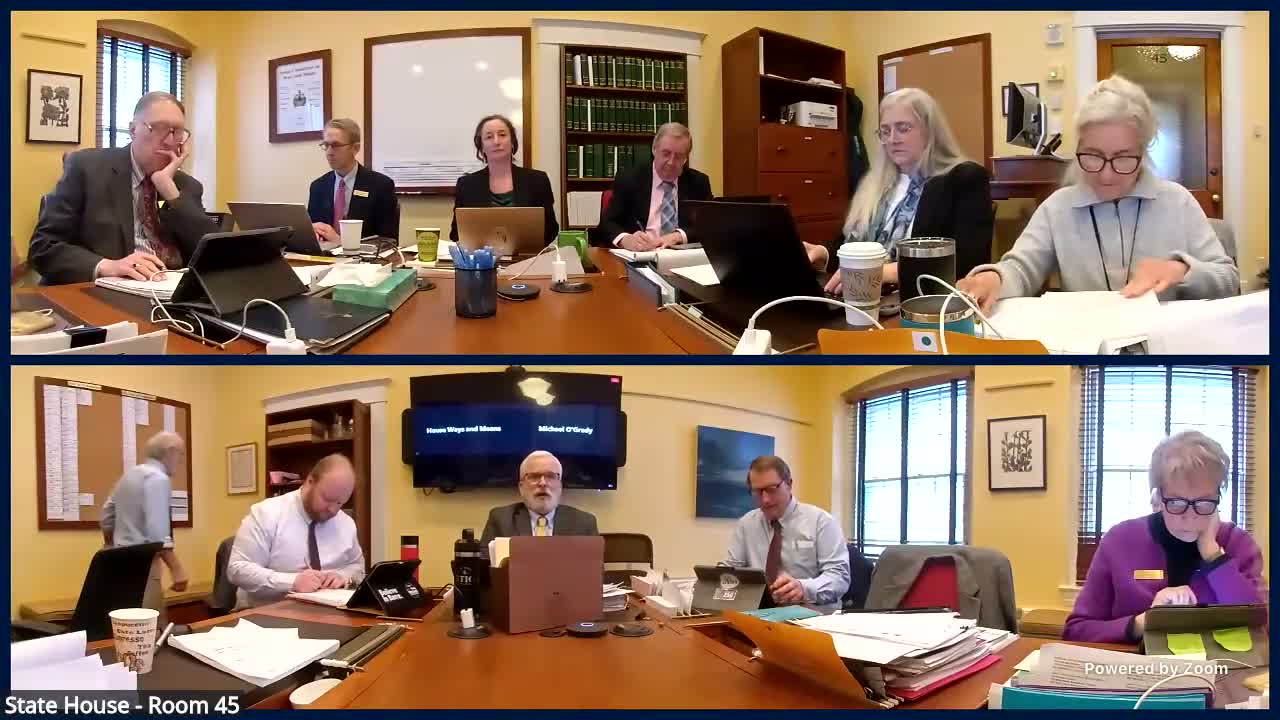
The Ways & Means committee voted to report H.632 — a package of miscellaneous environmental amendments — favorably after a review of technical changes and program clarifications affecting state environmental programs.
Michael Grady, speaking for the record, summarized the bill as a collection of nonrevenue technical fixes and program adjustments. He told the committee that two originally included sections on water-impact fees had been removed by the House Environment Committee and that "I don't believe there's anything else in the bill that affects revenue of the state." Grady walked members through multiple provisions, from extended producer responsibility for batteries to changes in emergency rulemaking authority.
Why it matters: The bill touches several state programs and processes that affect permitting and implementation — for example, clarifying confidentiality for applicants to an ARPA-funded Healthy Home Initiative, standardizing public-notice requirements for clean-water service providers, and giving ANR more time to finish river-corridor rulemaking tied to the 2024 Flood Safety Act. It also contains EPA-requested technical edits to clarify ANR and Agency of Agriculture authority over CAFO discharges.
Key provisions and details
- Batteries and extended producer responsibility: Section 1 gives the stewardship/product-responsibility organization an extra year to produce a report on recycling and managing hard-to-recycle batteries, including EV and large-format storage batteries. As Grady put it, "The stewardship organization has volunteered to do that report instead of ANR. They just need an extra year." The change delays the agency report rather than changing the underlying program.
- Underground storage tanks: Section 2 tightens inspection requirements for category 1 underground storage tanks and makes delivery to unpermitted tanks subject to prohibition until the tanks obtain ANR permits. Committee members asked whether in-use but unpermitted tanks would be immediately barred from delivery; Grady confirmed the bill would prevent deliveries to unpermitted tanks and clarified that a category 1 tank includes the associated system components and that an underground tank is one that is 10% or more buried in the ground.
- Healthy Home Initiative confidentiality: Section 3 explicitly defines personal information supplied to the ARPA-funded Healthy Home Initiative (which funded wastewater, water and stormwater replacement for low- and moderate-income households) as confidential under state law.
- Flood Safety Act extensions: Sections 4–7 extend deadlines related to the 2024 Flood Safety Act so ANR can complete river-corridor rulemaking, permitting, and related NFIP study work. Grady said those extensions respond to staffing and workload needs tied to implementing provisions enacted last year.
- Clean-water service providers and public notice: Sections 8–9 standardize which public-notice process ANR should use when notifying the public about watershed plans and nonregulatory programs, to avoid inconsistent notice practices.
- CAFO and EPA-driven edits: Sections 10–15 implement EPA-requested technical revisions clarifying ANR's authority over CAFO discharges and correcting statutory cross-references (including clarifying when "cow/calf" means both cow and calf). Grady characterized these as EPA compliance edits rather than new policy.
- Dam permitting and removal option: Section 16 requires DEC to inform applicants when dam removal may be an appropriate alternative to repair or replacement, allowing applicants the option to revise their application but not forcing removal.
- Emergency rulemaking pathway: Sections 17–18 add an emergency-rulemaking option for state agencies to address the possible loss of federal incorporations after recent federal court developments. Grady explained the proposal in the context of the Supreme Court changes to Chevron deference and emphasized the temporary nature of emergency rules: "Emergency rules are only valid for 180 days." Agencies adopting emergency rules would still be required to pursue permanent rules on the usual timetable.
- Waste tires and hauling enforcement: Rather than adopt an EPR program for tires, the bill seeks to enable local enforcement of rules governing transport of waste tires and orders ANR to report on legacy tire piles and recycling/reuse options.
- Emissions repair assistance program: The bill adjusts eligibility criteria for a low- and moderate-income emissions-repair assistance program tied to air-quality planning. Grady said the program has had only three applicants to date and that DMV waivers had reduced demand; the bill would simplify eligibility to a percentage of the federal poverty level plus applicant attestation.
Committee questions and fiscal context
Members pressed staff on practical effects and timing — for example, how long emergency rules last, the definition of category 1 tanks, and whether permit fees or voucher increases were budgeted. A fiscal office representative characterized the proposed impacts as minor and said a fiscal note would be available early next week. Staff confirmed that expected voucher increases tied to an initiative program would affect future fiscal years (the discussion cited FY27 as the planning year) and that some permit-fee levels have not yet been set.
Vote and next steps
Representative Anthony moved that the committee find the "draft 5 1 1 strike-all amendment to H.632" favorable "based on no financial impact at this stage," and Representative Wozniak seconded. The committee conducted a roll-call; the recorded outcome was nine yes votes and two no votes (Representatives Higley and Cage). The committee reported H.632 favorably as amended and will send the measure on for further consideration.
What remains unclear
Staff repeatedly characterized several changes as technical or responsive to federal requirements; the bill does not set specific new fee amounts for permits and leaves some implementation details to ANR rulemaking. The precise fiscal magnitude of extending some deadlines (for example, river-corridor permitting fee timing) was described as uncertain pending the fiscal note.
The committee adjourned after reporting the bill favorably.
Michael Grady, speaking for the record, summarized the bill as a collection of nonrevenue technical fixes and program adjustments. He told the committee that two originally included sections on water-impact fees had been removed by the House Environment Committee and that "I don't believe there's anything else in the bill that affects revenue of the state." Grady walked members through multiple provisions, from extended producer responsibility for batteries to changes in emergency rulemaking authority.
Why it matters: The bill touches several state programs and processes that affect permitting and implementation — for example, clarifying confidentiality for applicants to an ARPA-funded Healthy Home Initiative, standardizing public-notice requirements for clean-water service providers, and giving ANR more time to finish river-corridor rulemaking tied to the 2024 Flood Safety Act. It also contains EPA-requested technical edits to clarify ANR and Agency of Agriculture authority over CAFO discharges.
Key provisions and details
- Batteries and extended producer responsibility: Section 1 gives the stewardship/product-responsibility organization an extra year to produce a report on recycling and managing hard-to-recycle batteries, including EV and large-format storage batteries. As Grady put it, "The stewardship organization has volunteered to do that report instead of ANR. They just need an extra year." The change delays the agency report rather than changing the underlying program.
- Underground storage tanks: Section 2 tightens inspection requirements for category 1 underground storage tanks and makes delivery to unpermitted tanks subject to prohibition until the tanks obtain ANR permits. Committee members asked whether in-use but unpermitted tanks would be immediately barred from delivery; Grady confirmed the bill would prevent deliveries to unpermitted tanks and clarified that a category 1 tank includes the associated system components and that an underground tank is one that is 10% or more buried in the ground.
- Healthy Home Initiative confidentiality: Section 3 explicitly defines personal information supplied to the ARPA-funded Healthy Home Initiative (which funded wastewater, water and stormwater replacement for low- and moderate-income households) as confidential under state law.
- Flood Safety Act extensions: Sections 4–7 extend deadlines related to the 2024 Flood Safety Act so ANR can complete river-corridor rulemaking, permitting, and related NFIP study work. Grady said those extensions respond to staffing and workload needs tied to implementing provisions enacted last year.
- Clean-water service providers and public notice: Sections 8–9 standardize which public-notice process ANR should use when notifying the public about watershed plans and nonregulatory programs, to avoid inconsistent notice practices.
- CAFO and EPA-driven edits: Sections 10–15 implement EPA-requested technical revisions clarifying ANR's authority over CAFO discharges and correcting statutory cross-references (including clarifying when "cow/calf" means both cow and calf). Grady characterized these as EPA compliance edits rather than new policy.
- Dam permitting and removal option: Section 16 requires DEC to inform applicants when dam removal may be an appropriate alternative to repair or replacement, allowing applicants the option to revise their application but not forcing removal.
- Emergency rulemaking pathway: Sections 17–18 add an emergency-rulemaking option for state agencies to address the possible loss of federal incorporations after recent federal court developments. Grady explained the proposal in the context of the Supreme Court changes to Chevron deference and emphasized the temporary nature of emergency rules: "Emergency rules are only valid for 180 days." Agencies adopting emergency rules would still be required to pursue permanent rules on the usual timetable.
- Waste tires and hauling enforcement: Rather than adopt an EPR program for tires, the bill seeks to enable local enforcement of rules governing transport of waste tires and orders ANR to report on legacy tire piles and recycling/reuse options.
- Emissions repair assistance program: The bill adjusts eligibility criteria for a low- and moderate-income emissions-repair assistance program tied to air-quality planning. Grady said the program has had only three applicants to date and that DMV waivers had reduced demand; the bill would simplify eligibility to a percentage of the federal poverty level plus applicant attestation.
Committee questions and fiscal context
Members pressed staff on practical effects and timing — for example, how long emergency rules last, the definition of category 1 tanks, and whether permit fees or voucher increases were budgeted. A fiscal office representative characterized the proposed impacts as minor and said a fiscal note would be available early next week. Staff confirmed that expected voucher increases tied to an initiative program would affect future fiscal years (the discussion cited FY27 as the planning year) and that some permit-fee levels have not yet been set.
Vote and next steps
Representative Anthony moved that the committee find the "draft 5 1 1 strike-all amendment to H.632" favorable "based on no financial impact at this stage," and Representative Wozniak seconded. The committee conducted a roll-call; the recorded outcome was nine yes votes and two no votes (Representatives Higley and Cage). The committee reported H.632 favorably as amended and will send the measure on for further consideration.
What remains unclear
Staff repeatedly characterized several changes as technical or responsive to federal requirements; the bill does not set specific new fee amounts for permits and leaves some implementation details to ANR rulemaking. The precise fiscal magnitude of extending some deadlines (for example, river-corridor permitting fee timing) was described as uncertain pending the fiscal note.
The committee adjourned after reporting the bill favorably.
Don't Miss a Word: See the Full Meeting!
Go beyond summaries. Unlock every video, transcript, and key insight with a Founder Membership.
✓
Get instant access to full meeting videos
✓
Search and clip any phrase from complete transcripts
✓
Receive AI-powered summaries & custom alerts
✓
Enjoy lifetime, unrestricted access to government data
30-day money-back guarantee
