Commerce tells Minnesota Senate committee generation has gotten cheaper but transmission and distribution are driving higher bills
February 21, 2026 | 2026 Legislature MN, Minnesota
This article was created by AI summarizing key points discussed. AI makes mistakes, so for full details and context, please refer to the video of the full meeting. Please report any errors so we can fix them. Report an error »
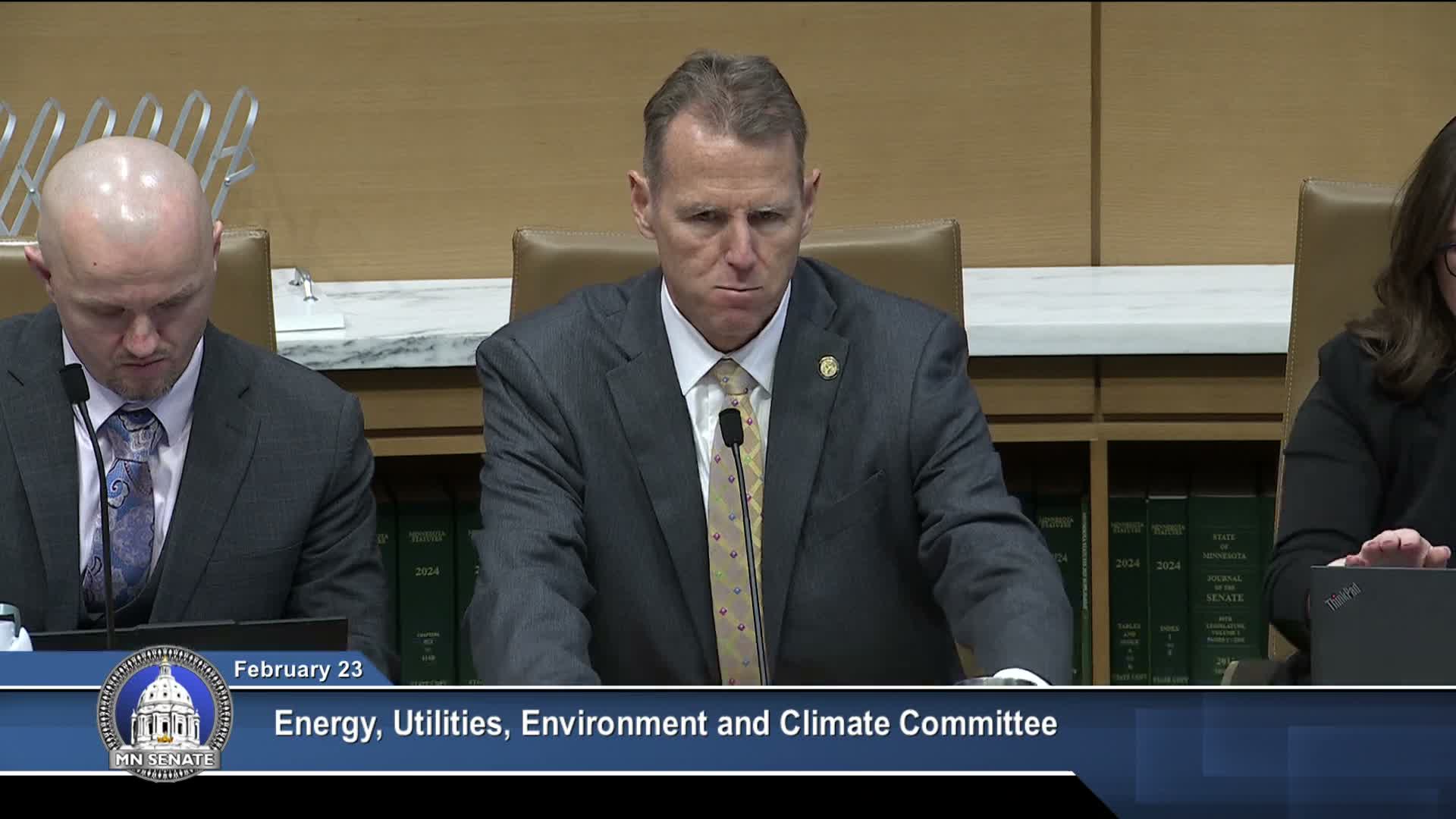
Deputy Commerce Commissioner Pete Wyckoff told the Minnesota Senate Energy, Utilities, Environment and Climate Committee on Feb. 23 that while generation costs have fallen in recent decades, transmission and distribution work is now the leading driver of rising utility bills.
Wyckoff, who runs the department’s Division of Energy Resources, summarized a Sept. 2024 Lawrence Berkeley National Laboratory study covering 2019–2024 and said that, "inflation adjusted, [costs] have been going down," but that many households still feel higher bills because distribution and other local costs are increasing. He said some counties—particularly areas that rely on delivered fuels such as propane or fuel oil—face energy burdens above 7% of disposable income.
Why the change? Wyckoff described electric costs in three parts: generation, transmission and distribution. "Generation costs have come down, way, way down," he said, noting coal retirements and a shift to gas, wind and solar. By contrast, he called distribution a "black box" made up of thousands of small components and said his office is using integrated distribution plans to better understand those costs.
Committee members pressed Commerce on near-term drivers. Wyckoff said recent federal actions—Congressional rollbacks of some commercial-scale wind and solar tax credits and termination of certain household clean-energy and EV credits in 2025—could shift roughly $7 billion in expected federal support for three rate-regulated utilities onto Minnesota ratepayers. "That's $7,000,000,000 coming off the U.S. taxpayer and going to Minnesota ratepayers," he said.
Wyckoff also cited broader federal factors that can be inflationary, including policies that preserve uneconomic coal plants in other states, tariffs and increased natural gas exports. Quoting federal forecasts, he warned of prospective natural-gas price increases and said the Energy Information Administration expects higher prices in the coming year.
Members debated the policy implications. Senator Glenn Gruenhagen criticized renewable policies, calling them a "Green New Deal scam" and arguing wind and solar cannot provide baseload electricity; his remarks included a specific personal bill example. Chair (identified in the record as Senator Friends) and other members pushed for a statewide perspective and asked Commerce to clarify that Wyckoff’s charting referred to inflation-adjusted trends, which Wyckoff confirmed.
Wyckoff urged a mix of responses: continuing to pursue wind and solar (which he said remain cheapest on a per-megawatt basis even without credits), restarting some mothballed nuclear where feasible, building new gas plants where necessary and advancing efficiency, demand response and grid-enhancing technologies to raise effective capacity. He also said Commerce has used state competitiveness funds to leverage remaining federal incentives for municipal solar projects.
The committee did not take votes; members moved on to a Midwest Reliability Organization briefing on grid risks. The Commerce presentation ran from the department’s introduction through Wyckoff’s wrap-up and the initial Q&A.
The committee is expected to continue reviewing these policy tradeoffs and may call additional state or federal experts as members evaluate affordability, reliability and the sequencing of new generation and grid investments.
Wyckoff, who runs the department’s Division of Energy Resources, summarized a Sept. 2024 Lawrence Berkeley National Laboratory study covering 2019–2024 and said that, "inflation adjusted, [costs] have been going down," but that many households still feel higher bills because distribution and other local costs are increasing. He said some counties—particularly areas that rely on delivered fuels such as propane or fuel oil—face energy burdens above 7% of disposable income.
Why the change? Wyckoff described electric costs in three parts: generation, transmission and distribution. "Generation costs have come down, way, way down," he said, noting coal retirements and a shift to gas, wind and solar. By contrast, he called distribution a "black box" made up of thousands of small components and said his office is using integrated distribution plans to better understand those costs.
Committee members pressed Commerce on near-term drivers. Wyckoff said recent federal actions—Congressional rollbacks of some commercial-scale wind and solar tax credits and termination of certain household clean-energy and EV credits in 2025—could shift roughly $7 billion in expected federal support for three rate-regulated utilities onto Minnesota ratepayers. "That's $7,000,000,000 coming off the U.S. taxpayer and going to Minnesota ratepayers," he said.
Wyckoff also cited broader federal factors that can be inflationary, including policies that preserve uneconomic coal plants in other states, tariffs and increased natural gas exports. Quoting federal forecasts, he warned of prospective natural-gas price increases and said the Energy Information Administration expects higher prices in the coming year.
Members debated the policy implications. Senator Glenn Gruenhagen criticized renewable policies, calling them a "Green New Deal scam" and arguing wind and solar cannot provide baseload electricity; his remarks included a specific personal bill example. Chair (identified in the record as Senator Friends) and other members pushed for a statewide perspective and asked Commerce to clarify that Wyckoff’s charting referred to inflation-adjusted trends, which Wyckoff confirmed.
Wyckoff urged a mix of responses: continuing to pursue wind and solar (which he said remain cheapest on a per-megawatt basis even without credits), restarting some mothballed nuclear where feasible, building new gas plants where necessary and advancing efficiency, demand response and grid-enhancing technologies to raise effective capacity. He also said Commerce has used state competitiveness funds to leverage remaining federal incentives for municipal solar projects.
The committee did not take votes; members moved on to a Midwest Reliability Organization briefing on grid risks. The Commerce presentation ran from the department’s introduction through Wyckoff’s wrap-up and the initial Q&A.
The committee is expected to continue reviewing these policy tradeoffs and may call additional state or federal experts as members evaluate affordability, reliability and the sequencing of new generation and grid investments.
Don't Miss a Word: See the Full Meeting!
Go beyond summaries. Unlock every video, transcript, and key insight with a Founder Membership.
✓
Get instant access to full meeting videos
✓
Search and clip any phrase from complete transcripts
✓
Receive AI-powered summaries & custom alerts
✓
Enjoy lifetime, unrestricted access to government data
30-day money-back guarantee
